How Profitable are Hyperliquid Frontend Traders?
We pulled all perp trades from Aug 2025 to Apr 2026 and found out that 29% of directional Hyperliquid native frontend traders are profitable. More data in this research article.
TL;DR - we pulled all perp trades from Aug 2025 to Apr 2026 and filtered out market makers and delta neutral farmers. 29% of users of native frontend are profitable in this time period, with users of builder apps clustering around 15-25%, even excluding builder fees. We think user selection is the culprit for lower builder app user profitability.
Builder codes were introduced on Hyperliquid at the end of 2024. The mechanism is straightforward — any frontend application can get its users to authorize a builder fee, which gets added on top of every fill the user performs through the app. The fee is programmable: up to 10bps on perps and up to 100bps on spot.
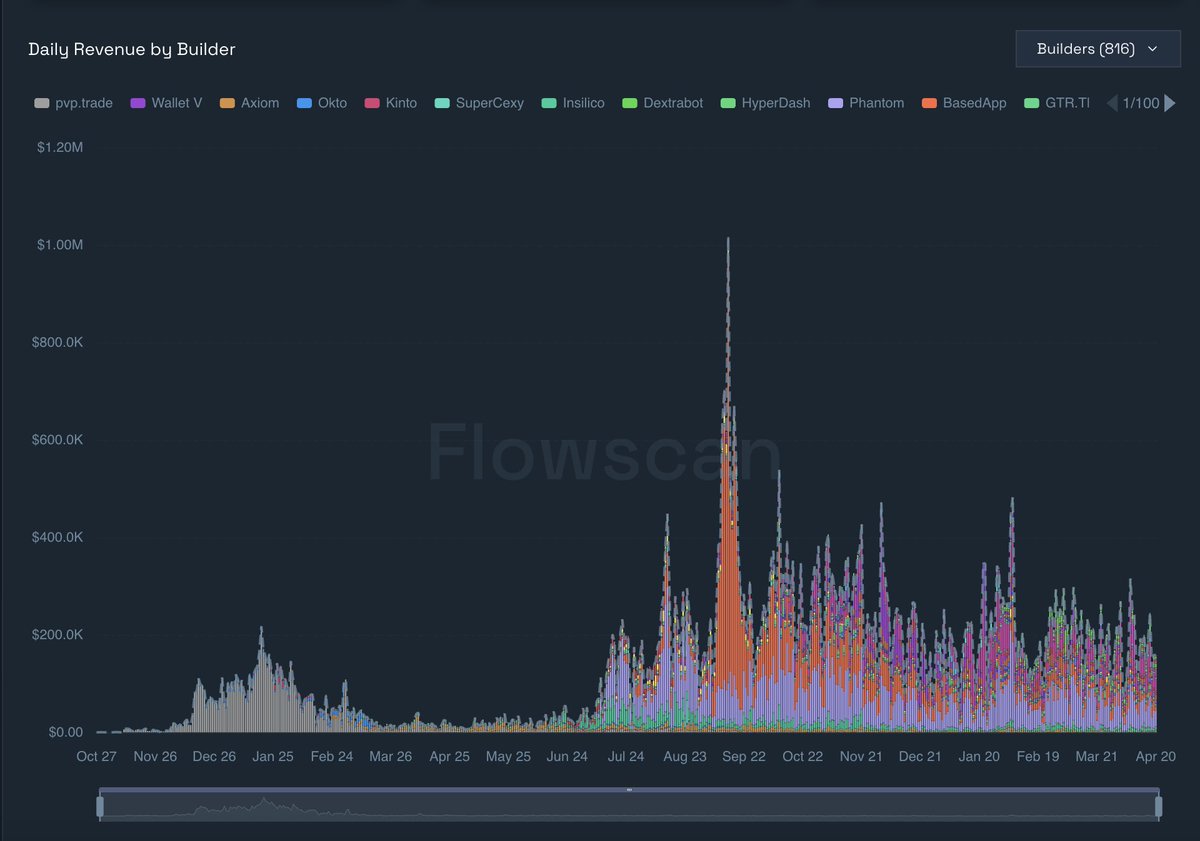 Chart of historical builder app revenues
Methodology in brief
We analyzed all HyperCore fills between August 1, 2025 and April 9, 2026, including both native and HIP-3 markets. True PnL per user is calculated as realized PnL plus funding minus fees.
Three filters were applied before analysis.
First, we removed the HLP vaults and automated traders identified through behavioral signatures (primarily fill frequency combined with hour-of-day coverage patterns that aren't achievable manually). This filter removes 0.48% of users but 71.9% of native volume versus only 5.62% of builder volume.
Second, we filtered delta neutral positions observable onchain (spot hedged with perp positions), as well as accounts whose activity is matching delta-neutral activity with spot legs held on outside exchanges.
Third, we applied a $1,000 lifetime volume floor per user-builder pair to exclude platform testers.
The main challenge was that liquidations and TWAP fills carry no builder tag. Therefore we matched the user's most recent liquidation or TWAP on that asset to the last used builder. A trade through the native interface resets this state. Full methodology will be published in a complete research paper later.
Hyperliquid user breakdown
In total, there were 460k different users, most being either native frontend users or users of a single builder app.
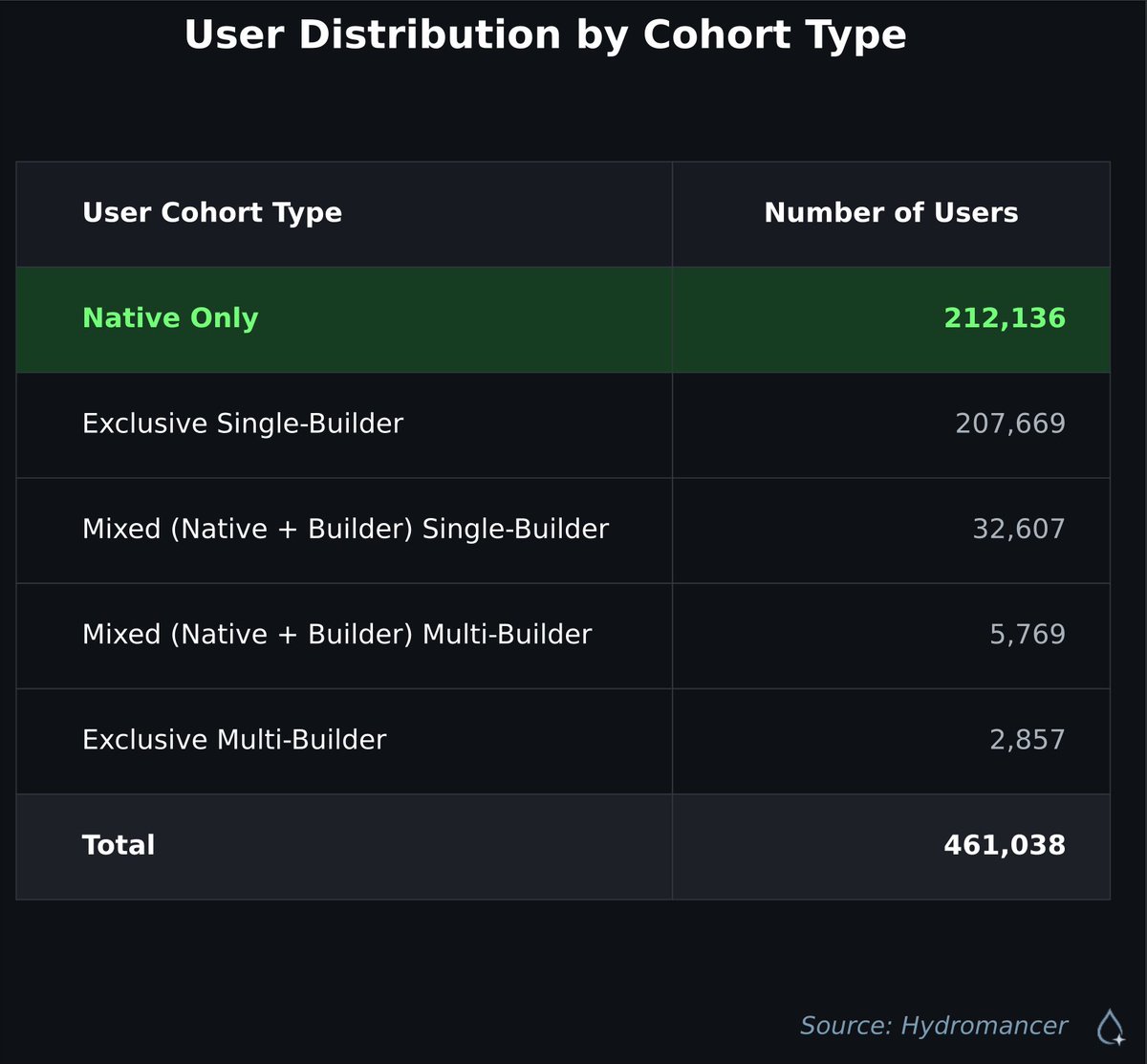 Hyperliquid user distribution
Exclusive single-builder users with less than $1M in volume across the observed period were the only cohort larger than the native frontend; the native frontend clearly dominated all other volume cohorts. This suggests that the penetration of "whale" userbase by builder apps still remains low.
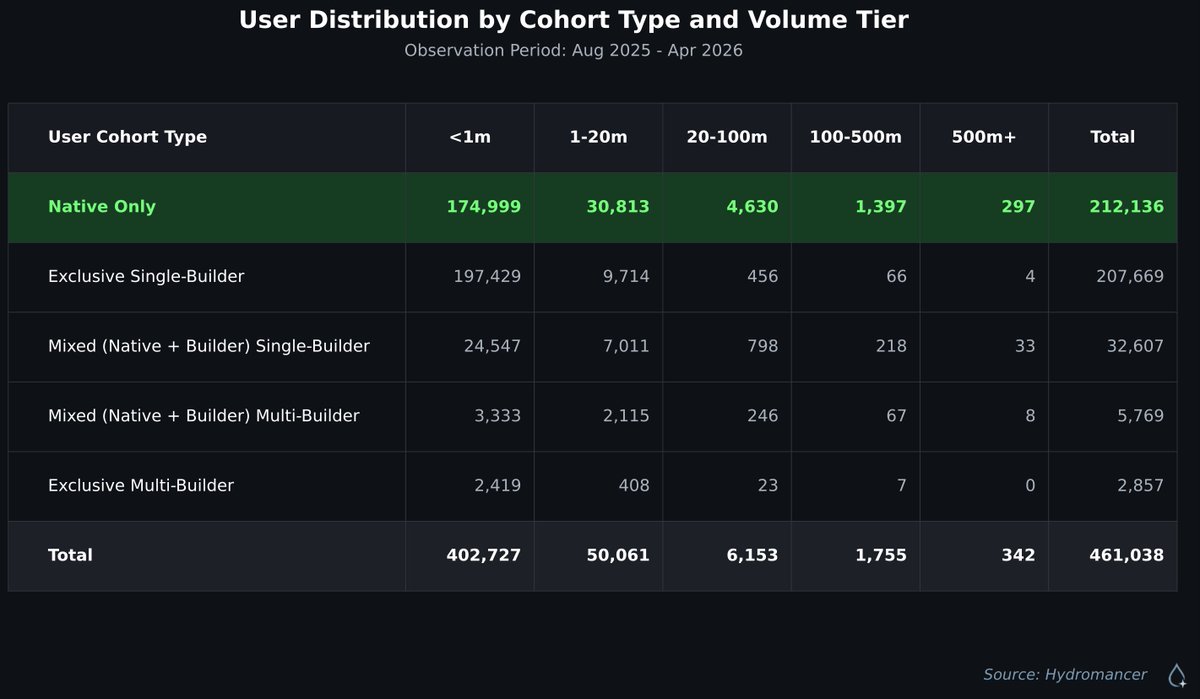 Hyperliquid native frontend and builder apps population cohorts
Overall, Hyperliquid users use either the native frontend or a single builder exclusively — only around 1% of observed users have fills from multiple builders on one wallet.
User profitability
For this research, we focused exclusively on user profitability of trading perps, including both crypto perps and HIP-3 perps. Across the observed period, directional traders have generated:
- 1 trillion (!) of volume
- -1.945 billion in PNL
- 124 million net funding payments
29.06% of native frontend users were profitable during the August 2025 – April 2026 period.
Interestingly, the share of profitable frontend users decreased as volume traded per cohort increased: almost 30% of users in the lowest volume cohort were profitable, 25% of users with $1–20M in volume, 24.20% of users with $20–100M, and 22.45% of users with $100–500M.
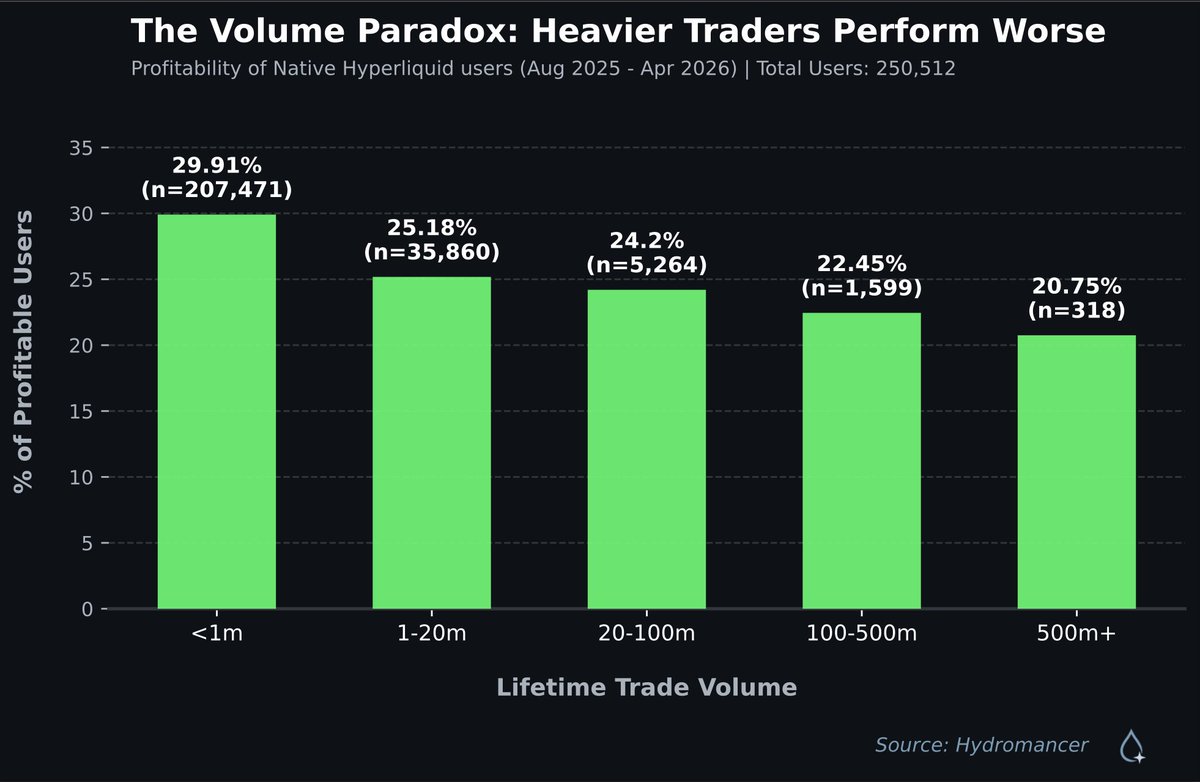 Hyperliquid native frontend user cohorts by volume traded
Across apps that generated more than $1B in volume during the observed period, most apps' userbase profitability was below that of the native frontend, except for MoonBot Terminal, Rabby and OneKey.
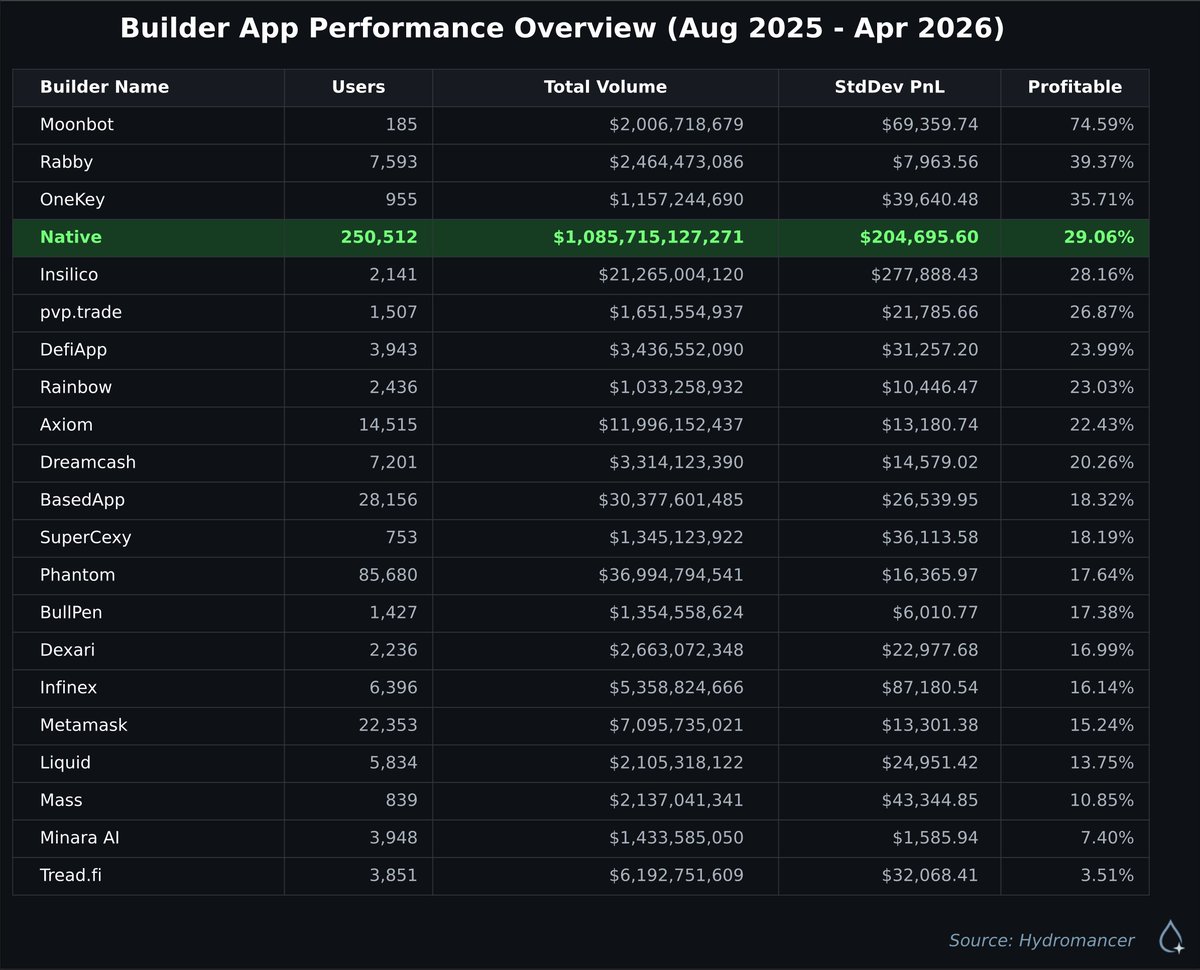 User profitability, apps with >1bn trading volume
What’s driving the performance?
To isolate the impact of builder fees on user performance, we recalculated user PnL without builder fees to see whether users would have been profitable otherwise.
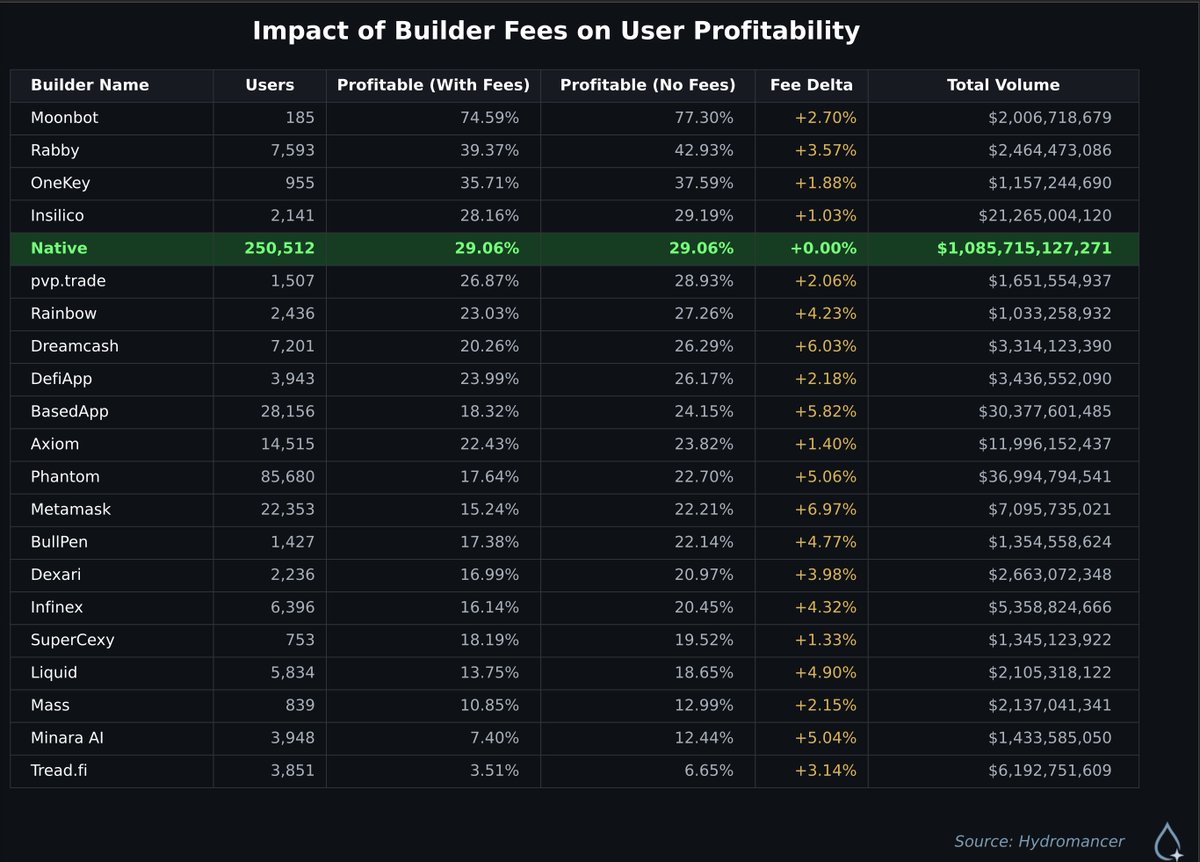 User profitability ex-builder fees, apps with >1bn trading volume
Most apps saw a 2–5% bump in user profitability, but this doesn't change the overall picture significantly. Average profitability for users of most apps is still below the native frontend, clustered in the 22–27% range.
The analysis of the $1–20M volume cohort changes the picture somewhat. While 1 in 4 native frontend users in this cohort are profitable, several builder apps show significantly higher profitability for this cohort than the native frontend.
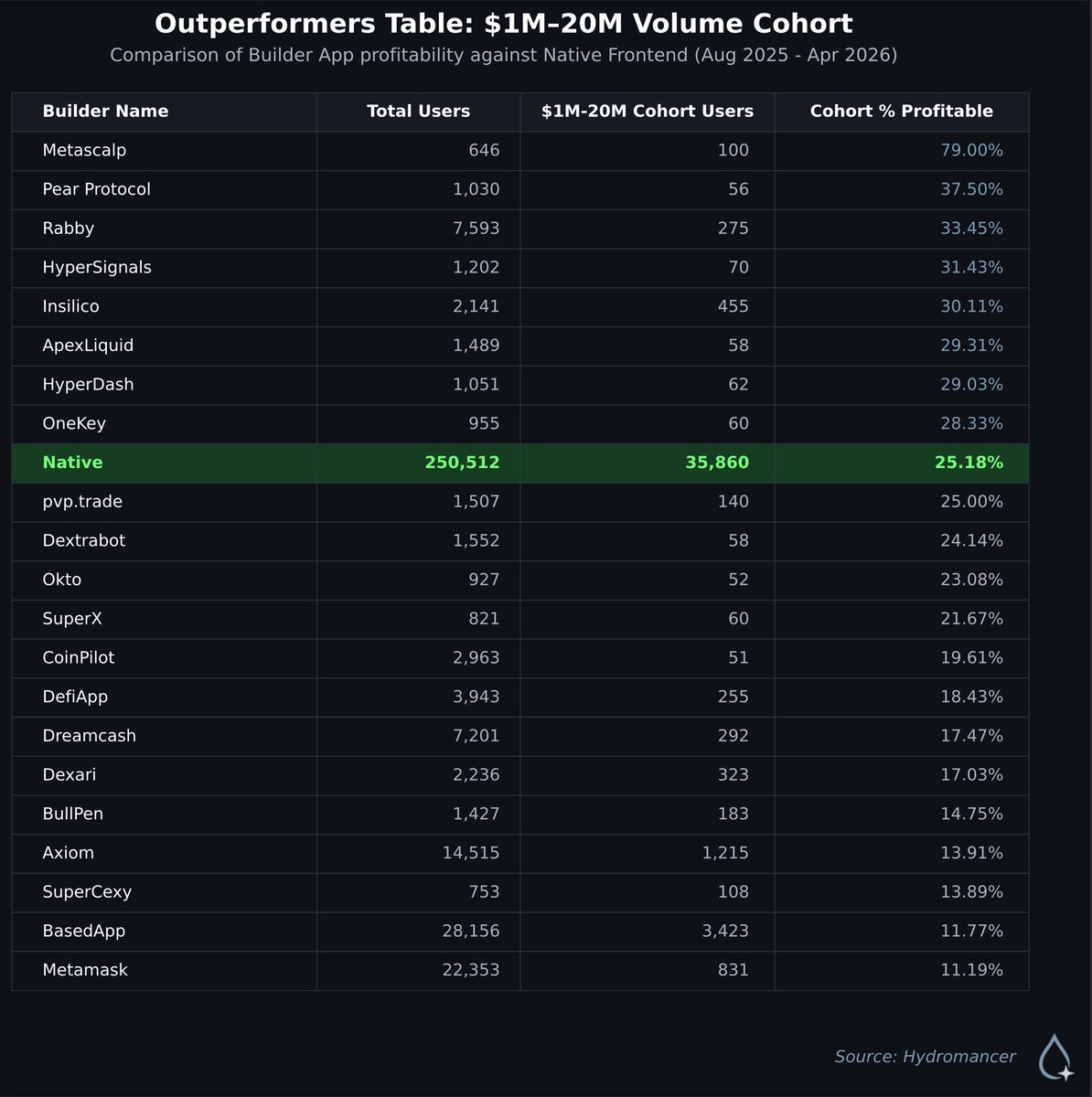 User profitability, $1M-20M volume cohort
Theories and implications for builders
There are several distinct reasons for the profitability gap between frontend users and builder app users. We think that the most powerful one is user selection. The apps with higher-than-native user profitability are either dedicated scalping terminals (MoonBot Terminal, MetaScalp), or apps that give more tooling to traders (Pear Protocol, Insilico Terminal and HypurrDash)
However, beginner users are rarely onboarded to these apps - usually traders move to advanced terminals after understanding perps trading enough to get value out of the advanced tooling.This may also be why the native frontend outperforms many of the apps, especially those with distribution — users who chose to trade on the native frontend made a conscious effort to onboard to Hyperliquid rather than clicking a 'perps' tab in their wallet of choice. This later shows up in the profitability stats, as users of native frontend are possibly more intentional about their usage.
Another possible reason, builder fees, is a driver of some underperformance, but not significant enough by itself to claim that an additional layer of fees completely upends the profitability picture. However, in the game of narrow edges, the smartest users are often the most fee-sensitive, which could also explain the relatively poor builder app penetration among power-user cohorts (100m+ volume).
The big question is - how sustainable is the perp trading ecosystem? The provably verifiable stats from Hyperliquid match the stats published by traditional CFD brokers - 75-85% of users lose money using these products. These businesses are still here, and the demand does not seem to be waning. 29% of users being profitable on Hyperliquid is genuinely a decent result and a high benchmark to overcome.
To give you a builder’s perspective, we’ve asked Ryoh, a founder of legend.trade who has explicitly stated that user profitability compared to other/native frontend users is a north star metric for them. We asked whether aggregated user profitability is a user selection problem or a product feature problem.
Yes and no, I think it's more about building a product that inspires people to want to be better. You would think that people would be inspired purely from PnL but I think it's not true, you need to communicate it through product design and brand/vision.
Should builders care about user profitability? From a purely business perspective, retention is the core metric that the builders should optimize for. And, rationally, user profitability and retention should be tightly coupled. If profitable users retain and unprofitable users churn, then optimizing for user profitability is optimizing for retention, just upstream of it. The two metrics collapse into one, and the builder's job becomes straightforward: help users be better, and the business takes care of itself.
We pulled the retention data to see how cleanly this holds. Across most apps in the dataset, the relationship between PnL and retention isn't what the theory predicts — in some cases, it runs in the opposite direction. That's the subject of our next piece.
This piece is an early look at our research on native frontend and builder app user profitability. The full methodology and extended findings will be published in a follow-up paper.
This article was created by Hydromancer in collaboration with @intern_cc. All data used in the research was taken from Reservoir - complete, free historical Hyperliquid data storage, reservoir.hydromancer.xyz.
This article is originally posted on our X profile on April 22.