Top 5 Prediction Market Platforms built on Hyperliquid
The top five prediction market platforms built on Hyperliquid are Outcome, Share, Trade[XYZ] Events, Skew and Liquidiction.
 JoshuaGrowth Lead
Hyperliquid’s prediction market platforms share the same underlying technology, but offer different ways to trade. Some create markets for prices, sports and real-world events; others bring existing markets together in one app.
This article explains what makes each platform different, how Hyperliquid’s prediction markets work, and also, we break down fees comparison with Kalshi and Polymarket.
#1: Outcome
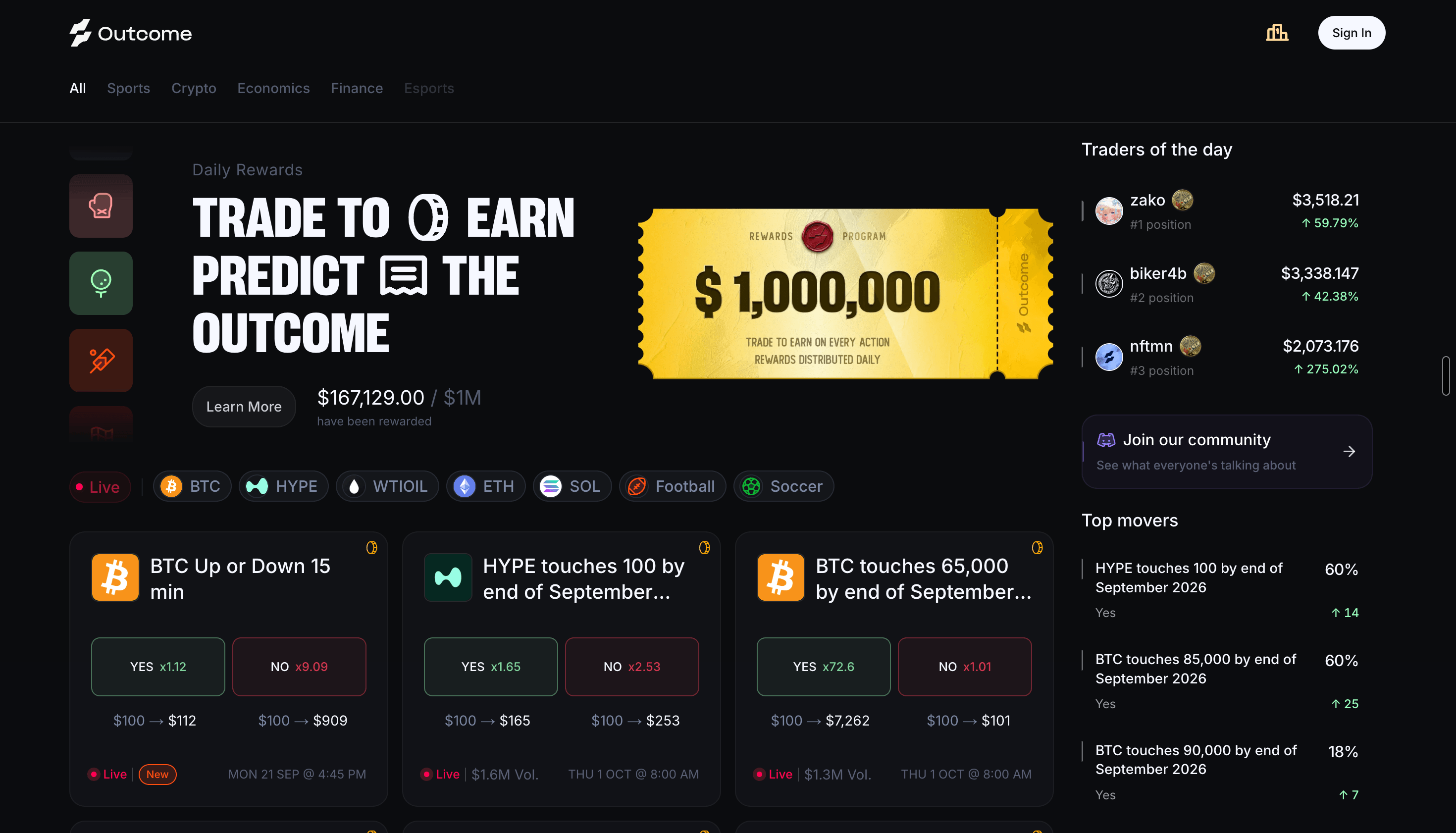
Outcome creates prediction markets covering crypto prices, sports and interest-rate decisions. It sets the rules and checks results, while also offering other teams’ markets.
What stands out: Outcome combines its own market supply with a dedicated prediction-market interface. It is worth examining when the actual events being listed matter more than having every possible venue in one app.
Fees: Zero fees as of Sept 2026.
#2: Share
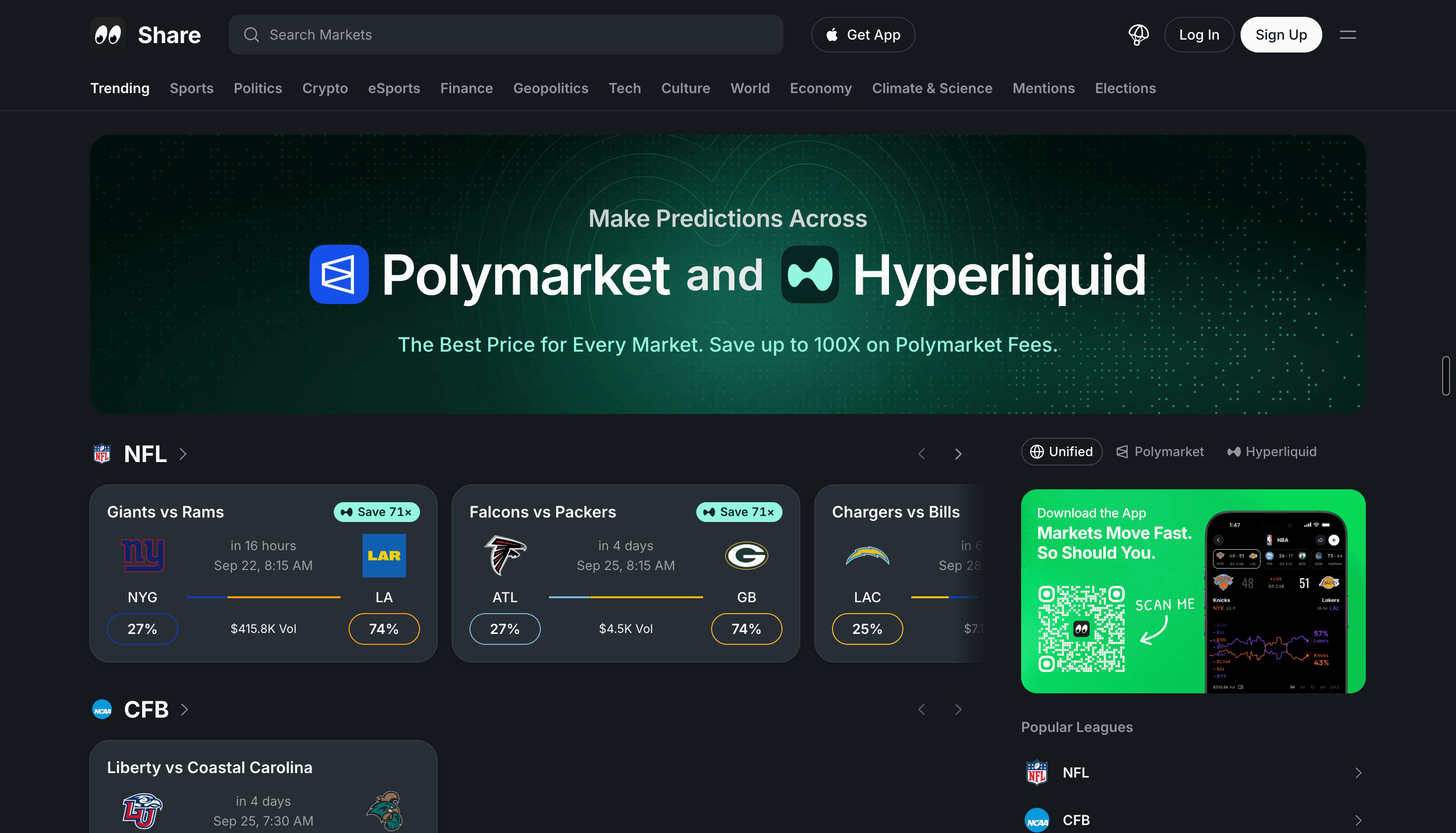
Share lets users explore and trade prediction markets across Polymarket and Hyperliquid. Rather than creating its own markets, it connects users to existing ones, including those from Outcome, Skew and Trade[XYZ].
What stands out: cross-venue discovery and routing. Share is relevant to readers who want to compare opportunities across Polymarket and Hyperliquid without treating each venue as a separate browsing session.
Fees: Zero fees as of Sept 2026.
#3: Trade[XYZ] Events
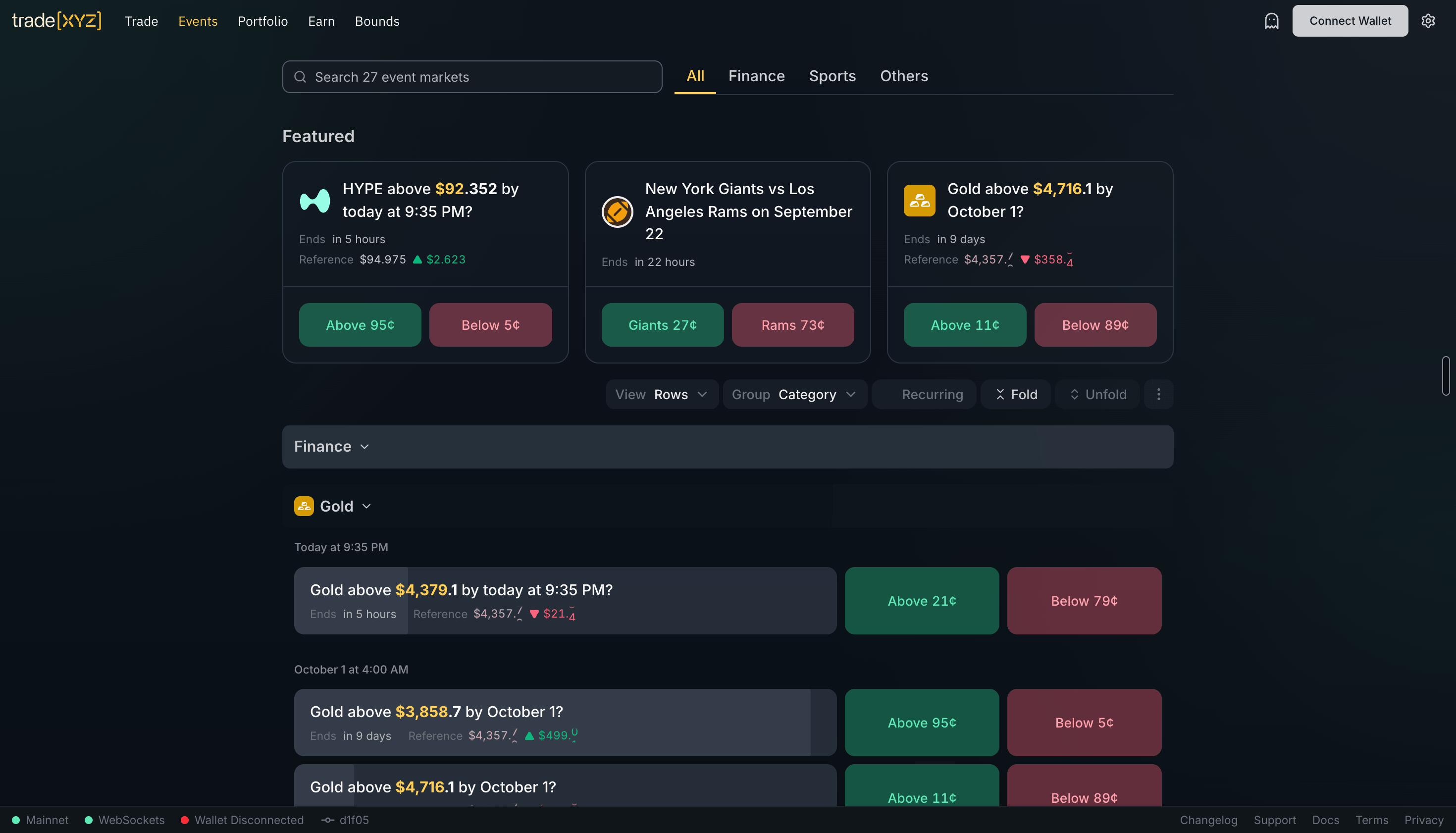
Trade[XYZ] Events extends the team's Hyperliquid products beyond perpetuals. Events are fully collateralized HIP-4 contracts with fixed settlement rules; unlike its perpetual markets, they expire and do not use leverage, funding or liquidations.
What stands out: the relationship between the outcome products and Trade[XYZ]'s existing financial-market infrastructure. Its documented Daily Up/Down method uses a five-minute average derived from the corresponding perpetual's candles. Sports markets use a different declared source and their own event rules.
Fees: the official Events fee page sets the initial deployerFeeScale to zero. Users still pay Hyperliquid's base outcome fees; the displayed Tier 0 rates are 0.070% taker and 0.040% maker before applicable adjustments. Fees apply on closing or settlement, not opening.
#4: Liquidiction
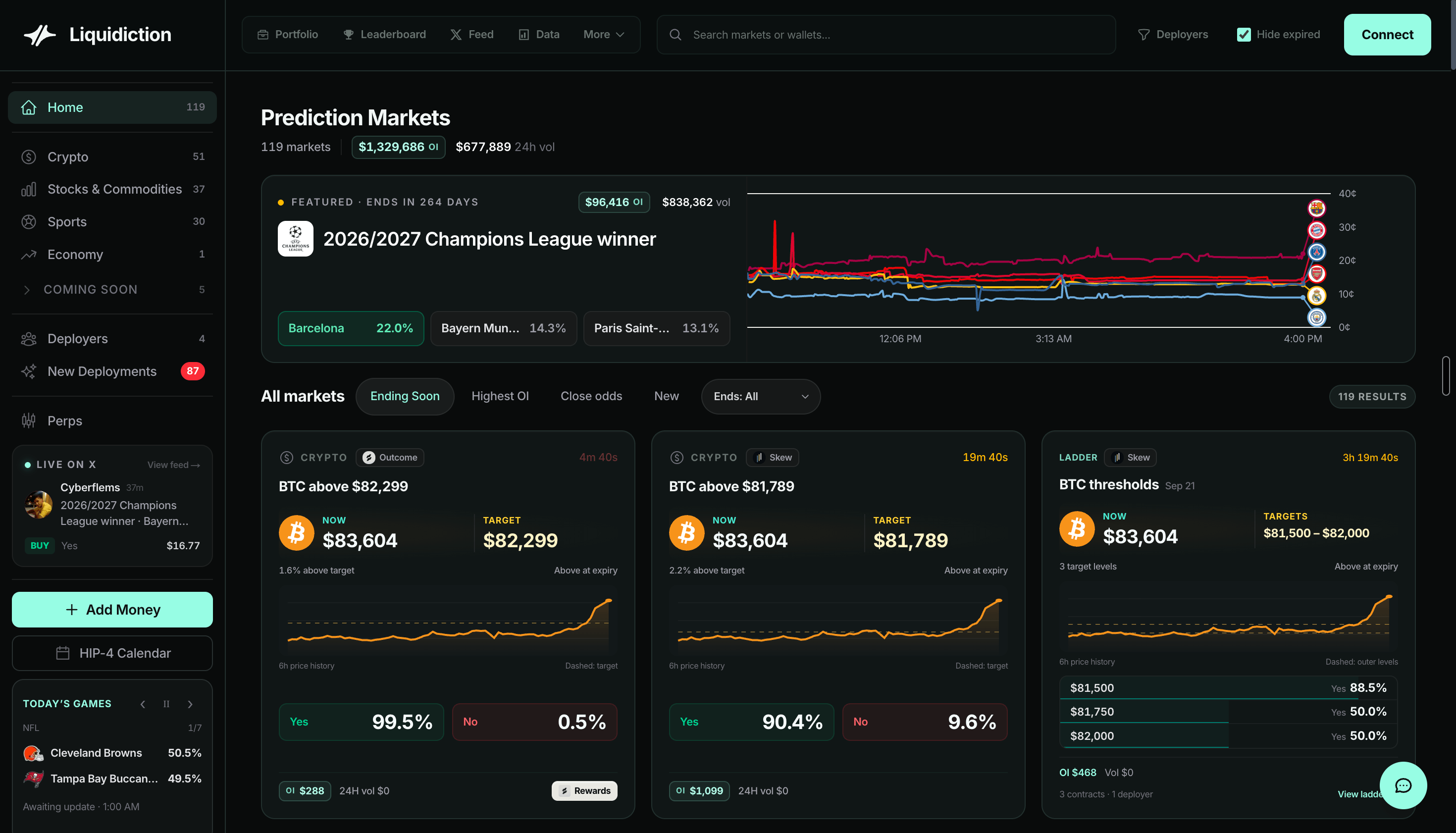
Liquidiction is a non-custodial frontend and order router. Its terms explicitly distinguish it from the teams that deploy markets, define outcomes and determine settlement.
It aggregates HIP-4 prediction markets alongside HIP-3 and native Hyperliquid perpetual markets. The product layer includes market discovery, analytics, social features and leaderboards.
What stands out: a Hyperliquid-focused interface across deployers and product types. Its value is in how it organizes and presents markets, rather than issuing a separate family of prediction contracts.
Fees: Liquidiction says it may receive a builder-tag fee on routed trades. Its terms also disclose a 0.05% integrator fee on bridged amounts, in addition to underlying bridge and aggregator costs.
#5: Skew
Skew focuses on price-outcome markets. Its documented catalogue includes hourly, four-hour, daily and weekly Bitcoin products, plus US500 and Nasdaq-100 weekly markets. Current mainnet metadata also contains HYPE and ZEC price outcomes, so the documented families are not an exhaustive list.
What stands out: recurring expiries and strike ladders. A ladder offers several separately tradable thresholds for the same underlying reference and expiry. It is useful for expressing more specific price views than a single up-or-down question, but each contract still has its own book.
Fees: the BTC Hourly documentation specifies a deployer fee scale of one, with Tier 0 closing rates of 0.14% taker and 0.08% maker before discounts. It also specifies a settlement charge and warns readers to check the fee stamped on each market.
Why Hyperliquid built HIP-4, the prediction-market engine
A perp is ongoing exposure to a price. An outcome contract is exposure to one result, under one set of rules.
HIP-4 is how that second trade lives on HyperCore. Dated contracts, nonlinear payoffs, no leverage and no liquidations inside the outcome itself. Fully collateralized is not the same as safe. You can still be wrong and expire at zero.
If you’re building on it, three design choices matter:
#1: You use the exchange engine that already exists.
HIP-4 markets run on HyperCore’s trading stack. Nobody has to ship a separate matching engine for each app.
A deployer defines the market and submits settlement. An interface can just let people trade it. That split is the point. One team can live in event selection and resolution. Another can live in discovery, analytics, or routing. Same books underneath.
#2: Yes and No are one market, not two.
Hyperliquid merges the complementary Yes and No books for the same outcome. Buying Yes at p is the same trade as selling No at 1 − p, so those orders can hit each other.
That is not one shared pool for every prediction market on the chain. Separate events stay separate instruments. Two Bitcoin contracts can still differ on expiry, price source, or payout rules.
#3: The market and the frontend are different layers.
The same market can show up in more than one app. Share and Liquidiction are the clean examples: a lot of what they do is give people a way into markets someone else deployed, not issue every contract on the screen.
So when you store or count this stuff, pin identity to the underlying outcome. The app is just the window. Count the same market once per interface and your dashboard will look bigger than the ecosystem actually is.
Hyperliquid vs Kalshi vs Polymarket: Fee Comparison
Suppose a trader sells 100 existing contracts at 0.50 each, receiving 50 before fees. The order takes liquidity, and no discounts or rebates apply.
This is how the fees compares:
| Platform / market | Fee |
|---|---|
| Hyperliquid — base rate | 0.035 USDC |
| Kalshi — standard rate | $1.75 |
| Polymarket — crypto | 1.75 USDC |
| Polymarket — sports | 1.25 USDC |
| Polymarket — finance | 1.00 USDC |
| Polymarket — fee-free markets | 0 |
Those are different fee configurations on the same protocol.
What this means for builders?
The opportunity is broader than launching another prediction-market homepage. Market discovery, liquidity comparison, settlement alerts and venue-aware analytics all depend on understanding which underlying contract an interface is showing.
Build around the outcome ID and deployer, then attach the question, sides, quote asset, reference source, expiry and settlement state. Keep the interface used for execution separate. That avoids counting one book several times or comparing contracts that only appear equivalent.
Hydromancer's HIP-4 APIs expose registered and settled outcome data for this work. For the streaming side of an application, the Hyperliquid data-feed guide covers the surrounding trade and order-book infrastructure.
The useful distinction is not which platform has the longest feature list. It is who creates the market, how the result is determined, where liquidity sits and what the interface adds. That is the comparison worth making as Hyperliquid's prediction-market ecosystem grows.