Hyperliquid Data Feeds: Every Real-Time Stream Explained
Hyperliquid presents multiple different ways of getting data feeds. We explain how to do it and where Hydromancer can help.
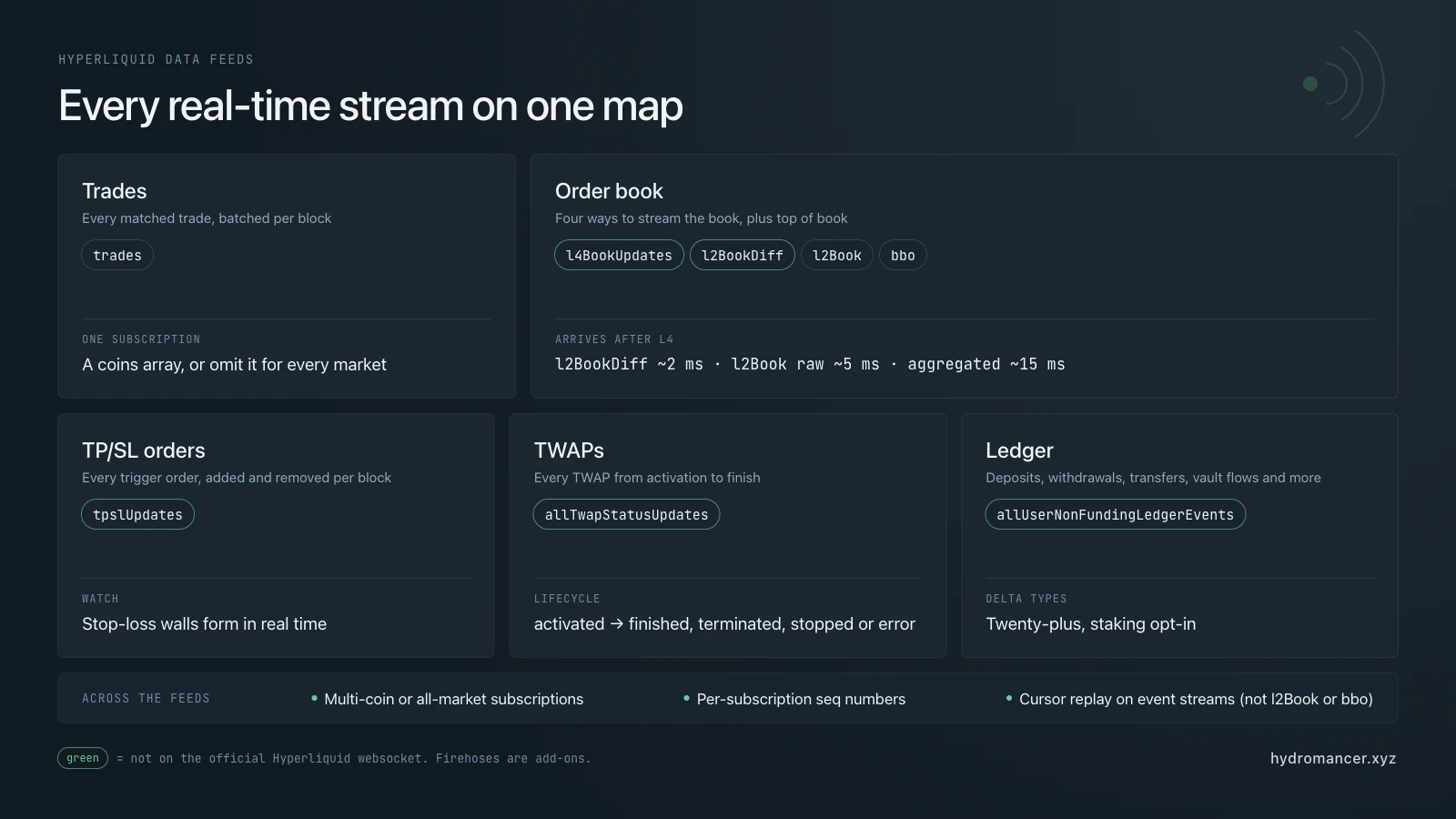
Hyperliquid produces a block roughly every 70ms, and everything on the exchange — every trade, book update, stop-loss, TWAP, deposit — can be consumed as a stream. There are two ways to do it: the official Hyperliquid websocket (free, single-coin subscriptions) and Hydromancer's feeds (wire-compatible with the official API, plus multi-coin subscriptions, all-market firehoses, four ways to stream the orderbook, and channels that don't exist anywhere else). This guide maps all of it, with runnable code.
Two ways to stream Hyperliquid
One honest caveat: the official websocket at api.hyperliquid.xyz is free and fine for a lot of jobs. One bot, one coin, a book and a trade stream — use it, skip the rest of this page. Read the official Hyperliquid docs to get started.
Our feeds exist for everything past that point. They're wire-compatible — an HL client sending the native coin: "BTC" shape works as-is — and they add what builders kept asking us for:
- Multi-coin subscriptions —
coins: ["BTC", "ETH", "xyz:SP500"]in one subscription instead of one socket dance per market. - All-market firehoses — every coin on the exchange, one subscription.
- Four different ways to stream orderbook — from L4 with user addresses down to aggregated display books.
- Lower latency than the official stream — for users who demand the lowest ms from block time to message time.
- Streams the official API doesn't have — every TP/SL order, every TWAP, every ledger event on the exchange.
- Reconnection that doesn't lose data — gap-free sequence numbers and cursor-based replay.
Quick start: live trades in twenty lines
Wait for connected, subscribe, answer pings. That's the whole protocol.
The trade feed
Each message is a batch of WsTrade objects — one per matched (buyer, seller) pair, batched per block. The shape matches Hyperliquid exactly, which means it also inherits HL's one genuinely confusing field, so let's spell it out:
sideis the taker's side."B"means the taker bought;"A"means the taker sold.usersis always[buyer, seller]. The taker isusers[0]whenside="B"andusers[1]whenside="A".tidis unique within(coin, time)— for a globally unique trade id, key on(block_time, coin, tid).
One gotcha worth knowing before you hit it: all trades messages share a single channel, so a connection holds one trades subscription. Watching several coins means one subscription with a coins array — not several subscriptions. Omit the filter entirely and you get the all-coins firehose (ws:allTrades add-on).
The orderbook feeds: four ways to stream the book
“Stream the Hyperliquid orderbook” means four different things depending on what you're building. We publish the tradeoffs:
StreamLatencyBuilt forl4BookUpdatesFastestHFT and market making — user address on every levell2BookDiff~2ms after L4Maintaining local books — per-level diffs, lowest bandwidthl2Book (raw)~5ms after L4Stateless consumers — every message is a complete snapshotl2Book (aggregated)~15ms after L4Charting and displaybboSame as l2BookPrice tracking — minimal bandwidth
For an in-depth explanation of the difference between the orderbook streaming types, read our guide: BBO vs L2Book vs L4Book: types of orderbook streaming on Hyperliquid.
l2Book ships every block (~70ms) at 1, 10, 20, or 50 levels per side, with optional price aggregation — nSigFigs 2–5, plus a mantissa snap. With nSigFigs: 5, mantissa: 2, a bid at 70325 becomes 70324 and an ask at 70325 becomes 70326: bids round down, asks round up, always against you, never flattering the spread.
The all-markets firehose deserves its own paragraph, because it's where bandwidth goes to die if you do it wrong. Omit coins and you get every market — filtered by marketTypes ("perp", "spot", "outcome", or "*" to auto-opt-in to whatever ships next; the default is perps only and never silently grows). Then set pushMode: "delta": a full snapshot of every coin once on subscribe, then only the coins that changed each block. Same data as "full" mode for ~80% less bandwidth. Each delta message is still a complete snapshot for the coins it contains — overwrite your local book per coin, no diff-merging logic needed.
Streams that don't exist anywhere else
Three channels marked 💧 in our docs — not part of the original Hyperliquid API, added because builders needed them:
tpslUpdates— every TP/SL trigger order on the exchange, streamed asadd/removediffs per block. Trigger orders are immutable, so the state machine is trivial: an order appears, then it terminates (triggered,canceled,siblingFilledCanceled,liquidatedCanceled…). This is how you watch stop-loss walls form in real time.allTwapStatusUpdates— every TWAP on the exchange through its lifecycle:activated,finished,terminated,error, with executed size and notional as it fills. Large algorithmic flow, visible while it's happening instead of after.allUserNonFundingLedgerEvents— exchange-wide ledger stream: deposits, withdrawals, transfers, vault flows, liquidation events, borrow/lend, and (opt-in) staking. Twenty-plus delta types. One subscription replaces the polling loop behind most flow dashboards.
If it's happening on Hyperliquid right now, there's a channel for it.
Built for reconnects
Feeds are only as good as their failure behavior, so the semantics are explicit:
- Every message carries a per-subscription
seq, and it's gap-free. A jump inseqmeans you lost a message — no guessing. - Sessions replay from a
cursoron reconnect. Replay and live can overlap by design; each stream documents its dedup key —(time, txIndex, role)for ledger events,(time, txIndex)for TWAPs — so exactly-once processing is a three-line check, not a research project. - The server never starts a delta book stream without first delivering the full snapshot. If it can't, the subscribe is rejected with a retryable error instead of leaving you with a silently incomplete book.
Official websocket vs Hydromancer feeds
CapabilityOfficial Hyperliquid WSHydromancerCoins per subscriptionOneMulti-coin arrays, or all-market firehoseOrderbook optionsL2 snapshotsL4 with addresses, L2 diffs, raw, aggregated, BBOBook depthStandard levels1 / 10 / 20 / 50 per sideTP/SL, TWAP, ledger streamsNot availabletpslUpdates, allTwapStatusUpdates, allUserNonFundingLedgerEventsReconnect semanticsResubscribe, gap unknownGap-free seq, cursor replay, documented dedupWire compatibility—HL-native shapes accepted as-isPriceFreeTiered by coin count; firehoses are add-ons
The latency figures above are our published numbers, and the wire compatibility is checkable in an afternoon: point your existing HL client at our endpoint and diff the streams.
What about historical data?
Feeds are for now. Everything before now — every fill, 1-second candle, position snapshot — lives in Reservoir, our free S3 archive. Full walkthrough: How to get Hyperliquid historical data — for free. The common pattern is both: backfill from the archive, then subscribe and dedupe at the seam.
FAQ
Does Hyperliquid have a real-time data feed?
Yes — an official websocket, plus Hydromancer's feeds on top. Some streams, like trades, accept the official subscription messages as-is, but connecting needs an API key and sessions work differently, so see connecting and reconnecting and each stream's page before switching.
What's the lowest-latency Hyperliquid data feed?
l4BookUpdates, which includes the user address on every level. l2BookDiff lands ~2ms behind it, raw l2Book snapshots ~5ms.
Can I stream every Hyperliquid market on one connection?
Yes. Omit the coin filter for the firehose (add-on permission), set marketTypes for the venues you want, and use pushMode: "delta" — full snapshot once, then only what changed.
Do the feeds cover HIP-3 venues and spot?
Yes. Coin strings carry the venue prefix ("xyz:SP500"), and book firehoses filter by market type: perp, spot, outcome.
What happens when my connection drops?
Reconnect with your session and replay resumes from your cursor. Overlapping events dedupe on a documented key per stream. seq restarts on every connection, so it catches gaps within a connection; after a reconnect, the replay sets hasGap if anything you missed couldn't be replayed.
How is it priced?
Tiers cap how many coins you can stream per feed; all-market firehoses are add-on permissions. Current limits are in the docs. Early-stage team? You may be eligible for the early-stage program 🌱
Grab a key, open a socket:
Subscribe to trades on one coin and you'll have live prints before your coffee cools. The full channel reference is in the docs — and if you build something on the feeds, show us in Discord.
Read next

Hyperliquid API Guide for Builders
A builder's guide to the Hyperliquid API: which endpoint answers which question, API keys, testnet USDC, tested limits and common mistakes, with code.
Read ↗
How to Build a Hyperliquid Whale Tracker (Live Positions, Fills and Alerts)
Find the biggest traders on Hyperliquid, see what they hold and get an alert when they move, first with the official Hyperliquid API, then without its limits.
Read ↗
How to Build with Liquidation Data from Hyperliquid
Learn how to build a Hyperliquid liquidation dashboard with historical data, live events and reliable monitoring.
Read ↗