Top Prop Firms on Hyperliquid: Side-by-Side Comparison
A side-by-side comparison of PROPR, Hypernova and Iceberg, covering account fees, trading tools and payout rules, with observations from using all three.
 JoshuaGrowth Lead
PROPR, Hypernova and Iceberg differ in their evaluation requirements, trading tools and payout rules. PROPR provides a trading API, Hypernova offers native Scale order controls, and Iceberg provides account access without an evaluation.
This comparison combines their published rules with account results and observations from my use of all three platforms. It is not an exhaustive ranking of every prop firm in the ecosystem.
Disclosure: PROPR and Hypernova each gave me one free account via my personal X account at @realJoJo. However, I also bought one PROPR account, four Hypernova accounts and my Iceberg account myself.
Account results and published rules reviewed as of 24 September 2026. Prices and account terms can change
What are these prop firms actually offering?
The basic offer is access to a trading account for a fee, with a share of eligible profits paid under the firm’s rules. PROPR and Hypernova offer evaluation-based routes: reach a target without breaching the risk limits, then qualify for the funded stage. Iceberg’s Instant account skips that evaluation.
“Funded” does not mean you own the advertised account balance or place every trade directly on Hyperliquid. All three describe simulated user trading in their terms or documentation. PROPR may copy trader signals into its own live positions; Hypernova and Iceberg describe simulated execution using Hyperliquid market data. Real payouts and simulated trading can coexist.
That distinction matters. A $5,000 account is not $5,000 you can withdraw. The relevant questions are how much you pay, how much loss the rules allow, and what profit you can actually claim.
What do prop firms bring to Hyperliquid?
Prop firms give traders another way to engage with Hyperliquid’s markets through evaluations, trading tools and performance-based payouts. For the ecosystem, they can introduce new audiences to its markets and create demand for market data, analytics and trading infrastructure.
The direct trading benefit depends on how each firm operates. If a firm copies trader signals or hedges exposure on Hyperliquid, those live trades contribute to exchange activity. Simulated trades alone do not. The broader value is therefore not just potential trading volume, but more products and services built around Hyperliquid’s markets.
A quick comparison
These are published $5,000 plan examples, not a comparison of each firm’s cheapest advertised offer. The PROPR and Hypernova examples have matching headline targets and loss percentages; Iceberg charges for immediate access without an evaluation.
| Firm and example plan | Access fee | Evaluation target | Daily loss limit | Total drawdown |
|---|---|---|---|---|
| PROPR — Classic 1-Step | $60 | 10% | 3% | 6% static |
| Hypernova — Conservative / Low risk | $60 | 10% | 3% | 6% static |
| Iceberg — Instant | $167 | None | 3% | 6% static |
All three examples use an 80% trader profit share, subject to their payout conditions. The fees shown are the published prices at the time of review, not necessarily what I paid. Check the selected plan’s terms and final checkout price before purchasing.
The percentages also aren’t the whole rule. Open losses, fees and funding can affect equity and trigger a breach before you close a trade.
1. PROPR: trading API and performance analytics
PROPR offers several evaluation formats, including Classic, Turbo and Pro one-step plans, plus a two-step option. It describes itself as built by XBorg and backed by SwissBorg.
Account results and trading tools
I tried the $5,000 Starter and $10,000 Explorer Classic one-step accounts. PROPR supports automated trading through its API. I connected Hermes Agent and instructed it to trade aggressively, but the strategy was unprofitable.
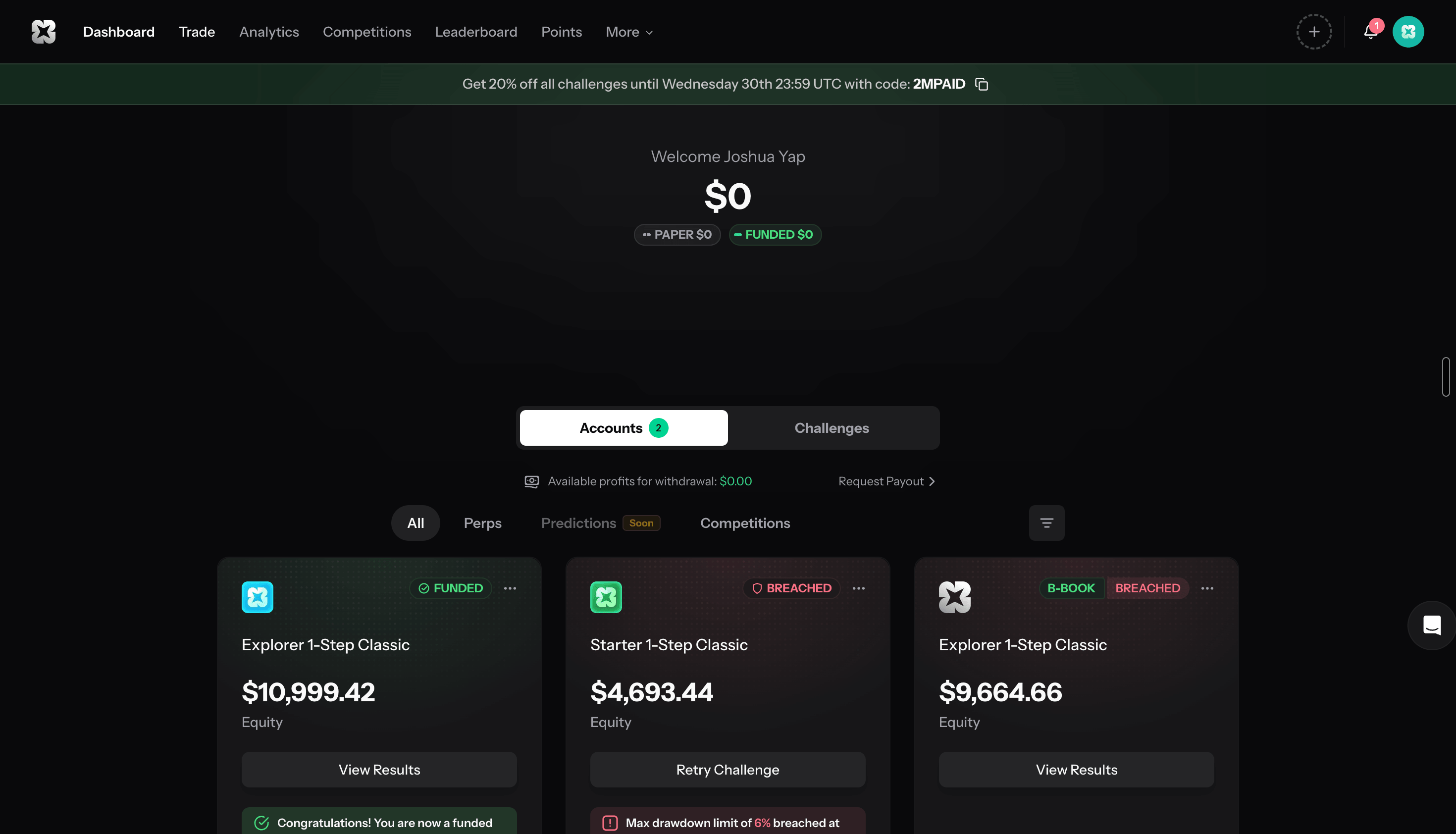
The analytics dashboard displayed performance by asset and day, long-versus-short results, trade duration, fees and slippage.
The account results here cover Classic one-step plans; I did not test the two-step evaluation.
Payout conditions and restrictions
In my experience, payouts took roughly six to twelve hours, and I couldn’t keep trading that account while the withdrawal was processing. That is my observed experience, not a universal processing time. The public rulebook says payouts are processed within 24 hours, with a $20 minimum, closed positions and a full-profit sweep rather than partial withdrawals.
KYC is required before funded activation and payouts. The documented API supports automated trading, but that access does not remove strategy restrictions.
There is also a documentation issue worth flagging: PROPR’s homepage allows copying between your own accounts, while its evaluation terms prohibit mirrored trades across accounts you control. Its funded terms warn that identical or off-the-shelf bots can be flagged as coordinated trading. These conflicting statements leave the permitted scope of multi-account automation unclear.
2. Hypernova: native order tools and on-demand payouts
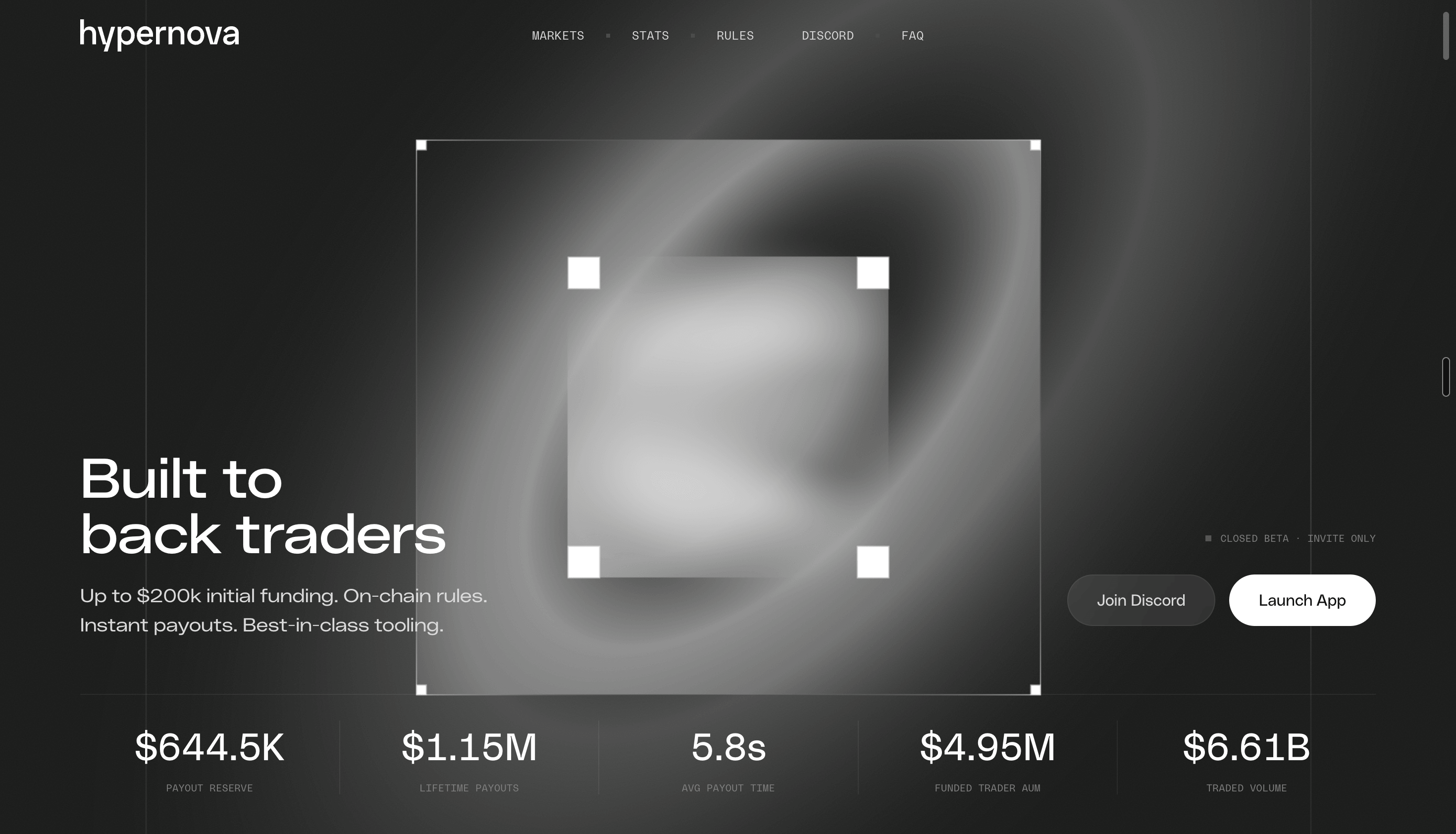
Hypernova offers one-step assessments with different risk tiers. Its Conservative plan has a 10% target, 3% daily loss limit and 6% static drawdown; Standard increases the daily and total limits to 4% and 7% respectively, at a higher fee.
Account results and trading tools
I opened five Hypernova accounts: one provided free and four I purchased.
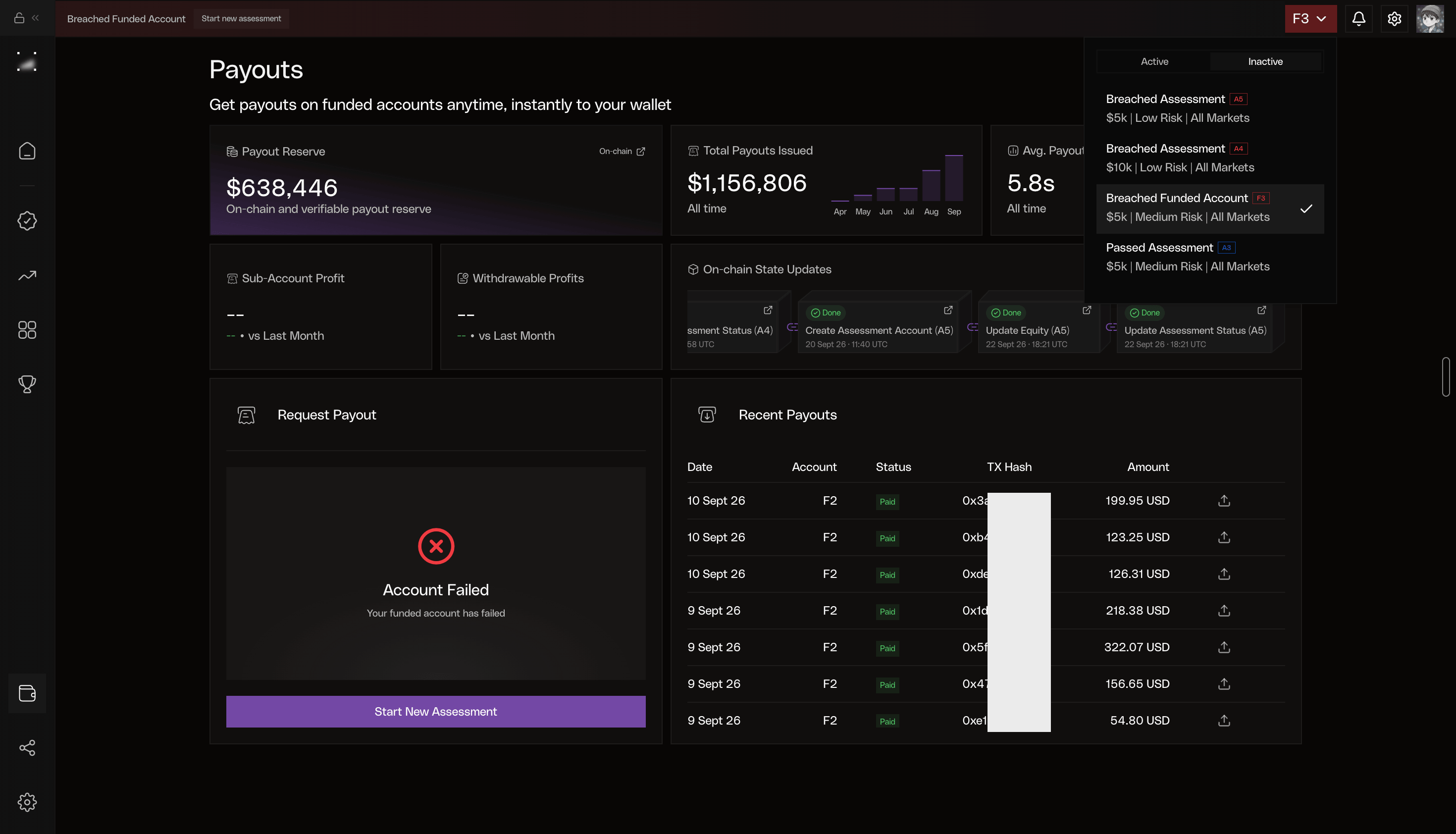
One account paid out more than $1,000 before it eventually breached. Seven payments marked “Paid” in that account’s payout history, dated 9–10 September, totalled $1,201.41. My other four accounts also breached. This payout subtotal should not be read as my net profit across all five accounts.
The terminal showed Scale controls and a TWAP tab. Its documentation explains scale orders as a ladder of limit orders across a price range.
Payout conditions and restrictions
Hypernova’s linked API specification explicitly says it is currently UI-only and does not expose a public API.
The payout documentation says there is no minimum and no cooldown, but the account must be eligible and flat, with no open positions or orders. It describes approximately five-second end-to-end settlement—not a guarantee for every withdrawal.
The dedicated payout documentation also lists a $10,000-of-profits daily cap per user during closed alpha, and requires another open-and-close trading cycle before repeat settlement. Its terms also reserve the right to request identity verification.
Its rulebook also prohibits copying third-party trade ideas and switching to a materially different strategy after passing the assessment. These apply in addition to the account’s loss limits.
Hypernova announced that KYC will become mandatory to receive a funded account from 30 September 2026. In-app verification opens on 25 September, through Sumsub.
3. Iceberg: no evaluation and a per-request payout ceiling
Iceberg’s clearest difference is its Instant model: pay for access and start without passing an evaluation. Its currently available sizes are $5,000, $10,000 and $25,000, priced at $167, $337 and $767. The larger advertised tiers are marked coming soon.
That makes the entry fee higher than the evaluation examples above. You are paying to skip the assessment, not buying ownership of live trading capital.
Account results and pending payout
I bought the $5,000 account for $167. At the time of writing, it showed $349.47 in unclaimed profit.
The payout screen applied the following limits and split:
| Payout breakdown | Amount |
|---|---|
| Unclaimed profit | $349.47 |
| Maximum gross payout | $250.00 |
| Iceberg’s 20% share | $50.00 |
| My 80% share | $200.00 |
| Excess flagged for forfeiture | About $99.47 |
My share of the payout is $200, covering the $167 account fee and leaving $33 above the initial cost. I had therefore reached breakeven on an earned-profit basis, with the payout still awaiting receipt.
Payout conditions and account lifetime
Iceberg’s documentation confirms a 5% maximum gross payout per request, measured against initial account size, before the 80/20 split. The minimum eligible profit is 1%. Claims take all eligible realized profit; partial payouts are not allowed. Any amount above the cap is permanently forfeited when the claim settles successfully.
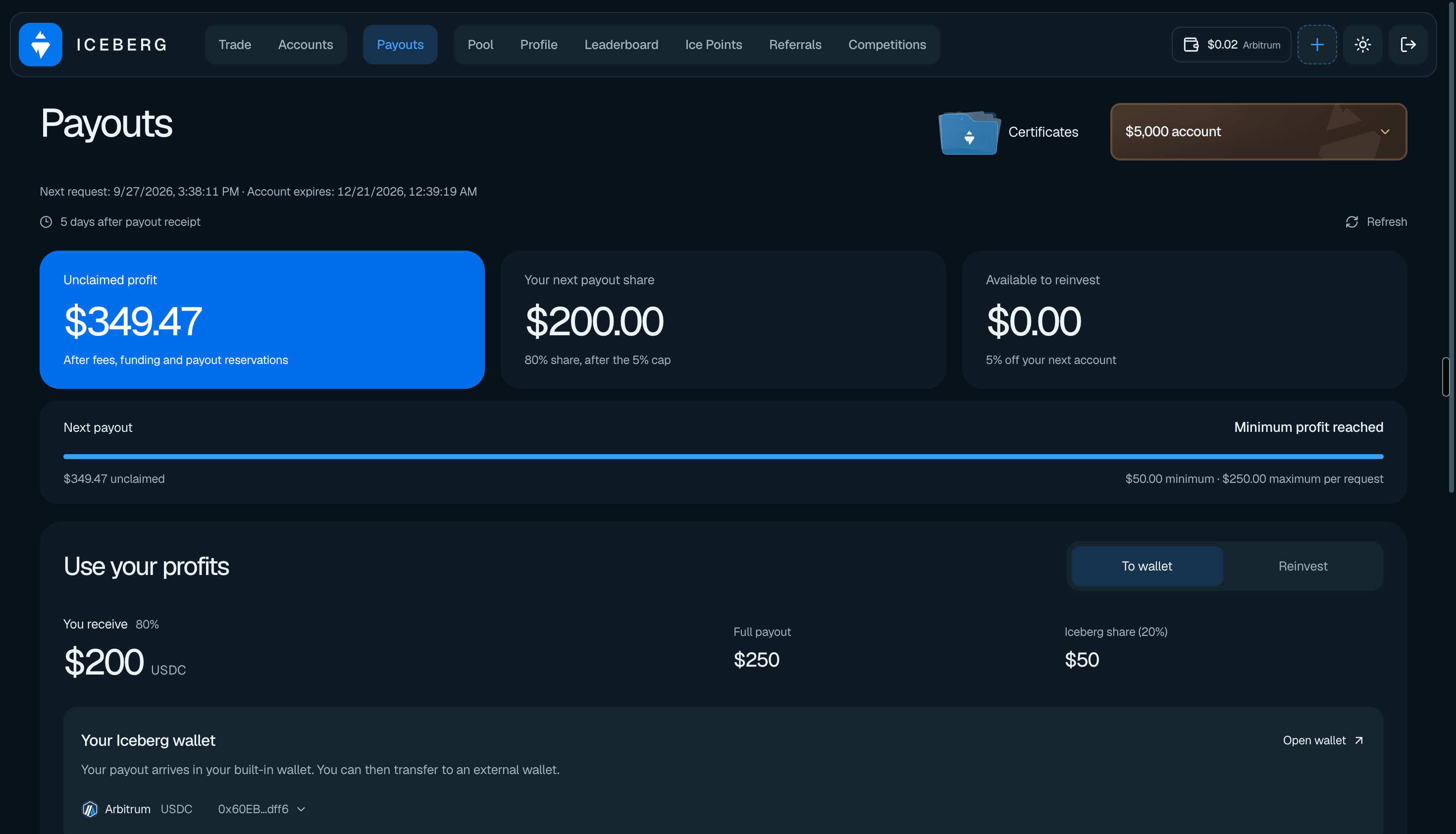
For my $5,000 account, that explains the $250 gross ceiling and $200 trader share. Profit above the cap does not carry into the next withdrawal once the claim settles.
Timing matters too. Current documentation says the first request opens five days after the first executed trade, and subsequent requests open five days after the previous payout is received.
Accounts also expire 90 days after activation. And becoming eligible to request a payout does not guarantee immediate payment: Iceberg says requests can remain queued until its payout pool has available liquidity.
Also, Iceberg is the only platform that does not impose KYC as of now, a big win for those who values more privacy.
The main differences
- PROPR provides a documented trading API and offers one- and two-step evaluations. Its payout rules specify a $20 minimum and processing within 24 hours.
- Hypernova provides native order tools but currently no public API. Its payout documentation states no minimum or cooldown, subject to eligibility and the closed-alpha daily cap.
- Iceberg removes the evaluation stage. In exchange, its Instant plans have a higher entry fee than the evaluation examples above, a 5% gross payout ceiling per request, five-day eligibility periods and a 90-day account lifetime.
None of this makes my results a prediction of yours. I breached accounts on both PROPR and Hypernova. A few successful payouts do not establish long-term profitability, and advertised funding size is not a substitute for reading the loss limits.
For broader context—not a prop-firm success-rate comparison—our research on Hyperliquid frontend traders examines realised trading outcomes and why trader selection matters.
Account size alone does not determine what a trader can withdraw. Access fees, loss limits, profit splits and payout conditions determine how these plans differ.
Sources
#1: Propr Model: propr.xyz/funded-terms
#2: Propr Rules: propr.xyz/rules
#3: Hypernova Rules: hypernova.xyz/rulebook
#4: Hypernova Payouts: hypernova.xyz/docs/payouts
#5: Iceberg Model: docs.iceberg.cash
#6: Iceberg Payout Requests: docs.iceberg.cash/payout-requests