How to Build a Hyperliquid Copy Trading Bot
Learn how to build a Hyperliquid copy trading bot on Hyperliquid with the Hyperliquid API.
What if your account could trade alongside a Hyperliquid trader who keeps getting it right, automatically?
That's what a copy trading bot does. It follows the trader's wallet, the "leader", and mirrors each trade in your account at a smaller size.
Hyperliquid copy trading compared with a CEX
Copy trading means something different on Hyperliquid than on a centralized exchange (CEX) such as Binance or Bybit:
| On Hyperliquid | On a centralized exchange | |
|---|---|---|
| Who you can copy | Any wallet: every trade and position is public on-chain | Usually only traders in the exchange's copy-trading program |
| Checking a leader first | Pull their trades and PnL history yourself from the API | Usually the stats the exchange chooses to show |
| Where your money sits | Your own account, under your own sizing rules | Usually an account the exchange holds your funds in |
| Building it for others | Builder codes earn up to 0.1% on the perp fills you place for users | The exchange runs the program |
Hyperliquid also has a built-in way to follow a trader: vaults. In a user vault, you deposit into the leader's vault, they trade it, and they keep 10% of the profits. A copy bot works the other way around. Your money stays in your account, and you set the size, caps and leverage of every copy.
The goal is a bot that keeps up with the leader. To get there, we'll look at:
- Why the usual ways of copy trading on Hyperliquid fall short.
- The limits of Hyperliquid's API for following many wallets, and how Hydromancer's API lifts them.
- How to build a copy bot step by step: stream the leader's trades, size each copy, and catch missed trades.
We'll use a mini example: Hydromancer supplies the leader's data, and Hyperliquid's SDK places the orders. It's one use case to adapt, not a production template. Nothing here is financial advice: copying a trader copies their losses too. Prices are a snapshot from when we tested.
How most people copy trade on Hyperliquid, and why it falls short
| Approach | How it works | Where it breaks |
|---|---|---|
| Copy-trading apps and chat bots | Paste a wallet in, set a size | You often can't see or change the sizing and risk logic |
| Polling the public API | Ask for the leader's positions or fills every few seconds | Copies arrive up to a polling interval late, and polling eats your rate limit |
| Copying positions, not fills | Compare snapshots and trade the difference | Trades that open and close between snapshots are never seen |
| One-to-one size and leverage | Mirror the leader exactly | One large trade can take over a small account |
| No recovery | Trust the feed to never drop | One missed fill and your positions drift from the leader's for good |
An effective copy bot does the opposite of each. It gets fills pushed to it as they happen. It sizes every copy with its own caps and leverage. And it re-checks the leader's real positions whenever it might have missed something.
The limits of Hyperliquid's API for copy trading
Hyperliquid's API can do all of this for one or two leaders. Past that, its limits bite. These are per IP address, from Hyperliquid's rate limits docs:
| Limit | What it means for copy trading |
|---|---|
| 10 unique users across user-specific live subscriptions | You can follow at most 10 leaders live from one IP |
| 10 live connections | The 10-user cap applies across all of them, so more connections don't help |
| 1,200 REST weight per minute | Shared by every read and every order you send |
clearinghouseState costs 2 | Polling 20 leaders' positions every 2 seconds uses the whole 1,200 |
userFills costs 20, plus 1 per 20 fills | Polling one leader's fills every 2 seconds uses half the budget or more |
userFills returns at most 2,000 recent fills | Catching up after a gap means paging userFillsByTime ,which keeps only the 10,000 most recent |
Your own account has one more limit: an action budget. It starts at 10,000 requests and grows by one per USDC you trade. Small copies earn little budget, so don't waste it on needless cancels and retries.
How Hydromancer's API comes in when copy trading on Hyperliquid
Hydromancer streams the same Hyperliquid data, with limits built for following many wallets. Here's a copy bot with and without it:
| What the copy bot needs | Without Hydromancer (Hyperliquid's API only) | With Hydromancer's API |
|---|---|---|
| Follow leaders live | One subscription per leader; the docs allow 10 unique users per IP | userFills takesup to 1,000 addresses in one subscription |
| Recover from a drop | Resubscribe, then backfill over REST | Reconnect with your session ID to replay up to 30 seconds |
| Fill longer gaps | userFillsByTime ,the 10,000 most recent fills | userFillsByTimewith history from 28 July 2025 |
| Re-check leaders' positions | clearinghouseState, one leader per request | batchClearinghouseStates: up to 1,000 wallets on one DEX per request |
| Copy leverage changes and resting orders | Per-user live subscriptions or REST reads, within the same 10-user cap | userLeverageUpdatesand userOrderUpdatesfor many addresses at once |
| Choose who to follow | The undocumented leaderboard file | userPnlLeaderboard: ranked by realized PnL, with a bot filter |
| Place the copies | Hyperliquid's exchange API | The same: orders always go to Hyperliquid |
Each followed address counts toward your plan's subscription total. That's 500 on Starter, 5,000 on Growth and 10,000 on Scale, per our streaming limits docs. Orders still go to Hyperliquid, through the SDK.
Which to use: to follow one or two wallets, Hyperliquid's own live feed is enough. Choose Hydromancer when you follow more than 10 leaders, or need to recover quickly when a connection drops.
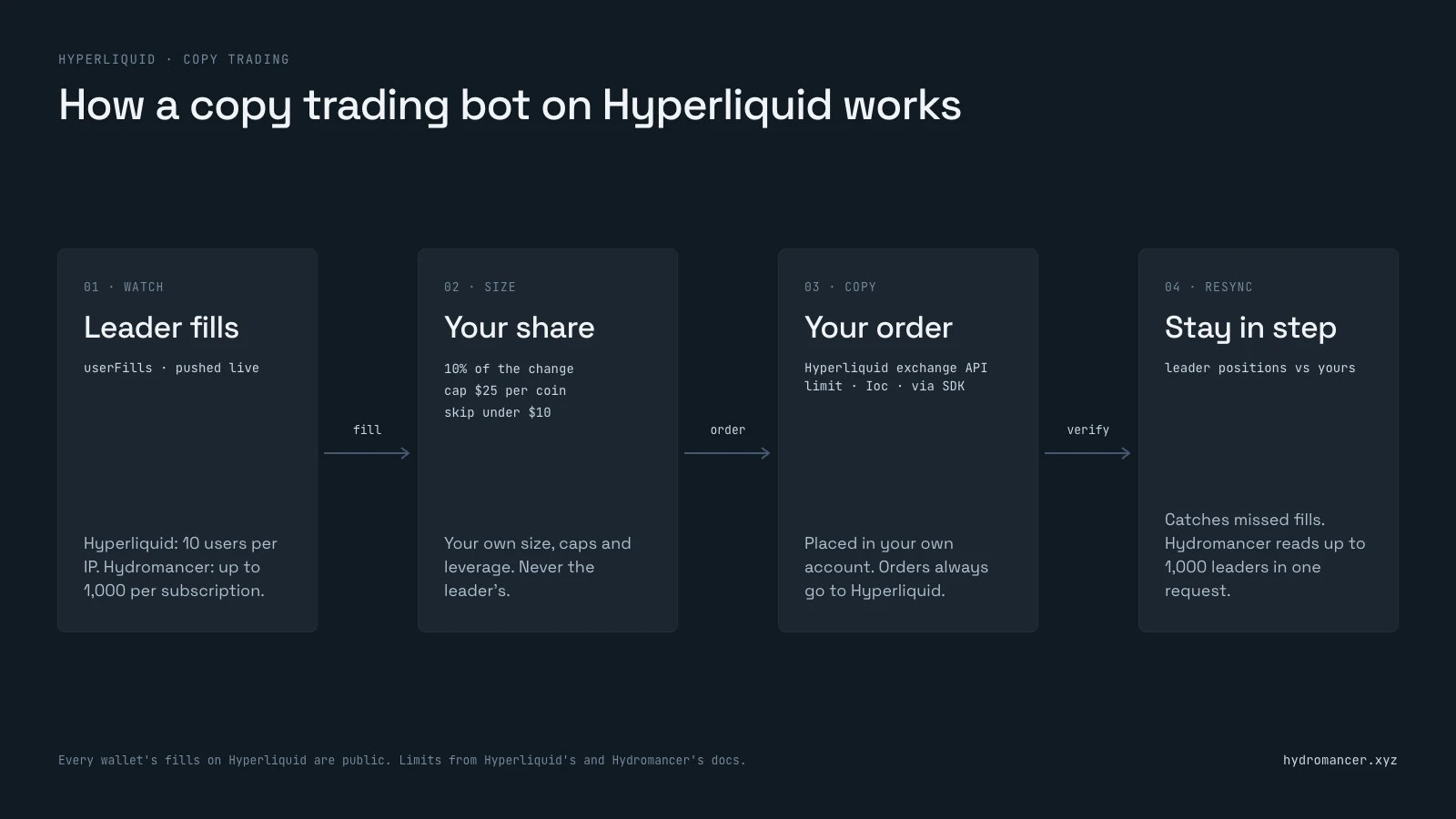
How the mini example works
| Job | What it does |
|---|---|
| Watch the leaders | Hydromancer's userFills feed, pushed as fills happen |
| Decide what to copy | New opens and adds on perps you can trade |
| Size it | 10% of the leader's change, capped at $25 per coin and $60 in total |
| Place orders | Immediate-or-cancel orders through Hyperliquid's SDK, at your own leverage |
| Stay in step | Re-reads the leader's positions after a reconnect, every 5 minutes, and when a fill doesn't add up |
| Stop safely | Limits and a kill file, then cancel, flatten and check |
You need Python 3, pip install hyperliquid-python-sdk, a Hydromancer API key, and a Hyperliquid account with an API wallet. Use an account that does nothing but copy. Our trading bot guide covers order placement and the kill switch, and our whale tracker guide shows how to find active wallets.
Step 1: Stream the leader's trades as they happen
A copy bot reacts to the leader's fills. A fill is one executed trade, with its coin, side, size and price. Rather than asking for the leader's fills every few seconds, subscribe once and let the server push each new fill to you. On Hyperliquid's own live feed, that's one subscription per leader:
import json
import websocket

ws = websocket.create_connection("wss://api.hyperliquid.xyz/ws")
sub = {"type": "userFills", "user": LEADER}
ws.send(json.dumps({"method": "subscribe", "subscription": sub}))

while True:
    msg = json.loads(ws.recv())
    if msg.get("channel") != "userFills":
        continue
    if msg["data"].get("isSnapshot"):
        continue  # skip the first, historical batch
    f = msg["data"]["fills"][0]
    print(f["dir"], f["sz"], f["coin"], "@", f["px"],
          "| leader's position before:", f["startPosition"])
breakClose Short 0.022 XMR @ 605.1 | leader's position before: -3333.903Each fill carries the leader's position before it (startPosition), so one fill tells you both the trade and the new position. That's what the bot copies: position changes, not orders. In a long-running bot, send {"method": "ping"} when the feed has been quiet for about 50 seconds; Hyperliquid closes connections that stay silent for 60.
Following more than 10 leaders: plug in Hydromancer. Hyperliquid's live feed stops at 10 users per IP. Hydromancer's userFills takes a list of up to 1,000 addresses in one subscription, and fills arrive as [address, fill] pairs:
import json
import os
import websocket

key = os.environ["HYDROMANCER_API_KEY"]
ws = websocket.create_connection("wss://api.hydromancer.xyz/ws?token=" + key)
ws.recv()  # the "connected" message

sub = {"type": "userFills", "addresses": LEADERS}
ws.send(json.dumps({"type": "subscribe", "subscription": sub}))
The fill fields are the same. The only change is that each fill comes with its address, so route it to the right leader before sizing the copy.
Step 2: Decide how much to copy
Copying the leader's exact size rarely makes sense. Their account is likely far bigger than yours, and one large trade could take over your whole balance. So each copy is a fraction of the leader's change, with two limits: a cap per coin, and a skip when the order would be too small to trade.
With a 10% ratio, a $25 cap per coin and ETH at $2,300:
| Leader adds | You hold | You copy | Why |
|---|---|---|---|
| 4 ETH | 0 ETH | 0.0108 ETH | 10% would be 0.4 ETH, cut to the $25 cap |
| 0.03 ETH | 0 ETH | Nothing | 10% is worth $6.90, under Hyperliquid's $10 minimum |
| 2 ETH | 0.0102 ETH | Nothing | Too little room left under the cap for a minimum-sized order |
Closes are sized from your position: if the leader closes half, you close about half of what you hold, adjusted for size steps and the minimum. A flip closes what you hold, then opens the new side within the same limits. Set your own leverage per coin rather than mirroring the leader's.
Step 3: Re-check the leader's positions to catch missed trades
No feed is perfect. A dropped connection or a restart can make the bot miss a fill, and then its copy of the leader's positions is wrong for good. The fix is to check its view against the leader's real positions from time to time. On Hyperliquid, that's one clearinghouseState request per leader:
import requests

state = requests.post(
    "https://api.hyperliquid.xyz/info",
    json={"type": "clearinghouseState", "user": LEADER},
).json()

positions = {}
for p in state["assetPositions"]:
    positions[p["position"]["coin"]] = p["position"]["szi"]

print(len(positions), "open positions, e.g. XMR:", positions.get("XMR"))24 open positions, e.g. XMR: -3339.508Many leaders: plug in Hydromancer. At 2 weight per request, re-checking hundreds of leaders eats your 1,200-a-minute budget. Hydromancer's batchClearinghouseStates reads up to 1,000 wallets on one DEX in a single request:
import os
import requests

states = requests.post(
    "https://api.hydromancer.xyz/info",
    json={"type": "batchClearinghouseStates", "users": LEADERS},
    headers={"Authorization": f"Bearer {os.environ['HYDROMANCER_API_KEY']}"},
).json()

print(len(states["successful_states"]), "leaders' positions in one request")50 leaders' positions in one requestThe bot uses these checks in three ways:
- Out-of-step check. If a fill's
startPositiondoesn't match what the bot thinks the leader holds, something is out of step, possibly a missed fill. - Resync. The bot then re-reads the leader's real positions and copies any difference.
- Timer and reconnects. It also resyncs every 5 minutes and after each reconnect. The mini example reconnects with a fresh session and relies on this resync. A production bot can also reconnect with its session ID to replay short drops.
A change found by a resync is copied late, at the current price. It's a repair, not a good copy.
What one live run did
We let the mini example follow an active leader for about 12 minutes, with orders on Hyperliquid's testnet:
| Count | |
|---|---|
| Leader fills seen | 23 |
| Copied | 2 (BTC and SOL shorts, each cut to the $25 cap) |
| Skipped: at or near the cap | 2 |
| Skipped: too small after caps and rounding | 4 |
| Skipped: leader reduced a position we didn't hold | 11 |
| Skipped: market not available to the test account | 4 |
We then stopped it with the kill file. It closed both positions and confirmed the account was flat. Of the 21 skips, 6 came from the caps and the minimum order size. The other 15 were reductions of positions we never copied, or markets we couldn't trade.
Be honest about what copying can't do
- You always trade AFTER the leader, possibly at a different price.
- Leverage differs. A large account can ride out a move that would liquidate a small copy.
- Results will differ from the leader's, because of skipped fills and caps. You also pay or receive funding on your own positions, which won't match the leader's.
- Your current portfolio move is not the same as the leader as there are way too many factors beyond your control.
FAQ
Is copy trading on Hyperliquid profitable?
It can be, but not automatically. You trade after the leader, possibly at a different price, skip fills that are too small, and pay your own fees and funding. A leader's past results don't promise future ones, so size copies small and check the leader's history first.
Is copy trading allowed on Hyperliquid?
Every wallet's trades on Hyperliquid are public, so following a wallet means reading public data, and your copies are ordinary orders through Hyperliquid's API. Rules can differ by country, and this isn't legal advice.
What's a good copy trading strategy on Hyperliquid?
Pick leaders by their closed-trade results over months, not one big win, and follow several rather than one. Cap your size per coin and in total, skip copies too small to trade, and set your own leverage. Our leaderboard guide shows how to rank traders by realized PnL.
How many wallets can I copy on Hyperliquid?
With Hyperliquid's own live feed, up to 10 users per IP. Hydromancer's userFills takes up to 1,000 addresses in one subscription, within your plan's subscription total (500 on Starter, more on higher plans).
Why not just poll the leader's positions?
Polling makes every copy as late as your polling interval, and it uses the request weight you need for your own orders. It also misses trades that open and close between polls.
Should I copy the leader's existing positions?
The mini example doesn't. It records them at start and copies only changes from then on, so it never enters an old trade at a later price.
Next steps
- Watch a leader: run the first snippet with any active address.
- Find leaders worth following: our leaderboard guide and whale tracker guide.
- Learn the bot basics: our trading bot guide.
- Following more than a few wallets? See Hydromancer's data streaming.
Read next

Hyperliquid Leaderboard: How to Track Top Addresses' PnL
How to get Hyperliquid leaderboard data using the Hyperliquid API.
Read ↗
How to Build a Hyperliquid Trading Bot
Learn how to build a Hyperliquid trading bot: a signal from market data, signed orders through Hyperliquid's API, risk limits and a kill switch, with examples.
Read ↗
How to Build a Hyperliquid Orderbook Heatmap
Learn how to build a Hyperliquid order book heatmap: sample l2Book snapshots, choose the price grouping, then read walls, pulled liquidity and depth.
Read ↗