How to Get Hyperliquid Data: Best Providers, API or Node
Compare the three ways to get Hyperliquid data: the official API, your own node or a data provider. What each covers, its limits, and which fits your build.

Getting Hyperliquid data can be confusing for newcomers. The native APIs and websockets from the Foundation exist, but the official recommendation is often to run a Hyperliquid node — and there are multiple data providers offering streams, managed nodes, and other solutions.
This guide explains the trade-offs with each and lays out your Hyperliquid data options concisely.
#1: Official API
The official Hyperliquid API supports most of the basic operations Hyperliquid users and builders need — retrieving (non-aggregated) user trade history, deposits/withdrawals, subscribing to wallet activity feeds, and fetching user positions.
Without going deep into rate limits (you can read about them here), the official API is mainly limited on these vectors:
- Historical data: you can only retrieve a limited amount of actions.
- Concurrent subscriptions: heavily rate-limited on how many concurrent wallets you can subscribe to.
- Almost no aggregated/processed data: no separate liquidation stream, for example. (We covered
Update: Hyperliquid launched with CEX-level generous real-time feeds, but as the network has scaled, it has started dialing them back. The June 2026 API changes are a clear example — the default l2Book subscription that used to push 20 levels every two seconds is being stepped back to every five, with the faster cadence moved behind the fast: true flag. As Hyperliquid becomes more of a chain than a DEX, we can expect even more tightening of the official API's rate limits.
#2: Running a node
A node is your own copy of the Hyperliquid machine, running on a server you control. Most of the time when people mention running a node, they mean a non-validator node. A non-validator node just listens — it streams every trade, order, and state change off the network and writes it to disk. Running one means:
- Getting a beefy machine — 16 CPUs, 128 GB of RAM, 500 GB of fast storage.
- Archiving data, as it spits out roughly 100 GB of logs every single day.
- Optimizing — for best latency the node server has to be placed in the Tokyo region, and for stability it's recommended to find a stable peer.
- Maintaining — it's a 24/7 operations commitment: finding peers, staying synced, handling crashes, monitoring.
When you run your own node, you get the full firehose locally — everything happening on Hyperliquid, in real time, without depending on someone else's API. You can also turn on a local server to answer your own queries and an EVM endpoint for HyperEVM data. It's the “own your data path” option.
HyperCore also has no archival node option. A fresh node only gives you data from the moment you start it forward. So if you want deep history, a node alone won't be enough — you'd either have been running it (and saving the files) the whole time, or you pull history from the S3 archives instead.
The cost of running a node with these requirements is around $1k/month, including server and data-archive costs. Running node(s) is usually a preference for teams:
- Who want to keep and maintain all infra in-house.
- Who are extremely latency-sensitive and want full control over how their market data is ingested.
For everyone else, it's worth asking:
'Do you want a node, or do you want the data from the node?'
This is especially relevant because on HyperCore there are no alternative order-submission paths other than the official API — RPC in the traditional blockchain sense does not exist on HyperCore, and everyone goes through the official API.
So the only purpose of running a node is to get the data streams. Turning that firehose into something you can build on is a second project most teams underestimate — and then they own it forever: every crash, every network upgrade, every schema change.
#3: Hyperliquid API providers
This is the gap a Hyperliquid API provider like Hydromancer fills. Instead of running and maintaining nodes yourself, a provider delivers indexed APIs, real-time streams and historical archives, with SLAs and without the public API's rate limits.
Choosing your providerDifferent providers cover different layers of Hyperliquid. When comparing them, ask:
- Do you need HyperCore (order books, trades, positions, liquidations) or HyperEVM (smart contract JSON-RPC)?
- Do you need real-time streams, deep history for backtesting, or both?
- Is your app built only on Hyperliquid, or spread across many chains?
At a glance:
- Hydromancer: HyperCore data provider. Real-time L2 and L4 order book streams, all fills and liquidation fills, builder streams, REST APIs up to 50,000 weight a minute, batch position queries for up to 1,000 wallets, history from late July 2025, and node peering.
- Reservoir (by Hydromancer): free S3 archive of Hyperliquid fills, 1-second candles, position snapshots and L2 order book depth, in Parquet.
- QuickNode: multi-chain provider covering HyperEVM JSON-RPC and HyperCore streams over gRPC, with usage-based credit pricing.
- Alchemy: HyperEVM JSON-RPC; its HyperCore API is in private preview.
- HyperTracker: wallet cohorts and positioning analytics, with a tiered API.
1. Hydromancer: HyperCore streams, high-limit REST API and node peering
Hydromancer is a Hyperliquid data provider. It runs six nodes in parallel, peered to the Foundation node and its own validator, and serves HyperCore data through real-time streams and an indexed REST /info endpoint with up to 50,000 weight a minute on its top plan. Streams cover L2 and L4 order books, BBO, all fills, liquidation fills and builder orders and fills. The REST API adds oracle price history, HIP-4 outcome markets, batchClearinghouseStates (positions and margin for up to 1,000 wallets in one request) and historical data from late July 2025. Teams running their own nodes can also use Hydromancer's SLA-backed peering. The trade-off is chain scope: Hydromancer covers Hyperliquid only, not other chains.
Choose Hydromancer if you're building a HyperCore trading app, terminal, bot, analytics dashboard or market-making system and need real-time streams, batch wallet queries and historical depth.
2. Reservoir (by Hydromancer): free Parquet archive on S3
Reservoir is Hydromancer's free public S3 archive of Hyperliquid's full market: every perp and spot market on the main DEX and all HIP-3 deployers. It stores daily Parquet files of every fill since late July 2025 (trades, liquidations, ADLs, builder and TWAP fills), 1-second OHLCV candles, daily position and balance snapshots, and 20-level L2 order book depth. You query it straight from DuckDB, Polars or pandas with no API key or subscription, paying only AWS's requester-pays transfer costs. For Hyperliquid backtesting, that covers the trades, candles and order book depth you'd otherwise buy from a paid multi-exchange archive like Tardis.
Choose Reservoir if you need bulk Hyperliquid history to backtest trading strategies. See the Reservoir guide.
3. QuickNode: multi-chain provider
QuickNode covers Hyperliquid alongside many other chains. It offers HyperEVM JSON-RPC and HyperCore streams over gRPC (trades, orders, L2 and L4 order books), priced with usage credits. Its gRPC streams are real-time only; history comes through block queries. Chainstack is a similar multi-chain option with Hyperliquid nodes.
Choose QuickNode if your app spans several chains and you want one vendor for all of them.
4. Alchemy: HyperEVM JSON-RPC
Alchemy is an Ethereum-stack provider. On Hyperliquid it serves standard JSON-RPC for HyperEVM, so Foundry, Hardhat, ethers.js and viem work unchanged. Its HyperCore API is in private preview, so for order books, trades and liquidations today you'll need a HyperCore provider.
Choose Alchemy if you're building smart contracts on HyperEVM and don't need HyperCore market data.
5. HyperTracker: trader analytics
HyperTracker (by CoinMarketMan) turns Hyperliquid data into labeled wallet cohorts and positioning signals. Rather than raw order book feeds, it offers ready-made classifications, with a developer API in five tiers, including a free one.
Choose HyperTracker if you want ready-made cohort labels rather than building your own analytics.
Which source has which Hyperliquid data
| Data | Official API | Hyperliquid S3 archive | Your own node | Reservoir (free) | Hydromancer API |
|---|---|---|---|---|---|
| Fills (trades) | A wallet's 10,000 most recent fills, 2,000 per request | Node fill files | From the day you start it | Every fill from 28 Jul 2025, daily Parquet | Per wallet from 28 Jul 2025, past the 10,000 cap |
| Candles | The 5,000 most recent per interval (1-minute ≈ 3.5 days) | Not provided | Build them from fills | 1-second candles from 31 Jul 2025 | Older 1-minute candles than the official API |
| Order book | Current book, 20 levels a side | L2 snapshots, uploaded about monthly | Book updates from the day you start it | 1-minute snapshots, 20 levels, from 15 Dec 2025 | Live L2 and L4 streams |
| Funding | 500 rows per request, page through | Funding events in node event files | From the day you start it | Not included | From 28 Jul 2025 |
| Positions and balances | Current state only | Not provided | Current state, plus the snapshots you keep | Daily snapshots from 29 Jul 2025 (none 25 Oct–14 Dec 2025) | Current state, up to 1,000 wallets per request |
| Liquidations | Inside the fills of the wallet liquidated | In node fill files | From the day you start it | Liquidation fills from 28 Jul 2025 | Liquidation history and streams |
Checked 20–22 October 2026 against the live APIs, the Reservoir bucket and each source's docs.
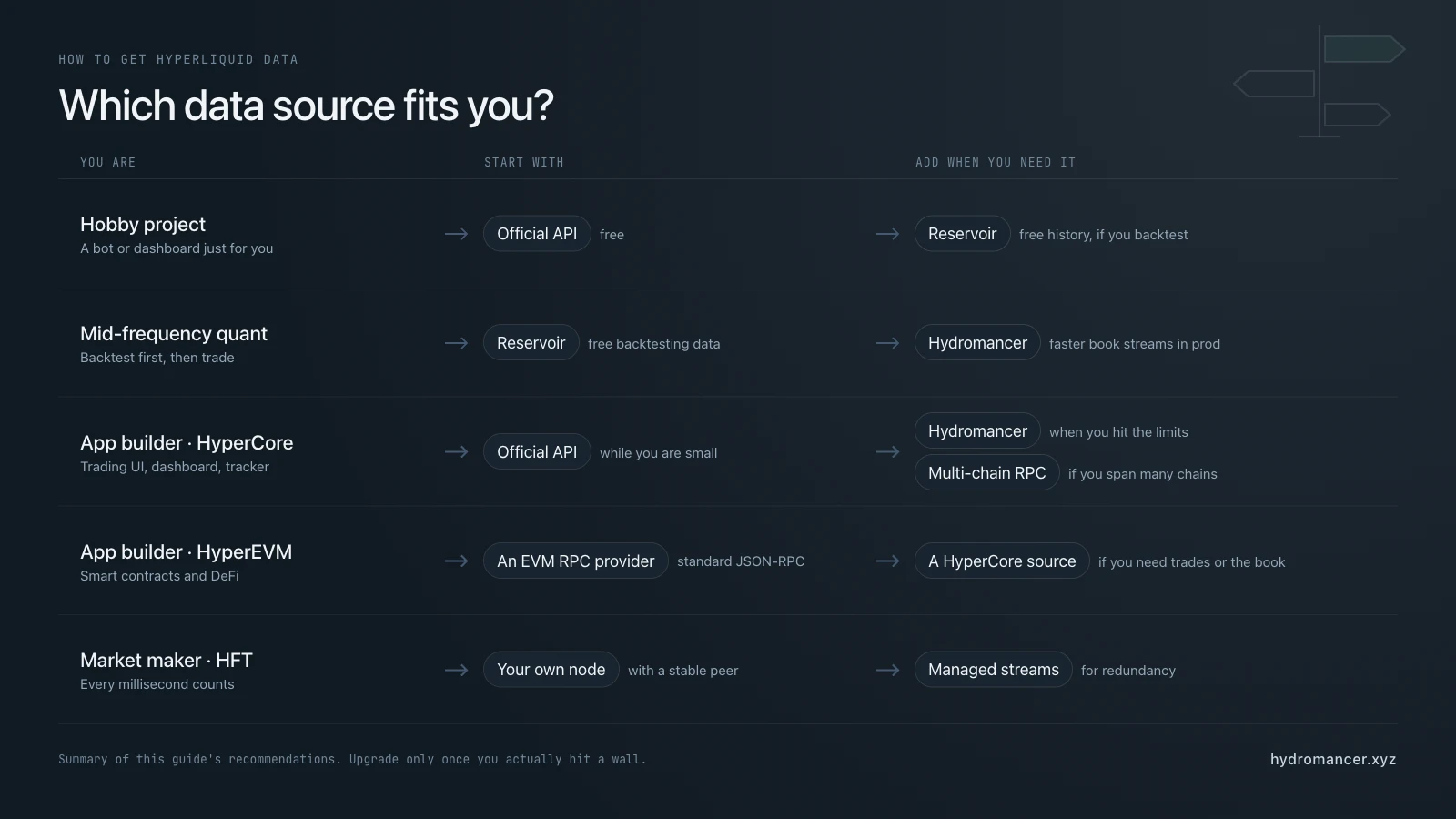
Market maker or high-frequency trader
If you're a market maker or high-frequency trader, you live and die by your latency. Most HFTs run their own optimized nodes for data ingestion, but also use managed data streams for redundancy.
Find a peered connection for your node
If you're running a latency-optimized node, Hydromancer offers node peering as a service starting from $500/month.
Get low-latency data streams
If the official Hyperliquid API isn't fast enough for you, use Hydromancer for low-latency orderbook streams.
Mid-frequency quant trader
If you don't operate at high frequency, you mostly need clean, quality data to backtest your strategies before deploying them in prod. In that case, Reservoir is your best choice — a free, complete Hyperliquid S3 archive deployed by the Hydromancer team, perfect for backtesting mid-frequency quant strategies.
Once you start running strategies in prod and want faster orderbook streaming, you can also use Hydromancer for low-latency orderbook streams.
App builder — HyperCore
If you're building an app on HyperCore — a trading interface, dashboard, portfolio tracker, anything that reads trades, positions, or the order book — you need reliable, clean data, but you're not chasing nanoseconds like an HFT.
Start on the official API. For basic user-facing queries — positions, fills, wallet feeds — it's free and completely sufficient while you're small.
Move to managed streams when you outgrow it. As you scale, you'll hit the API's real limits: caps on concurrent wallet subscriptions, tightening rate limits, and raw-only data (no ready-made liquidation stream, funding, or OHLCV).
At that point Hydromancer gives you low-latency, cleaned, structured HyperCore streams hyper-optimized for Hyperliquid builders. If your app is also multi-chain, a multi-chain RPC provider is the generalist alternative.
App builder — HyperEVM
If you're deploying smart contracts or building DeFi on HyperEVM, you're in familiar Ethereum territory — standard JSON-RPC, and Foundry, Hardhat, ethers.js and viem work as they do on other EVM chains. What you need is a solid HyperEVM RPC endpoint: Hyperliquid's public one for testing, or a private one from an RPC provider for production.
Pick a multi-chain provider if you're multi-chain or also want HyperCore access from the same vendor; pick an EVM RPC provider if you're purely on HyperEVM and want familiar EVM tooling.
One thing to keep straight: these cover the EVM layer — if you also need order book or trade data, that's a HyperCore question and a different tool.
Hobby projects
If it's a personal or hobby project — a bot just for you, a side dashboard, something you're building to learn — the official API is almost certainly all you need. It's free, official, and its rate limits are generous enough for a single user doing basic queries and feeds.
Don't pay a provider or stand up a node for this; you'd be solving a scaling problem you don't have. The one exception is if your project is trading- or backtesting-related and needs historical data — for that, reach for Reservoir, which is free.
Upgrade to anything heavier only once you actually hit a wall.
This is especially relevant because on HyperCore there are no alternative order-submission paths other than the official API — RPC in the traditional blockchain sense does not exist on HyperCore, and everyone goes through the official API. So the only purpose of running a node is to get the data streams. Turning that firehose into something you can build on is a second project most teams underestimate — and then they own it forever: every crash, every network upgrade, every schema change.
FAQ
Where can I download Hyperliquid historical data?
Three places: Hyperliquid's own S3 archive (L2 snapshots and node files, uploaded about monthly), Reservoir (free daily Parquet files of fills, 1-second candles, position snapshots and order books), or a paid Hyperliquid historical data API.
How far back does the Hyperliquid API go?
For fills and candles, not far. You get a wallet's 10,000 most recent fills and the 5,000 most recent candles per interval, which is about 3.5 days of one-minute candles.
Do I need a node to get Hyperliquid data?
Only if you want the full live feed in-house. A new node records from the day you start it, with no history before that.
What's the best source for backtesting?
A free archive. Reservoir has fills, 1-second candles and order book snapshots, and Hyperliquid's S3 archive has L2 snapshots. The API's candle limit is too short for most one-minute backtests.
Which Hyperliquid data provider is best for developers?
It depends on the layer. For HyperCore apps, trading bots and market makers, use a Hyperliquid-specialist provider like Hydromancer, which offers real-time L2 and L4 order book streams, liquidation and builder fill streams, batch position queries for up to 1,000 wallets, and history from late July 2025. For free backtesting data, use Reservoir, Hydromancer's Parquet archive on S3. For an app across many chains, a multi-chain provider like QuickNode. For HyperEVM smart contracts only, an EVM provider like Alchemy.
Read next

How to Query Reservoir's Hyperliquid Data
Explore Reservoir's Hyperliquid fills, candles, snapshots and order books, with tested examples that pull only the markets, wallets and time ranges you need.
Download Hyperliquid Historical Data Free (S3 Archive)
Free Hyperliquid historical data: every fill since July 2025, 1-second candles, and position and order book snapshots, as daily Parquet files on AWS S3.
How to Build a Hyperliquid Copy Trading Bot
Build a copy trading bot on Hyperliquid: follow a trader's fills live, size each copy, re-check positions for missed trades, and know its limits.