Hyperliquid Staking: Guide for HYPE Stakers & Builders
How HYPE staking works on Hyperliquid: validators, commission, the 1-day lockup and 7-day unstaking queue, how APR is set, and how to read staking data.
Hyperliquid staking means delegating HYPE from your own HyperCore address to network validators in exchange for compounding emissions rewards and up to 40% off trading fees. Builders query that same on-chain state to show validators, APR and rewards in wallets and dashboards.
Staking takes a few clicks, yet moving HYPE back to spot requires a 1-day delegation lockup followed by a 7-day unstaking queue. Your validator choice decides your net return, because commission reduces yield and jailed validators earn nothing.
Hyperliquid's docs put the gross reward rate at about 2.37% a year when 400M HYPE is staked. Because the rate falls as total stake grows, pull live values from the API instead of treating that reference point as current APR.
For the live wallet balances, validator count and weekly APR replies behind both API scripts below, see Test and Validation.
Hyperliquid staking rules at a glance
These parameters govern when you can move staked HYPE and how rewards pay out, from Hyperliquid's staking docs:
| Rule | Value |
|---|---|
| Delegation lockup | 1 day per delegation |
| Unstaking queue, staking to spot | 7 days |
| Pending withdrawals per address | 5 at most |
| Validator self-delegation | 10k HYPE, locked for one year |
| Commission increases | Allowed only to a new rate of 1% or less |
| Reward rate | About 2.37% a year at 400M HYPE staked |
| Reward payments | Accrued every minute, paid daily, compounded |
| Staking epoch | 100k rounds, about 90 minutes on mainnet |
| Automatic slashing | None implemented |
Why HYPE staking matters on Hyperliquid
Beyond base emissions yield, staking HYPE directly lowers trading fees on HyperCore and secures consensus through the validators you back.
Trading fee discounts up to 40%
Staking HYPE cuts what you pay to trade on Hyperliquid. The fee schedule scales from a 5% discount above 10 HYPE (Wood) up to 40% above 500,000 HYPE (Diamond).
On $1 million of perp trades that take liquidity at the lowest volume tier (0.045% base taker fee), each tier saves:
| Staking tier | HYPE staked | Discount | Fee on $1M | You save |
|---|---|---|---|---|
| No stake | Under 10 | 0% | $450 | $0 |
| Wood | Over 10 | 5% | $427.50 | $22.50 |
| Bronze | Over 100 | 10% | $405 | $45 |
| Silver | Over 1,000 | 15% | $382.50 | $67.50 |
| Gold | Over 10,000 | 20% | $360 | $90 |
| Platinum | Over 100,000 | 30% | $315 | $135 |
| Diamond | Over 500,000 | 40% | $270 | $180 |
Maker fees get the same percentage cut, and higher volume tiers start from lower base rates. Our fees explainer has the full schedule and how discounts combine.
Validator choice and consensus security
Hyperliquid's consensus needs more than two-thirds of all stake to sit with honest validators. That is why its docs call delegating only to trusted validators every staker's responsibility.
You stake directly from your own HyperCore address and can split your HYPE across any number of validators. Every validator's commission, stake and jail status sits in Hyperliquid's own state, so you can verify it before delegating.
How Hyperliquid staking works
Hyperliquid uses delegated proof-of-stake, so "stake" and "delegate" mean the same thing in its docs. Validators run the network and produce blocks, while you back one or more of them with HYPE to share their rewards.
Staking runs on HyperCore, Hyperliquid's trading layer, inside a dedicated staking balance kept separate from your spot balance.
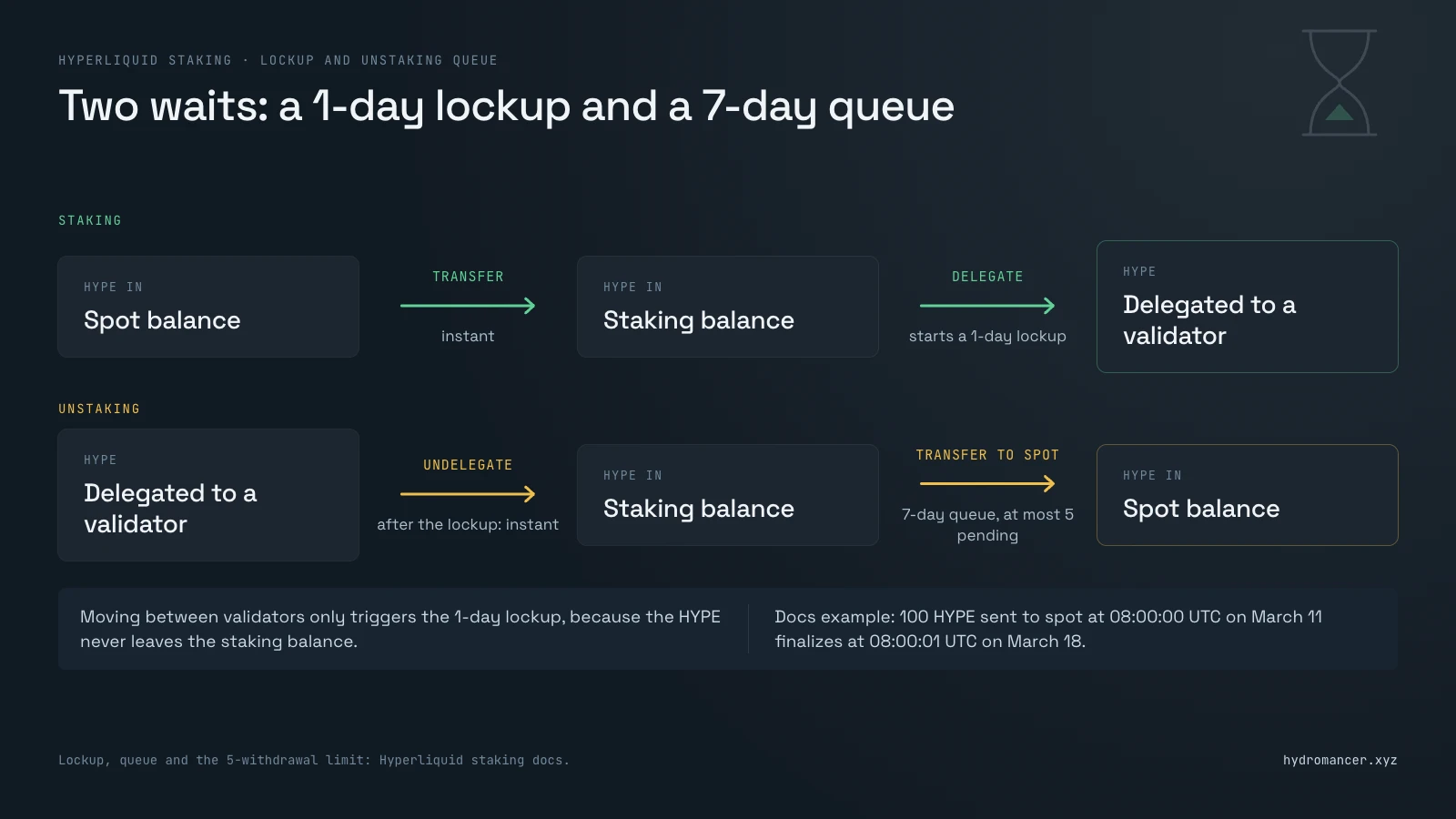
The 1-day lockup and 7-day unstaking queue
Staking involves two separate waiting periods that traders often mix up:
• Delegation lockup (1 day): After delegating to a validator, you cannot undelegate for 1 day. Once that ends, partial or full undelegations return to your staking balance instantly.
• Unstaking queue (7 days): Moving HYPE from your staking balance back to spot takes 7 days, with at most 5 pending withdrawals per address.
In Hyperliquid's docs example, a 100 HYPE transfer started at 08:00:00 UTC on March 11 finalizes at 08:00:01 UTC on March 18.
If you need HYPE liquid quickly, the 7-day queue is the wait that matters. Redelegating between validators only triggers the 1-day lockup, because your HYPE never leaves the staking balance.
Validators, self-stake and commission caps
To enter the active set, a validator must self-delegate 10k HYPE, locked for one year. If its self-delegation drops below 10k, it enters undelegate-only mode, accepting no new delegations so its stake can only shrink.
Active validators earn rewards in proportion to their total delegated stake and may charge delegators a commission.
A validator cannot raise its commission unless the new rate is 1% or less. That cap stops a validator from attracting stake at a low rate and hiking fees later.
How the HYPE staking APR is set
The reward rate follows a formula inspired by Ethereum: it scales inversely with the square root of total HYPE staked. As more HYPE gets staked network-wide, the rate falls for everyone.
Hyperliquid's docs give one reference point: about 2.37% a year at 400M HYPE staked. Rewards come from Hyperliquid's future emissions reserve, not from trading fees.
Four rules shape what actually reaches your balance:
• Rewards accrue every minute and pay out daily.
• Daily rewards redelegate automatically to the same validator, so they compound.
• Payouts use your minimum staked balance during each staking epoch (100k consensus rounds, about 90 minutes on mainnet).
• Your validator's commission comes off the top.
Jailing versus slashing
Validators can vote to jail a peer that fails to respond quickly or often enough. A jailed validator stops taking part in consensus and produces no rewards for its delegators.
A jailed operator can unjail itself after fixing the issue, subject to on-chain rate limits.
Jailing is not slashing. Slashing is reserved for provably malicious behavior such as double-signing, and Hyperliquid's docs state that no automatic slashing is currently implemented.
How to stake HYPE on HyperCore
You can stake through Hyperliquid's staking page or one of the third-party staking interfaces listed in its docs. The flow matches Hyperliquid's "How to stake HYPE" guide.
Step 1: Get HYPE into your HyperCore spot balance
Staking draws from HYPE sitting in your spot balance on HyperCore. If your HYPE is on HyperEVM, transfer it to HyperCore first.
Step 2: Move HYPE from spot to your staking balance
Your staking balance holds the HYPE available for delegation, separate from the HYPE you trade with. Transfers in from spot settle instantly.
Step 3: Choose a validator and delegate
Delegating puts your staking balance behind a validator, and you can split it across any number of them. Each delegation begins a 1-day lockup.
Unstaking HYPE back to spot
To exit staking, undelegate from the validator, transfer HYPE from staking to spot, and wait 7 days. Undelegating and transferring to spot are two separate actions, and the 7-day queue starts only with the transfer.
Every staking action is signed by your wallet. Only stake through sites you trust; our security guide covers what to verify before signing.
How to get Hyperliquid staking data from the API
Which API you need depends on whether you are checking a single wallet or comparing every validator on the network.
One wallet's staking with Hyperliquid's API
You can read any single wallet's staking state with Hyperliquid's free public API. Start with delegatorSummary for totals and delegations for one row per validator:
# Expected output: balances, then validator, amount and unlock time per line
import requests
from datetime import datetime, timezone

INFO = "https://api.hyperliquid.xyz/info"
me = "0xYOUR_ADDRESS"

s = requests.post(INFO, json={"type": "delegatorSummary", "user": me}).json()
print("Delegated:", s["delegated"], "| Undelegated:", s["undelegated"],
      "| Pending withdrawal:", s["totalPendingWithdrawal"])

for d in requests.post(INFO, json={"type": "delegations", "user": me}).json():
    t = datetime.fromtimestamp(d["lockedUntilTimestamp"] / 1000, timezone.utc)
    print(d["validator"], d["amount"], "unlocks", t)
Replace 0xYOUR_ADDRESS with the wallet you want to inspect. The script prints each validator by address, and a lockedUntilTimestamp in the past means the 1-day lockup has ended.
For one public staking address, those two requests returned about 10,056 HYPE delegated across two validators, with none undelegated and nothing pending withdrawal.
Hyperliquid's API also serves delegatorRewards (daily rewards by source) and delegatorHistory (staking actions). For tracking one wallet, those four requests cover everything you need.
Every validator and weekly APR with Hydromancer's API
Hyperliquid's API docs document no request for the full validator set. Hydromancer's API provides two endpoints built for comparing operators:
• stakingOverview: every validator with name, commission_bps, total_delegated, effective_stake, staker_count and is_jailed, plus network total_staked.
• validatorAprHistory: weekly netApr (after commission) and grossApr as simple annualized fractions, starting 1 August 2025.
This script lists the five largest validators by stake with commission, jail status and the last full week's net APR, using your key in HYDROMANCER_API_KEY:
# Expected output: five lines: name, commission %, status, last week's net APR
import os, time, requests

URL = "https://api.hydromancer.xyz/info"
H = {"Authorization": f"Bearer {os.environ['HYDROMANCER_API_KEY']}"}
ov = requests.post(URL, headers=H, json={"type": "stakingOverview"}).json()
mon = (int(time.time()) - 345600) // 604800 * 604800 + 345600  # Mon 0h UTC
for v in ov["validators"][:5]:  # sorted by total_delegated
    q = {"type": "validatorAprHistory", "validator": v["address"],
         "endTime": mon * 1000 - 1, "limit": 1}  # last full week
    apr = requests.post(URL, headers=H, json=q).json()  # newest week first
    net = apr[0]["netApr"] if apr else None
    print(v["name"], f"{v['commission_bps'] / 100}%",
          "jailed" if v["is_jailed"] else "active",
          f"{net:.2%}" if net is not None else "n/a")
Across 35 validators in the staking overview, the two largest (Hyper Foundation 2 and Hyper Foundation 1) each showed 3.0% commission, active status and 2.17% weekly net APR.
The newest week in validatorAprHistory stays partial until the week closes. Setting endTime to the end of the last completed week avoids partial numbers, and comparing several full weeks gives a fairer read.
Hyperliquid API vs Hydromancer API, side by side
The two APIs answer different questions: Hyperliquid's reports what one wallet has staked, while Hydromancer's compares every validator across the network.
| Hyperliquid API | Hydromancer API | |
|---|---|---|
| Requests | delegatorSummary,delegations | stakingOverview,validatorAprHistory |
| What comes back | One wallet's staking totals, and one row per validator it backs | Every validator's commission, stake, staker count and jail status, and each one's weekly net and gross APR |
| What you need first | The wallet's address | Nothing for the validator list; a validator's address for its APR |
| Covered by one request | One wallet | Every validator, or up to 100 weeks of one validator's APR |
| Every validator's commission and jail status | None documented in Hyperliquid's API docs | stakingOverview |
| Weekly APR per validator | Work it out yourself from rewards | validatorAprHistory,from 1 August 2025 |
| Rewards in dollars | Look up HYPE prices separately | delegatorRewardswith hypePrice |
| Staking events across the network | No request in Hyperliquid's API docs | stakingEvents |
| Limit | 1,200 request weight a minute per IP; each of these requests weighs 20 | 5,000 weight a minute on the Starter plan ($300/month); stakingOverview weighs 2,validatorAprHistory 5 |
| Key | None | API key |
| Reply | JSON | JSON |
| Fits | Your own stake, or a short list of wallets | Validator tables, APR charts and rewards in dollars |
Charting weekly validator APR history
A single week is one data point, so comparing multiple weeks side by side gives a clearer picture of validator consistency. validatorAprHistory returns 12 weeks by default and up to 100, starting from 1 August 2025.
Values recompute once a day, shortly after the midnight-UTC reward distribution.
Valuing HYPE staking rewards in dollars
Hyperliquid's delegatorRewards returns each day's rewards in HYPE. Hydromancer's version adds hypePrice and stakedAmount to every row and can scope results to one validator.
Having the HYPE price on each row lets you display rewards in dollars at the time they were paid.
Tracking network-wide staking events and staker lists
stakingEvents returns delegate, undelegate and withdrawal events, filterable by user, validator, type and time. It returns 500 events by default and up to 2,000.
To see who backs a single validator, stakingValidatorStakers returns its full staker list with each address and delegated amount.
Where Hydromancer fits
If you are tracking your own stake, Hyperliquid's free API covers it. You don't need Hydromancer for that, and we'd rather say so.
Hydromancer helps when you compare every validator, chart APR over time or display rewards in dollars.
Live REST data requires an API key on a paid plan starting at $300/month. Reservoir, Hydromancer's free historical archive (AWS requester pays), does not list staking datasets.
Disclosure: Hydromancer runs a validator in Hyperliquid's active set, according to its Why Hydromancer page. This post does not recommend any validator, including that one.
What to check before picking a Hyperliquid validator
The validator you back decides how much of the network reward rate reaches you, and whether you earn anything while it is jailed.
Check whether the validator is jailed
A jailed validator drops out of consensus and earns its delegators nothing until it unjails. Check jail status before delegating and periodically afterward, because status can change.
Compare net APR after commission
Commission is the share of rewards a validator keeps before distributing the rest. Lower commission passes more of the gross rate through, yet compare net APR rather than commission alone.
Check self-stake against the 10k HYPE minimum
Every active validator must maintain at least 10k HYPE delegated to itself. A validator near that line risks slipping into undelegate-only mode, which closes it to new delegations.
Spread stake across multiple validators
Splitting stake across several validators supports network decentralization. The Hyper Foundation's delegation program, which delegates HYPE to chosen validators, aims for the same diversity.
Look for a named operator with a public track record
Every validator publishes a name and description in the validator list. Look for a named operator with a public track record behind them.
For a sensible default, choose an unjailed active validator with low commission and steady weekly APR, then check on it regularly.
Next steps
• Stake from the staking page in Hyperliquid's app once your chosen validator passes the checks above.
• Build a validator dashboard with Hydromancer's staking and validator dashboards guide.
• Explore endpoints on the REST API page and compare plans on the pricing page.
• Read our fees explainer to see how staking discounts combine with volume tiers.
Test and Validation
Run setupBoth code blocks were run on 19 November 2026. The first used a staking address taken from Hyperliquid's public trades in place of 0xYOUR_ADDRESS, and the second used a Hydromancer API key.
The first script printed about 10,056 HYPE delegated, none undelegated and nothing pending withdrawal. It then printed two lines, one per validator, each with an amount and a UTC lockup end time.
Validator set and weekly APR outputThe second script ran with its loop cut to the two largest validators to limit keyed requests; the other three send the same request. It printed Hyper Foundation 2 3.0% active 2.17% and Hyper Foundation 1 3.0% active 2.17%.
It sent an endTime of Sunday 15 November 2026, 23:59:59.999 UTC, and both replies returned the week starting Monday 9 November, the last full week. stakingOverview listed 35 validators, verified sorted by total_delegated, largest first.
FAQ
How long does it take to unstake HYPE?
Undelegating from a validator is instant once the 1-day delegation lockup ends. Moving HYPE from your staking balance back to spot then takes 7 days.
Each address can hold up to 5 pending withdrawals at a time.
What is the HYPE staking APR?
It depends on how much HYPE is staked network-wide, because the rate scales inversely with the square root of total stake. Hyperliquid's docs put it at about 2.37% a year at 400M HYPE staked, before validator commission.
For the current rate, read a validator's latest full week from Hydromancer's validatorAprHistory or calculate it from your own daily rewards.
Can I lose HYPE by staking on Hyperliquid?
Hyperliquid's docs state that no automatic slashing is currently implemented. You can miss rewards if your validator is jailed, since a jailed validator produces no rewards for delegators.
HYPE's market price can also fall while tokens sit staked or in the 7-day unstaking queue.
How do I choose a Hyperliquid validator?
Confirm the validator is active and not jailed, compare net APR after commission, and check its self-stake against the 10k HYPE minimum where shown. Spreading stake across multiple validators also supports network decentralization.
Do staking rewards compound?
Yes. Rewards pay out daily and redelegate automatically to the same validator.
They are calculated on your minimum staked balance during each roughly 90-minute epoch.
Sources
1. Hyperliquid docs: staking
2. Hyperliquid docs: how to stake HYPE
3. Hyperliquid docs: unstaking transfer taking more than 7 days
4. Hyperliquid docs: fees
5. Hyperliquid docs: delegation program
6. Hyperliquid docs: info endpoint
7. Hyperliquid docs: rate limits and user limits
8. Hydromancer docs: stakingOverview
9. Hydromancer docs: validatorAprHistory
10. Hydromancer docs: stakingEvents
11. Hydromancer docs: stakingValidatorStakers
12. Hydromancer docs: delegatorRewards
13. Hydromancer docs: staking and validator dashboards
14. Hydromancer docs: get API keys
15. Hydromancer docs: rate limits and user limits
16. Hydromancer docs: Reservoir
17. Hydromancer: Why Hydromancer
Read next
Hyperliquid Security: A Guide for Traders and Builders
Secure your Hyperliquid account in self-custody: keys, API wallets, approvals and multi-sig. Plus a checklist for teams building apps on Hyperliquid.
HyperCore vs HyperEVM: Is Hyperliquid an L1 or L2?
Is Hyperliquid an L1 or L2? It's an L1 secured by HyperBFT. See how HyperCore and HyperEVM split the work, how they connect, and which one your app needs.

Top 12 Builders on Hyperliquid by Revenue
Explore Hyperliquid’s top 12 builders by all-time revenue, comparing builder fees, routed trading volume, and the products behind the numbers.