HyperCore vs HyperEVM: Is Hyperliquid an L1 or L2?
Is Hyperliquid an L1 or L2? It's an L1 secured by HyperBFT. Learn how HyperCore and HyperEVM split the work, how they connect, and which one your app needs.
Is Hyperliquid an L1 or an L2? You'll hear both, and "built on Arbitrum" too. Whether you're building on it or just trading on it, the answer decides where your data comes from and how your app talks to the chain.
Short answer: Hyperliquid is a layer-1 blockchain. It runs its own consensus, HyperBFT, with its own validators. Its state has two parts: HyperCore, the on-chain exchange, and HyperEVM, a smart-contract platform. HyperEVM isn't a rollup or a separate chain; it's secured by the same consensus.
What being an L1 means for Hyperliquid builders and traders
A layer-2 (L2) relies on an underlying L1, usually Ethereum, for settlement and security. A layer-1 (L1) secures itself. For anyone building or trading on Hyperliquid, being an L1 shapes a lot:
| Hyperliquid (an L1) | A typical L2 | |
|---|---|---|
| Security | Its own validators and HyperBFT consensus | Borrowed from the chain it settles on |
| Finality | One block, per Hyperliquid's docs | Depends on the chain it settles on |
| The exchange | Built into the chain (HyperCore) | Usually smart contracts on the L2 |
| Smart contracts | HyperEVM, in the same state as the exchange | The L2 itself |
Below, we clear up where the L2 idea comes from, then look at how HyperCore and HyperEVM fit together and which one your app needs. The details link to Hyperliquid's docs, and the prices shown are from our own requests.
HyperCore vs HyperEVM at a glance
| HyperCore | HyperEVM | |
|---|---|---|
| What it is | The exchange: order books, margin, positions | Smart contracts and ERC-20 tokens |
| Consensus | HyperBFT | The same HyperBFT |
| How you read it | Hyperliquid's API (REST and live streams) | JSON-RPC, like other EVM networks |
| How you write to it | Signed actions to the API | Ordinary EVM transactions |
| Fees | Trading fees on fills | Gas in HYPE |
| Chain ID | Not an EVM network | 999 mainnet, 998 testnet |
| Addresses | The same address on both sides | The same address on both sides |
Why people ask whether Hyperliquid is an L2
Three things cause the confusion:
- The Arbitrum bridge. USDC can come in from Arbitrum through what the docs now call the "legacy Arbitrum bridge". But USDC is minted natively on Hyperliquid, and the legacy bridge holds less than 10% of HyperCore's USDC.
- Signatures that mention Arbitrum. Some signed actions carry
signatureChainId, and the docs' example is Arbitrum's chain ID. It's only the chain used when signing. A separate field,hyperliquidChain, names the Hyperliquid network. - "L1" is used as a name. In Hyperliquid's docs, "the L1" means the Hyperliquid chain itself, as in "L1 blocks".
How Hyperliquid is built
- HyperBFT is the consensus algorithm. Validators produce blocks in proportion to the HYPE staked to them.
- HyperCore is the exchange. Every order, cancel, trade and liquidation happens on-chain, with one-block finality.
- HyperEVM runs smart contracts. Its blocks are built as part of Hyperliquid's execution and inherit HyperBFT's security.
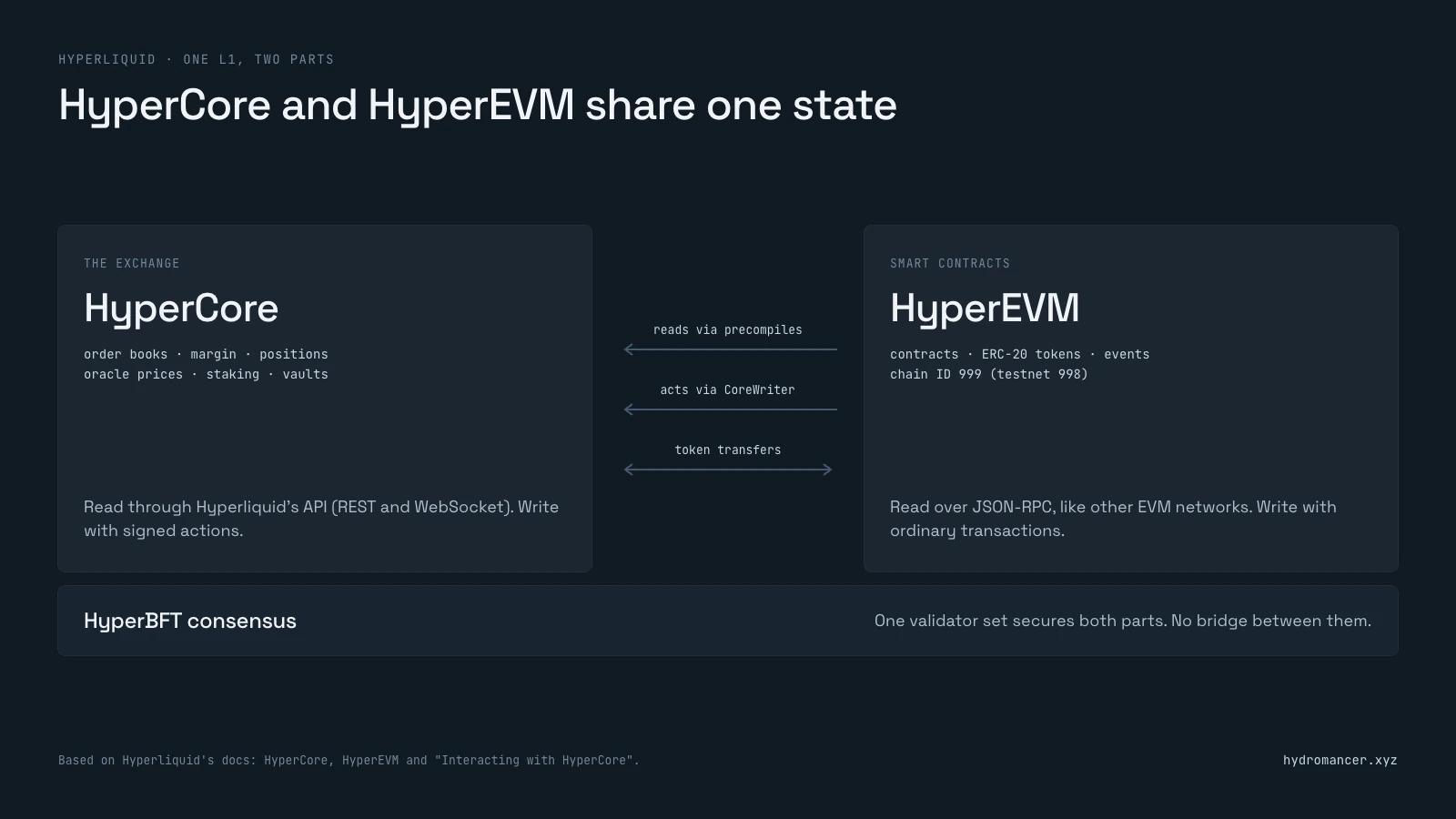
The onboarding docs put it simply: Hyperliquid is one state, with HyperCore state and HyperEVM state. Because it's one state, there's no bridge between the two parts.
One state, read from both sides
A HyperEVM contract can read HyperCore directly through built-in "precompile" contracts. You can try one from outside with an ordinary eth_call. This reads BTC's oracle price from both sides:
import requests

# HyperCore, through Hyperliquid's API
meta, ctxs = requests.post(
    "https://api.hyperliquid.xyz/info",
    json={"type": "metaAndAssetCtxs"},
).json()
print("BTC oracle price, HyperCore API:       ", ctxs[0]["oraclePx"])

# The same HyperCore value, read on HyperEVM
# through the oracle-price precompile
call = {
    "to": "0x0000000000000000000000000000000000000807",
    "data": "0x" + "00" * 32,  # perp index 0 = BTC
}
raw = requests.post(
    "https://rpc.hyperliquid.xyz/evm",
    json={
        "jsonrpc": "2.0",
        "id": 1,
        "method": "eth_call",
        "params": [call, "latest"],
    },
).json()["result"]

price = int(raw, 16) / 10 ** (6 - meta["universe"][0]["szDecimals"])
print("BTC oracle price, HyperEVM precompile: ", price)BTC oracle price, HyperCore API: 80608.9
BTC oracle price, HyperEVM precompile: 80608.9Same value, two routes. The precompile reflects HyperCore as of the latest HyperEVM block, so it can briefly trail the API.
How HyperCore and HyperEVM connect
| Direction | Mechanism | What to know |
|---|---|---|
| HyperEVM reads HyperCore | Read precompiles from 0x…0800 | Positions, balances, prices, block number |
| HyperEVM acts on HyperCore | The CoreWriter contract at 0x3333…3333 | Orders are delayed a few seconds on purpose |
| Tokens move between them | Each token's system address | HyperCore to HyperEVM waits for the next EVM block |
Details are in Hyperliquid's Interacting with HyperCore and transfers docs.
Which one does your app need?
- Trading data is HyperCore data. Fills, positions, liquidations, funding and the order book all live there. Read them from Hyperliquid's API, your own node or a data provider.
- Contract data is HyperEVM data. Balances, events and contract storage come over JSON-RPC.
- Many apps need both. A lending protocol that prices collateral from HyperCore order books reads two sources. They keep separate block numbers, so line them up by timestamp, not block number.
- Orders have two routes. A bot signs actions and sends them to the API. A contract uses CoreWriter. Both reach the same order book.
What to know about HyperEVM
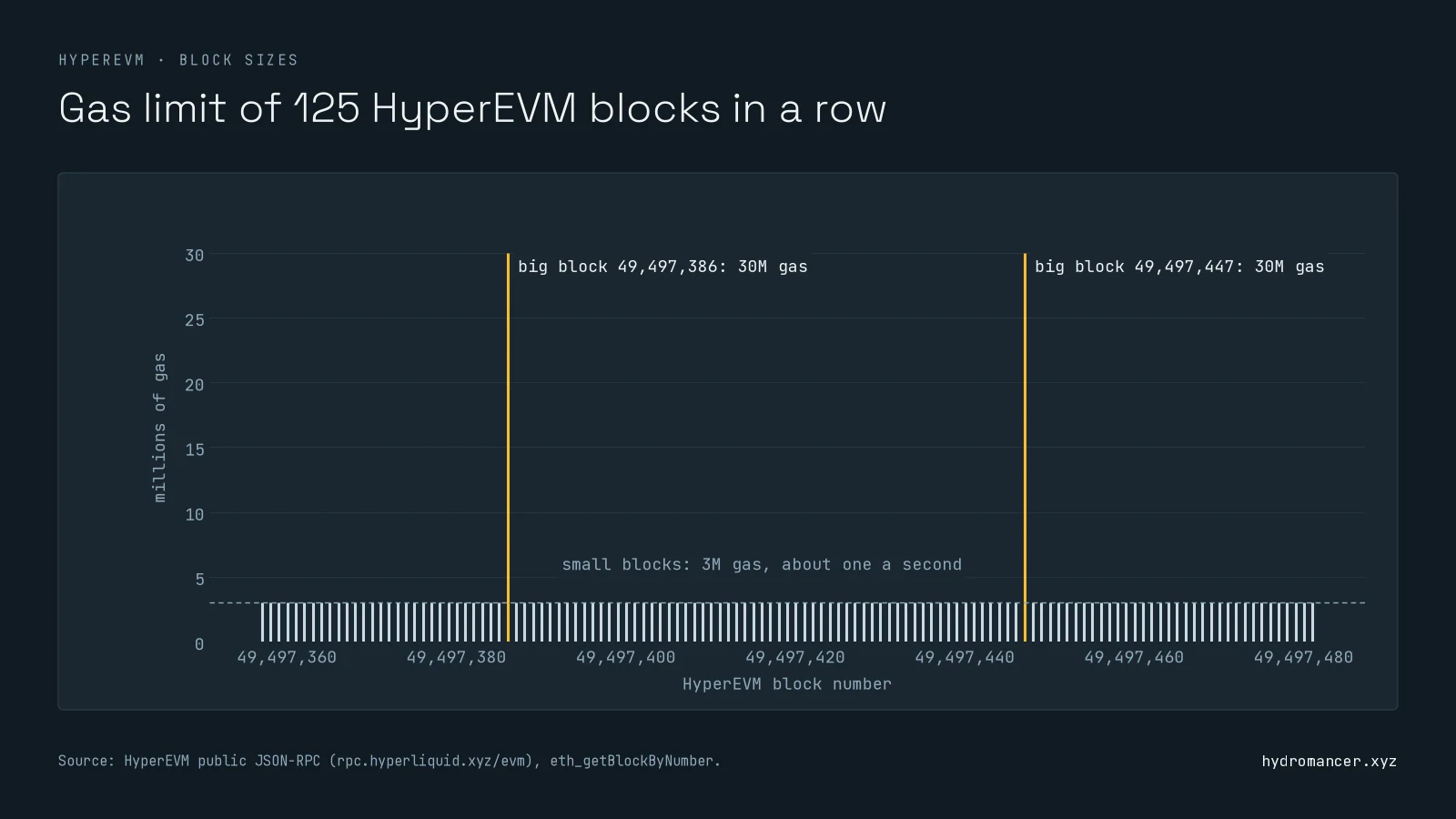
- Two block sizes. Small blocks come every second and big blocks every minute, in one numbering. Large deployments opt in to big blocks.
- The public RPC is rate-limited. It allows 100 requests a minute per IP and serves state for the latest block only.
- Endpoints and chain IDs for both networks are in our RPC vs data API guide.
HyperCore data for many wallets at once
Hydromancer serves HyperCore data: the exchange side. For HyperEVM contract data, you still use a JSON-RPC endpoint.
| What you need | Without Hydromancer (Hyperliquid's API only) | With Hydromancer's API |
|---|---|---|
| Positions for many wallets | clearinghouseState ,one wallet per request, from 1,200 weight a minute per IP | batchClearinghouseStates: up to 1,000 wallets in one request |
| Live fills for many wallets | One subscription per wallet; the docs allow 10 users per IP | One userFills subscriberequest for up to 1,000 addresses; each counts toward your plan's subscription total (500 on Starter) |
| HyperCore history | Recent data only (for example, a wallet's 10,000 most recent fills) | History from 28 July 2025, plus Reservoir , requester-pays S3 with no Hydromancer fee |
| HyperEVM contract data | JSON-RPC | The same: use a JSON-RPC endpoint |
Running your own node? The node software finds public peers on its own, and Hydromancer offers dedicated node peering. Our RPC vs data API guide explains which job needs which.
FAQ
What is an L1 crypto?
A layer-1 (L1) is a blockchain that secures itself, with its own validators and consensus. Ethereum, Solana and Hyperliquid are L1s.
Is ETH a layer 1 or layer 2?
Ethereum is a layer 1. Layer-2 networks such as Arbitrum settle on Ethereum and rely on it for security.
Is Hyperliquid an L2?
No. Hyperliquid's docs describe it as a layer-1 blockchain with its own consensus, HyperBFT, and its own validators.
Is HyperEVM an L1 or L2?
Neither on its own. HyperEVM is one of the two parts of the Hyperliquid L1, secured by the same consensus. It has an EVM chain ID (999) because EVM wallets and tools need one.
Is Hyperliquid built on Arbitrum?
No. Arbitrum hosts the legacy USDC bridge, which holds less than 10% of HyperCore's USDC. USDC is minted natively on Hyperliquid.
Can a HyperEVM smart contract trade on HyperCore?
Yes. It reads HyperCore through precompiles and sends orders through CoreWriter. Orders are delayed a few seconds, and the contract's address must already be a HyperCore account.
Next steps
- Try both sides: run the snippet above.
- Build on HyperCore: our Hyperliquid API guide.
- Pick your endpoints: Hyperliquid RPC vs data API.
- Need HyperCore data at scale? See Hydromancer's REST API.
Read next

Top 12 Builders on Hyperliquid by Revenue
Explore Hyperliquid’s top 12 builders by all-time revenue, comparing builder fees, routed trading volume, and the products behind the numbers.
Read ↗
Hyperliquid RPC vs Data API: Which One Do You Need?
Hyperliquid RPC endpoints and chain IDs, what an RPC covers and what it can't, and when you need the Hyperliquid API or a data API instead.
Read ↗
Top Prop Firms on Hyperliquid: Side-by-Side Comparison
A side-by-side comparison of PROPR, Hypernova, Iceberg and Ferm: account fees, trading tools and payout rules, with hands-on notes.
Read ↗