HLP Vault: Returns, Drawdowns and Tracking for Traders
What Hyperliquid's HLP vault does, how depositors earn and lose, the 4-day lock-up, and how to read its APR, PnL and drawdowns yourself.

Hyperliquid's HLP vault (Hyperliquidity Provider) is the exchange's protocol vault: a pool of USDC that trades on Hyperliquid for everyone who deposits. Depositors share its profit and loss in proportion to their stake.
On most exchanges, market-making and liquidation profits stay with the operator or privileged firms, whereas HLP opens them to any USDC depositor. The trade-off is passive strategy yield against sudden drawdown risk and a 4-day lock-up.
The short answer: HLP's headline APR is backward-looking, not the return you will get. Depositors share market making, backstop liquidations, Earn lending and trading fees with no vault fee or profit share, while taking real drawdown risk in volatile moves.
HLP's vault data showed an 18.53% APR and about $154 million in total value locked, the most of any open vault. Both numbers reflect one moment in time and move constantly.
For the exact timestamps, script outputs and Hyperliquid API cross-checks behind the APR, TVL, drawdown and child-vault numbers below, see Test and Validation.
The HLP vault at a glance
HLP is a protocol vault run by Hyperliquid's own strategies, unlike a user vault managed by an individual trader. Traders can check current stats on app.hyperliquid.xyz/vaults, and builders read the same public fields from the API.
| HLP | A user vault | |
|---|---|---|
| Who trades | The protocol's own strategies | The vault's leader |
| What it trades | Market making, backstop liquidations, USDC in Earn, a share of fees | Validator-operated perps its leader chooses |
| Fees and profit share | None | The leader takes 10% of profits |
| Lock-up | 4 days from your most recent deposit | 1 day |
| Where to read it | Its vault page, or vaultDetails | The same |
How the HLP vault works on Hyperliquid
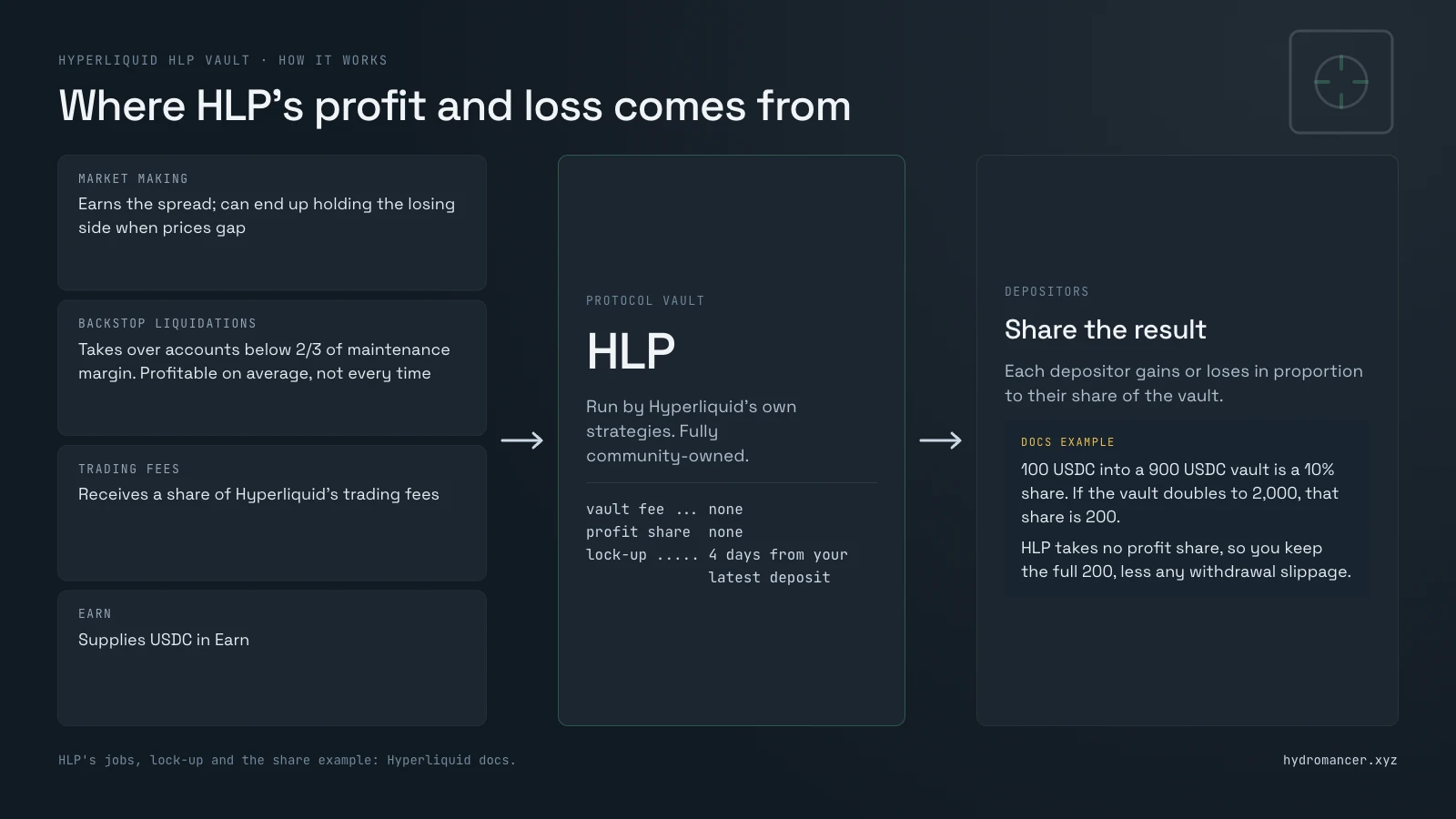
On Hyperliquid, a vault is a trading account funded by pooled USDC where depositors gain or lose in proportion to their share. Hyperliquid's docs describe HLP as fully community-owned, with protocol strategies running the capital and no leader cut.
Market making on Hyperliquid's order books
HLP quotes on Hyperliquid's order books through several protocol market-making strategies. It earns the spread when it buys and sells around a fair price and its inventory doesn't move against it.
When prices gap or one side of the market gets crowded, those strategies can end up holding the losing side. Depositors share the combined result of every strategy, so inventory losses land directly in everyone's PnL.
Backstop liquidations on Hyperliquid
Most liquidations on Hyperliquid go straight to the order book as market orders. If an account's equity falls below two-thirds of its maintenance margin before the book closes it, the liquidator vault can take the position over.
That takeover is a backstop liquidation, and Hyperliquid's docs list the liquidator vault as a component strategy of HLP. Because all backstop liquidation PnL goes to the community through HLP, every takeover lands directly in HLP's PnL.
Hyperliquid's docs note that backstop liquidations are profitable for the liquidator on average, not on every trade. A single large position taken over in a fast market can lose money; see our liquidation data guide for how liquidations flow through the system.
Trading fees and USDC lending in Earn
HLP also receives a share of Hyperliquid's trading fees. Hyperliquid's fee docs state that fees go entirely to the community (HLP, the assistance fund and deployers), without publishing the exact split between HLP and the assistance fund.
Separately, HLP supplies USDC in Earn. Hyperliquid's docs list Earn lending as one of HLP's four jobs without disclosing how much of the vault goes to it; our fees explainer covers the fee schedule itself.
How depositors share HLP's profit and loss
Depositing USDC into HLP gives you a proportional share of the vault that rises and falls with its equity. In Hyperliquid's user-vault example, adding 100 USDC to a 900 USDC vault gives you 10%.
If that vault doubles to 2,000, your stake reaches 200, and a user-vault leader takes 10% of your 100 profit, leaving 190. Because HLP charges no fees or profit share, you get the full 200, less any withdrawal slippage.
The 4-day HLP deposit lock-up
HLP locks withdrawals for 4 days from your most recent deposit, compared with 1 day for user vaults. Hyperliquid's docs give a concrete example: deposit on Sep 14 at 08:00, and you can withdraw on Sep 18 at 08:00.
Every new deposit restarts that 4-day clock. The timestamp that counts is always your latest deposit, not your first.
Withdrawal slippage when HLP closes positions
Hyperliquid's depositor docs warn that withdrawing from a vault can cost slippage if open positions have to close. When a vault lacks free margin to pay a withdrawal, it first cancels open orders that use margin.
If that still isn't enough, the vault closes 20% of its positions at a time until enough margin is freed, per the vault leader docs. Closing positions in a thin market can move prices, creating withdrawal slippage.
How to get HLP vault data from the Hyperliquid API
Every order, trade and liquidation on Hyperliquid happens on-chain, so HLP's positions, PnL history and largest depositors are public and free to query without an API key. If you only need HLP's numbers and your own stake, Hyperliquid's API is enough.
Traders can inspect the same numbers without code on app.hyperliquid.xyz/vaults. Builders pull them for earn pages and portfolio trackers showing which vaults a user holds, each deposit's value and its withdrawal date.
Reading HLP's APR and 30-day drawdown with vaultDetails
Hyperliquid's vaultDetails endpoint returns one vault's APR, settings, PnL history, account value history and largest depositors. Pass HLP's address below to read its APR and largest peak-to-trough PnL drop over the past 30 days:
# Expected output: HLP's name, APR and largest PnL fall in the last 30 days
import requests

HLP = "0xdfc24b077bc1425ad1dea75bcb6f8158e10df303"
r = requests.post("https://api.hyperliquid.xyz/info",
                  json={"type": "vaultDetails", "vaultAddress": HLP},
                  timeout=30)
r.raise_for_status()
v = r.json()

pnl = [float(p) for _, p in dict(v["portfolio"])["month"]["pnlHistory"]]
peak, worst = pnl[0], 0.0
for x in pnl:
    peak = max(peak, x)
    worst = max(worst, peak - x)

print(f"{v['name']} | APR {v['apr']:.2%} | 30-day max drawdown ${worst:,.0f}")Hyperliquidity Provider (HLP) | APR 18.53% | 30-day max drawdown $531,731That request returned an 18.53% APR and $531,731 30-day max drawdown on HLP's monthly PnL series. To inspect your own stake and lock-up, add "user": "<your address>" to the same request and read followerState, or call userVaultEquities for every vault an address holds.
Ranking HLP's TVL against every open vault
Because vaultDetails covers one vault per call, comparing HLP across the exchange uses the public vault-list file Hyperliquid's app loads, which holds each vault's name, address and TVL. Hyperliquid's docs don't describe this file, so it can change without notice:
# Expected output: HLP's name, TVL and rank among open vaults by TVL
import requests

HLP = "0xdfc24b077bc1425ad1dea75bcb6f8158e10df303"
# Undocumented file that Hyperliquid's app reads; it can change.
rows = requests.get("https://stats-data.hyperliquid.xyz/Mainnet/vaults",
                    timeout=30).json()
open_ = [r["summary"] for r in rows if not r["summary"]["isClosed"]
         and r["summary"]["relationship"]["type"] != "child"]
open_.sort(key=lambda s: float(s["tvl"]), reverse=True)

rank = [s["vaultAddress"] for s in open_].index(HLP) + 1
hlp = open_[rank - 1]
print(f"{hlp['name']} | TVL ${float(hlp['tvl']):,.0f} | rank {rank}"
f" of {len(open_)} open vaults")Hyperliquidity Provider (HLP) | TVL $153,955,933 | rank 1 of 3039 open vaultsExcluding closed and child vaults, the file placed HLP at rank 1 of 3,039 open vaults with $153,955,933 in TVL. For more request patterns covering deposits, withdrawals and child-vault positions, see the vaults API guide.
Reading every child vault's positions with batchClearinghouseStates
HLP's trading positions sit inside its child vaults rather than on the parent address itself. This script fetches HLP's child addresses from Hyperliquid's vaultDetails, then reads every child's open positions in one Hydromancer request using HYDROMANCER_API_KEY:
# Expected output: HLP's child vaults, open positions, long and short totals
import os
import requests

HLP = "0xdfc24b077bc1425ad1dea75bcb6f8158e10df303"
KEY = os.environ["HYDROMANCER_API_KEY"]

v = requests.post("https://api.hyperliquid.xyz/info", timeout=30,
                  json={"type": "vaultDetails", "vaultAddress": HLP})
v.raise_for_status()
kids = v.json()["relationship"]["data"]["childAddresses"]

r = requests.post("https://api.hydromancer.xyz/info", timeout=30,
                  headers={"Authorization": f"Bearer {KEY}"},
                  json={"type": "batchClearinghouseStates", "users": kids})
r.raise_for_status()
ok = r.json()["successful_states"]
pos = [p["position"] for _, s in ok for p in s["assetPositions"]]

long_ = sum(float(p["positionValue"]) for p in pos if float(p["szi"]) > 0)
short = sum(float(p["positionValue"]) for p in pos if float(p["szi"]) < 0)
print(f"{len(ok)} of {len(kids)} child vaults | {len(pos)} positions"
f" | long ${long_:,.0f} | short ${short:,.0f}")7 of 7 child vaults | 354 positions | long $2,955,892 | short $2,913,396That single batch call returned all 7 child vaults and 354 open perp positions, totaling $2,955,892 long and $2,913,396 short, matching seven separate public clearinghouseState calls within $30 per side as prices moved.
The first count shows how many child vaults succeeded, so a failed address appears below the total. The long and short totals sum the dollar value of the children's open perp positions on each side.
By default the request covers Hyperliquid's native perp DEX. Pass "dex": "ALL_DEXES" to include every HIP-3 DEX for up to 100 addresses; each address's state then returns keyed by DEX name, so the parsing above has to change.
Hyperliquid API vs Hydromancer API, side by side
Hyperliquid's free API covers HLP's APR, PnL history and TVL rank without a key. The difference shows up when reading positions: HLP trades through its child vaults, and Hydromancer batches many addresses into one request.
| Hyperliquid API | Hydromancer API | |
|---|---|---|
| Request | clearinghouseState | batchClearinghouseStates |
| What comes back | One address's positions and margin | Positions and margin for many addresses |
| What you need first | Each child's address, from vaultDetails | The same list of addresses |
| Covered by one request | One address | Up to 1,000 addresses (100 across every DEX) |
| Limit | Weight 2, of 1,200 per minute per IP | Weight 2 per address, at most 100 points, from a 5,000 to 50,000 per-minute budget |
| Key | None | API key on a paid plan |
| Reply | JSON | JSON |
| Fits | HLP's own children, in a few requests | Many vaults or depositors at once |
Where Hydromancer fits
You don't need Hydromancer to follow HLP, and we'd rather say so: Hyperliquid's free vaultDetails covers one vault in depth. One public clearinghouseState request per child also covers HLP's own positions.
Hydromancer helps when you track positions across many vaults or depositors. Live REST and WebSocket data needs an API key on a paid plan, from $300 a month per the docs; see the REST API page and pricing.
What to know before you read HLP's APR, PnL and drawdowns
HLP's vault page and Hyperliquid's API expose the same core numbers, yet each metric answers a different question. Knowing the edge cases keeps you from misreading deposits as trading profit or missing fast drawdowns.
HLP's APR is a trailing figure, not a forecast
The apr field in Hyperliquid's vaultDetails response is a fraction, so 0.0369 means 3.69%. Hyperliquid's docs don't publish how it's calculated or over which window.
Treat APR as a recent annualized result rather than an expected return. Hyperliquid's depositor docs are explicit that past performance doesn't guarantee future returns.
Judge HLP by its PnL, not its account value
Hyperliquid's vaultDetails returns two series for every time window: accountValueHistory and pnlHistory. Account value moves every time depositors add or withdraw USDC.
Per Hyperliquid's portfolio graphs docs, pnlHistory adjusts for deposits and withdrawals. Read pnlHistory to judge strategy performance, because a big jump in account value can come from new deposits rather than trading gains.
Measure HLP's worst drawdown, not just its average
A drawdown measures the drop from a peak to a later low on HLP's pnlHistory series. Scan for the highest cumulative PnL reached so far, then track the deepest dip that follows it.
That dollar figure shows how much the vault lost across that stretch. Converting it to a percentage by dividing by peak account value is only an approximation, because deposits and withdrawals change the vault's base.
HLP's history is sampled, so short drawdowns can hide
Hyperliquid's portfolio graphs sample every 15 minutes and on deposits or withdrawals, and the docs say they aren't meant for precise accounting. Longer API windows are thinner still.
HLP's 30-day window held 47 points, about 9.5 hours apart at the median, and its all-time window held roughly one point every two weeks. Because short falls can hide between samples, store vaultDetails on a schedule for denser history.
HLP's followers list doesn't include every depositor
The followers array in vaultDetails returns HLP's largest depositors, each with vaultEquity, pnl and lockupUntil. HLP's response listed 100 followers, and Hyperliquid's docs state no maximum, so don't treat it as every depositor.
HLP's live positions sit in its child vaults
The relationship field in vaultDetails marks HLP as a parent vault with child addresses, and HLP's response listed seven. Because active positions sit inside those children, querying HLP's parent address alone shows little of its trading.
To inspect HLP's open positions, read each child address using the clearinghouseState or batchClearinghouseStates pattern in the side-by-side table above.
Next steps
• Run the first script to read HLP's APR and its largest recent PnL fall yourself.
• Add your own address as user to the same request to see your stake and when you can withdraw.
• See more vault requests, from deposits to child-vault positions, in our vaults API guide.
• Read how liquidations reach HLP in our liquidation data guide.
Test and Validation
Public API scriptsThe first two scripts ran as printed on 19 November 2026, at about 07:10 UTC, using no key, only Hyperliquid's public API and public vault list file.
The first script called vaultDetails for HLP's address and printed Hyperliquidity Provider (HLP) | APR 18.53% | 30-day max drawdown $531,731.
The second filtered the vault list to open non-child vaults sorted by TVL and printed Hyperliquidity Provider (HLP) | TVL $153,955,933 | rank 1 of 3039 open vaults.
The third script ran as printed the same day at about 08:08 UTC, reading a Hydromancer API key from HYDROMANCER_API_KEY. It printed 7 of 7 child vaults | 354 positions | long $2,955,892 | short $2,913,396.
We checked that result seconds later with one public clearinghouseState request per child on Hyperliquid's API. That returned the same 354 positions, with $2,955,868 long and $2,913,423 short, a gap of under $30 per side as prices moved.
A separate public vaultDetails read the same day returned 100 followers and seven child addresses, matching the counts in our vaults API guide. Its 30-day window held 47 points over 30.1 days, about 9.5 hours apart at the median.
The all-time window's spacing, roughly one point every two weeks, comes from the October 2026 run in that guide.
FAQ
What does HLP stand for on Hyperliquid?
HLP stands for Hyperliquidity Provider. It is Hyperliquid's protocol vault, running market-making strategies, performing backstop liquidations, supplying USDC in Earn and accruing a share of trading fees.
How long is the HLP lock-up?
The HLP lock-up is 4 days from your most recent deposit. Every new deposit resets that clock, so topping up extends the time before you can withdraw.
Can you lose money in HLP?
Yes: HLP's PnL comes from market making and backstop liquidations, and both can lose money in volatile markets. Hyperliquid's docs note that trading is inherently risky and past vault performance doesn't guarantee future returns.
What is HLP's APR right now?
It moves constantly, so any printed figure goes stale right away. Check the vaults page on app.hyperliquid.xyz for the current rate, or read the apr field from Hyperliquid's vaultDetails endpoint as a fraction.
Does HLP charge fees?
Hyperliquid's docs state that protocol vaults charge no fees or profit share. User vaults work differently, with vault leaders taking 10% of profits.
Where can I see HLP's drawdown?
The vault page on app.hyperliquid.xyz shows HLP's PnL and max drawdown. For your own calculation, read pnlHistory from Hyperliquid's vaultDetails request and measure peak-to-trough drops, keeping in mind that the series is sampled.
Sources
1. Hyperliquid docs: protocol vaults
2. Hyperliquid docs: HyperCore vaults (legacy)
3. Hyperliquid docs: for vault depositors
4. Hyperliquid docs: for vault leaders
5. Hyperliquid docs: liquidations
6. Hyperliquid docs: fees
7. Hyperliquid docs: portfolio graphs
8. Hyperliquid docs: info endpoint
9. Hyperliquid docs: rate limits and user limits
10. Hyperliquid docs: about Hyperliquid
11. Hydromancer docs: batchClearinghouseStates
12. Hydromancer docs: rate limits and user limits
13. Hydromancer docs: get API keys
14. Hydromancer docs: Reservoir snapshots
15. Hydromancer docs: vaults and borrow/lend builder guide
Read next

Hyperliquid Staking: Guide for HYPE Stakers & Builders
How HYPE staking works on Hyperliquid: validators, commission, the 1-day lockup and 7-day unstaking queue, how APR is set, and how to read staking data.

HIP-3 on Hyperliquid: How It Works and How to Get the Data
HIP-3 lets teams deploy their own perp DEXs on Hyperliquid. How staking, oracles, fees and OI caps work, and how to list every DEX and market by API.

Hyperliquid Oil and Gold Perps: Guide for Traders & Builders
How Hyperliquid oil and gold perps work: which HIP-3 DEXs list them, how oracles track futures and spot, rolls, funding, and where to get the data.