HIP-3 on Hyperliquid: How It Works and How to Get the Data
HIP-3 lets teams deploy their own perp DEXs on Hyperliquid. How staking, oracles, fees and OI caps work, and how to list every DEX and market by API.

HIP-3 on Hyperliquid lets any team stake 500,000 HYPE and deploy its own perpetual futures DEX on HyperCore. Query Hyperliquid's default meta endpoint and you only get crypto perps, not NVIDIA (xyz:NVDA), the S&P 500 (xyz:SP500) or gold (xyz:GOLD).
Those stocks, indexes and commodities live on separate HIP-3 DEXs you ask for by name. Traders use them for non-crypto markets, deployers run them for a fee share, and builders read them through Hyperliquid's info endpoint.
Before HIP-3, Hyperliquid listed new perps itself; now any deployer with the stake sets its own price feed, leverage and fees. Hyperliquid's docs call this "a key milestone toward fully decentralizing the perp listing process."
Because HIP-3 runs on HyperCore, one wallet and one API client reach both the main DEX and every HIP-3 venue. Every deployer action, from oracle updates to fee changes and halts, is an on-chain transaction anyone can analyze.
For the live DEX counts, cap checks and Reservoir query outputs behind every code block below, see Test and Validation.
HIP-3 on Hyperliquid at a glance
These are the main rules Hyperliquid's docs set for a HIP-3 DEX on mainnet:
| Rule | Value |
|---|---|
| Stake to deploy a DEX | 500,000 HYPE, expected to fall over time |
| How long the stake stays | At least 183 days after the DEX is deployed |
| DEXs per deployer | 1 |
| Markets listed without an auction | The first 3 on each DEX |
| DEX name | 2 to 4 lowercase characters |
| Oracle updates | Expected every 3 seconds |
| Deployer fee share | 0 to 300% of the normal fee |
| Fee changes | 1 every 30 days |
| Maximum leverage | 50x |
| Slashing | Up to 100% of the stake, by validator vote |
Hyperliquid's perpCategories endpoint tags HIP-3 markets with categories like stocks, indices or commodities. For which deployers are active and how they compare, read Top HIP-3 Market Deployers by the Numbers.
How HIP-3 works on Hyperliquid
A HIP-3 perp DEX is an independent venue running on HyperCore, Hyperliquid's trading engine. It trades with the same exchange actions as any main-DEX perp, using that market's asset ID, while keeping four things separate.
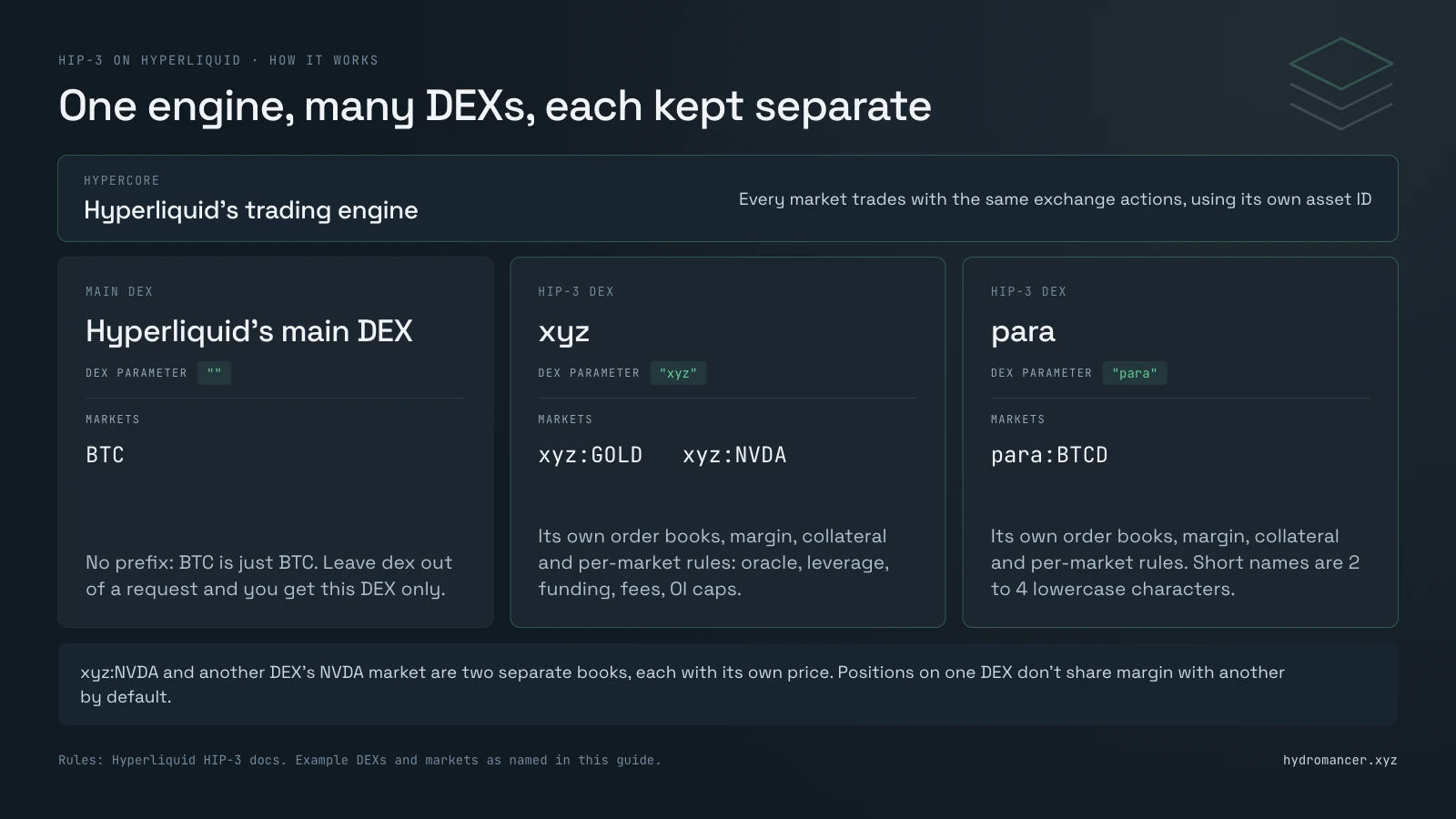
Separate order books per DEX
A HIP-3 market never shares an order book with a market on another DEX. xyz:NVDA and another DEX's NVDA market are two separate books, each with its own price.
Independent margin across DEXs
Hyperliquid's docs call HIP-3's margin setup independent margining. Positions on one DEX don't share margin with positions on another by default.
Custom quote collateral per DEX
Any quote asset that meets Hyperliquid's requirements can back a HIP-3 DEX, so margin on a HIP-3 market isn't always USDC. Reservoir's DEX pages show USDC, USDH, USDT0 and USDe in use.
Per-DEX and per-market rules
Each HIP-3 DEX sets its own oracle, leverage, funding, fees and open interest caps per market. Hyperliquid's perpDexs request returns several of those settings for every DEX, including per-asset open interest caps and funding multipliers.
Prefixed market names and the dex parameter
Each HIP-3 DEX has a short name of 2 to 4 lowercase characters, and its markets use dex:SYMBOL names like xyz:GOLD or para:BTCD. The main DEX has no prefix, which is why BTC is just BTC.
In Hyperliquid's API, the main DEX is the empty string "" and a HIP-3 DEX is its short name. Leave dex out of a request and you get the main DEX only.
What a HIP-3 deployer is responsible for
Hyperliquid's docs split a HIP-3 deployer's job in two: defining markets (the oracle and contract specs) and operating them (setting prices, leverage limits and settling if needed).
Staking 500,000 HYPE for at least 183 days
To deploy a HIP-3 DEX on mainnet, a team must stake 500,000 HYPE and keep it staked for at least 183 days after deployment. Each deployer can run one perp DEX, and Hyperliquid's docs expect the stake requirement to fall over time.
Sending oracle prices every 3 seconds
Every HIP-3 market needs a price feed run by its deployer or a named oracle updater. They submit prices with the setOracle action and are expected to send an update every 3 seconds.
If no update arrives for 10 seconds, Hyperliquid falls back to a price from the DEX's own order book. Hyperliquid's docs say deployers shouldn't rely on that fallback.
Listing 3 markets free, then bidding in auctions
A new HIP-3 DEX can list its first 3 markets without an auction. Every market after that goes through a Dutch auction shared across all HIP-3 DEXs.
Setting a deployer fee share up to 300%
On top of Hyperliquid's normal trading fee, a deployer can charge its own per-market share from 0 to 300% of the normal fee. Above 100%, the protocol's fee rises to match the deployer's.
In growth mode, the protocol fee drops to a tenth, and the deployer's share tops out just under 100% of the normal fee. A deployer can change its fees once every 30 days on mainnet.
For a trader, that means a HIP-3 market can cost several times the main DEX's fee to trade.
Capping open interest per DEX and per market
Open interest (OI) is the total size of all open positions, and every HIP-3 market enforces caps on it. Notional caps, counting size times mark price, apply to the whole DEX and to each market.
Size caps apply per market, and perpDexLimits returns the current one in its oiSzCapPerPerp field. When a market hits its cap, new exposure is blocked.
Halting and settling a market
A deployer can close a HIP-3 market with the haltTrading action, which cancels all orders and settles every position at the current mark price. The same action restarts trading, letting a deployer reuse a market for dated contracts without a new auction.
Validator slashing when inputs harm the protocol
Validators can slash a HIP-3 deployer's stake by a stake-weighted vote. Hyperliquid's docs give rough ceilings: up to 100% for inputs causing invalid state or long downtime, up to 50% for brief downtime and up to 20% for performance problems.
Stake in the 7-day unstaking queue can still be slashed, and slashed stake is burned rather than paid to traders. Slashing judges protocol impact rather than intent, so faithfully following a poorly designed contract spec can still be slashed.
What the protocol leaves alone is behavior that stays valid by its rules but looks wrong by human judgment. That risk falls to apps, users and the deployer's reputation.
Deploying a HIP-3 DEX through signed actions
Launching a HIP-3 DEX takes a sequence of signed actions: register the DEX and first asset, insert margin tables, start sending oracle prices, then set fees and caps. For the full walkthrough, see Deploy a HIP-3 Market on Hyperliquid: Guide for Builders.
How to get HIP-3 data on Hyperliquid
Start with Hyperliquid's free info API to see every live HIP-3 DEX and market with no key. When you need full history, oracle feeds or liquidity data, Reservoir and Hydromancer's API pick up where the free endpoint stops.
List every DEX and market with Hyperliquid's free API
You can map every live HIP-3 DEX and market with free POST requests to Hyperliquid's info endpoint, https://api.hyperliquid.xyz/info:
| Request | What it returns | Needs dex? |
|---|---|---|
perpDexs | Every perp DEX: name, full name, deployer, oracle updater, fee recipient, per-asset OI caps and funding multipliers. Index 0 is null (the main DEX). | No |
meta | One DEX's markets and margin tables | Optional (default main DEX) |
metaAndAssetCtxs | One DEX's markets plus mark, oracle, funding and OI | Optional |
allPerpMetas | Markets and margin tables for every DEX at once | No |
perpDexStatus | A DEX's totalNetDeposit | Yes |
perpDexLimits | totalOiCap, oiSzCapPerPerp,maxTransferNtl, coinToOiCap | Yes (an empty string returns null) |
perpsAtOpenInterestCap | Markets currently at their cap | Optional |
perpCategories | [coin, category] pairs, suchas stocks or commodities | No |
This script lists every HIP-3 DEX, its live market count, its total open interest cap and its net deposits:
# Expected output: one line per HIP-3 DEX, e.g. "xyz XYZ markets=122 ..."
import requests

def info(body, url="https://api.hyperliquid.xyz/info"):
    r = requests.post(url, json=body, timeout=10)
    r.raise_for_status()
    return r.json()

for dex in info({"type": "perpDexs"})[1:]:  # index 0 is the main DEX (null)
    meta = info({"type": "meta", "dex": dex["name"]})
    live = [a for a in meta["universe"] if not a.get("isDelisted")]
    limits = info({"type": "perpDexLimits", "dex": dex["name"]}) or {}
    status = info({"type": "perpDexStatus", "dex": dex["name"]})
    print(dex["name"], dex["fullName"], f"markets={len(live)}",
          f"totalOiCap={limits.get('totalOiCap')}",
          f"netDeposit={status.get('totalNetDeposit')}")
perpDexs includes closed DEXs whose markets stay in meta marked isDelisted, which is why the script filters that flag out. allPerpMetas returns the same markets as looping meta over every DEX in one call.
That script returned 10 HIP-3 DEXs: 123 live markets on xyz, 33 on para, 17 on io and 1 on mkts. Six wound-down DEXs (flx, vntl, hyna, km, cash and abcd) had every market marked isDelisted.
Query the same HIP-3 endpoints through Hydromancer
Hydromancer answers all eight request types above at https://api.hydromancer.xyz/info, with an API key sent as a Bearer token. It also serves what Hyperliquid's API doesn't: every oracle submission as a stream, oracle and mark price history, and liquidity history.
This request reads the caps of the xyz DEX using your key in the HYDROMANCER_API_KEY environment variable:
# Expected output: xyz caps (totalOiCap, oiSzCapPerPerp, ..., coinToOiCap)
import os
import requests

resp = requests.post(
    "https://api.hydromancer.xyz/info",
    json={"type": "perpDexLimits", "dex": "xyz"},
    headers={"Authorization": f"Bearer {os.environ['HYDROMANCER_API_KEY']}"},
    timeout=10,
)
resp.raise_for_status()
print(resp.json())
Hydromancer's docs note allPerpMetas costs 10 rate-limit points against 2 for meta, so loop meta if you only need a few DEXs.
Pull past trades, candles and order books from Reservoir
Hyperliquid's API mostly serves the present. For history, Hydromancer's Reservoir is a free archive on AWS S3 with one folder per DEX at s3://hydromancer-reservoir/by_dex/{dex}/.
Each folder holds every fill (with liquidations, ADL, builder and TWAP fills split out), 1-second candles, daily position snapshots and 20-level order books every minute.
For each HIP-3 DEX in Reservoir, fills and candles start on its launch day, and order books go back to 15 December 2025 at the earliest. When a DEX closes, its folder stays, so the history of wound-down venues remains readable.
The DuckDB SQL below totals one day of trading on km, market by market. Run it in the DuckDB CLI or with Python's print(duckdb.sql(query)) (pip install duckdb), with AWS credentials set up per How to Query Reservoir's Hyperliquid Data:
-- Expected output: one row per km market on 2026-03-22, largest first
INSTALL httpfs;
LOAD httpfs;
CREATE OR REPLACE SECRET (TYPE s3, PROVIDER credential_chain,
    REGION 'ap-northeast-1');
SET s3_requester_pays = true;

SELECT base_symbol, sum(price * size) AS volume_usd, count(*) AS trades
FROM read_parquet('s3://hydromancer-reservoir/by_dex/km/fills/perp/all/'
                  || 'date=2026-03-22/fills.parquet')
WHERE crossed  -- each trade has two rows, one per side: keep the taker
GROUP BY base_symbol
ORDER BY volume_usd DESC;
For 22 March 2026, that query returned 19 km markets, led by US500 at about $4.19 million (6,158 trades) and USOIL at about $3.68 million (4,473 trades).
Reservoir keeps one row for each side of a trade, so crossed keeps only the taker row and counts each trade once. Swap km for any other HIP-3 folder in Reservoir, such as xyz or para.
Reservoir is requester-pays: no Hydromancer key, only AWS transfer charges to your account. The Hyperliquid historical data page covers the datasets, and the Trade[XYZ] page shows one DEX in detail.
Get oracle, mark, funding and open interest history
Reservoir doesn't store oracle prices, funding or open interest. Hyperliquid's fundingHistory request returns past funding rates for HIP-3 markets too, and Hydromancer's openInterestHistory returns past open interest per market or per DEX (or you can record metaAndAssetCtxs yourself).
For oracle and mark prices, Hydromancer's perpPriceHistoryByTime returns the prices the network accepted about every 3 seconds. Its oraclePriceHistoryByTime returns the deployer's raw submissions instead.
Hyperliquid API vs Hydromancer, side by side
If you only need which DEXs and markets exist right now, Hyperliquid's free API is enough, and you don't need Hydromancer for it. Both serve the same eight live requests; Hydromancer adds higher limits, oracle and liquidity data, and Reservoir's archive.
| Hyperliquid API (free) | Hydromancer | |
|---|---|---|
| Live DEXs, markets, caps, deposits | perpDexs, meta,allPerpMetas, perpDexLimits,perpDexStatus and the restof the table above | The same eight request types and fields |
| What you need first | Nothing to list every DEX; a DEX name for one DEX's details | The same, plus an API key |
| One request covers | Every DEX (perpDexs,allPerpMetas) or one DEX | Every DEX or one DEX |
| Documented limit | 1,200 weight a minute per IP; each of these requests weighs 20 | 5,000 to 50,000 points a minute by plan; metaweighs 2, allPerpMetas 10 |
| Key and pricing | None (free) | API key, paid plans from $300 a month; Reservoir is free (AWS requester-pays) |
| Reply | JSON | JSON (API); Parquet on S3 (Reservoir) |
| Past trades, candles, books per DEX | Only the 5,000 most recent candles, and fills one wallet at a time | Reservoir, free (AWS requester-pays) |
| Every oracle submission, including failed ones | Not served | setOracleUpdates stream |
| Accepted oracle and mark history | Not served | perpPriceHistoryByTime |
| Liquidity and slippage per market | Build from the book | marketLiquidity,slippageHistory |
| Fits | A one-off map of DEXs, markets and caps | Tools that poll DEX data all day, or apps needing history, oracle feeds and liquidity |
Hydromancer's REST and WebSocket data needs an API key on a paid plan starting at $300 a month (see pricing). If you run or support a DEX, the HIP-3 market monitoring guide covers alerts on oracle updates and caps.
What to know before you trade a HIP-3 market
A HIP-3 market trades like any Hyperliquid perp, but its deployer sets the rules around it. Several of those rules differ from the main DEX's.
Mark prices move at most 1% per update
Hyperliquid uses the mark price for margining and liquidation, and on a HIP-3 market the deployer's updates feed into it. Each update can move it by at most 1%, and every price is clamped to 10 times its start-of-day value.
So a HIP-3 mark price can't jump in one step, even when the market it tracks gaps.
Leverage tops out at 50x in tiered margin tables
Each HIP-3 market has a margin table set by its deployer, with up to 3 tiers. Each tier sets maximum leverage for positions above a size, and no tier allows more than 50x.
Hyperliquid's meta request returns a DEX's margin tables, so you can check the tiers before sizing a position.
Cross margin is irreversible once enabled
A deployer can enable cross margin on a HIP-3 market, and Hyperliquid's docs call that choice irreversible. Validators only allow it on markets with enough observable liquidity, a reliable external oracle and resilience to price manipulation.
Hyperliquid's docs warn that using cross margin across DEXs with different deployers carries more risk for you. If such a market's external price moves more than 50% from its start-of-day price, validators review whether to slash the deployer.
Backstop liquidators run per DEX
Each HIP-3 DEX has its own backstop liquidator, a fully on-chain strategy that takes over positions due for backstop liquidation. It only accepts markets with cross margin enabled.
Hyperliquid's docs say that makes auto-deleveraging (ADL) significantly rarer on those markets in volatile periods. ADL closes opposing positions to cover a loss and stays as the last resort.
Funding rates can be scaled up to 10x
Funding is the regular payment between longs and shorts that keeps a perp near its oracle price. On a HIP-3 market, the deployer can scale it with a multiplier from 0 to 10 and set its interest rate and clamp.
perpDexs returns each market's funding multiplier, so you can check it before holding a position.
Next steps
• Compare the active deployers in Top HIP-3 Market Deployers by the Numbers.
• Set up alerts on oracle updates and caps with the HIP-3 market monitoring guide.
• Browse every Reservoir dataset on the Hyperliquid historical data page.
• Run the first code block to see every HIP-3 DEX as it stands now.
Test and Validation
Code blocksAll three code blocks ran as printed on 19 November 2026.
Native DEX listingThe first script listed 10 HIP-3 DEXs, with 123 live markets on xyz, 33 on para, 17 on io and 1 on mkts.
Six DEXs showed no live markets: flx, vntl, hyna, km, cash and abcd. Hyperliquid's meta reply marked every market on them isDelisted.
The Hydromancer request returned the caps of xyz: a totalOiCap of 10,000,000,000, an oiSzCapPerPerp of 20,000,000,000 and a maxTransferNtl of 3,000,000,000. These matched the public perpDexLimits reply from Hyperliquid's API.
\1 fills queryThe Reservoir query read the km fills for 22 March 2026 and returned 19 markets. US500 led with about $4.19 million in 6,158 trades, then USOIL with about $3.68 million in 4,473.
Of the day's 45,766 fill rows, 22,883 were taker rows, one for each of the 22,883 distinct trade IDs, so each trade was counted once.
FAQ
What does HIP-3 stand for?
HIP-3 is Hyperliquid Improvement Proposal 3, "builder-deployed perpetuals." It lets a team that meets the staking requirement deploy its own perp DEX on Hyperliquid's engine.
How much HYPE do you need to deploy on HIP-3?
Hyperliquid's docs set the mainnet requirement at 500,000 HYPE, held for at least 183 days after deployment. The docs expect the amount to decrease as the infrastructure matures, so check the current figure.
Who sets prices on a HIP-3 market?
The deployer or its named oracle updater submits oracle and mark inputs with setOracle, about every 3 seconds. The network combines the mark inputs with the order book's own mark and clamps sudden moves.
How do I get a list of all HIP-3 DEXs?
Send {"type": "perpDexs"} to Hyperliquid's info endpoint. It returns every perp DEX with its deployer, fee recipient and caps; then call meta with each dex name for its markets.
Is HIP-3 historical data free?
Yes, through Reservoir on AWS S3 with requester-pays transfer costs. It holds fills, candles, daily position snapshots and minute-level order books for each HIP-3 DEX it covers.
Hyperliquid's API doesn't serve oracle and mark price history. For those, use Hydromancer's paid API.
Can I trade HIP-3 markets with my Hyperliquid wallet?
Yes. HIP-3 markets use the same exchange actions as any Hyperliquid perp, so the same wallet trades them; only the asset ID changes.
Sources
1. Hyperliquid docs: HIP-3, builder-deployed perpetuals
2. Hyperliquid docs: HIP-3 deployer actions
3. Hyperliquid docs: info endpoint, perpetuals
4. Hyperliquid docs: info endpoint
5. Hyperliquid docs: rate limits and user limits
6. Hydromancer docs: allPerpMetas
7. Hydromancer docs: perpDexLimits
8. Hydromancer docs: rate limits and user limits
9. Hydromancer docs: setOracleUpdates
10. Hydromancer docs: perpPriceHistoryByTime
11. Hydromancer docs: marketLiquidity
12. Hydromancer docs: slippageHistory
13. Hydromancer docs: openInterestHistory
14. Hydromancer docs: HIP-3 market monitoring
15. Hydromancer docs: Reservoir
16. Hydromancer docs: Reservoir order books
17. Hydromancer: Hyperliquid historical data
18. Hydromancer: How to Query Reservoir's Hyperliquid Data
19. Hydromancer docs: Get API keys
Read next

Hyperliquid Staking: Guide for HYPE Stakers & Builders
How HYPE staking works on Hyperliquid: validators, commission, the 1-day lockup and 7-day unstaking queue, how APR is set, and how to read staking data.

HLP Vault: Returns, Drawdowns and Tracking for Traders
What Hyperliquid's HLP vault does, how depositors earn and lose, the 4-day lock-up, and how to read its APR, PnL and drawdowns yourself.

Hyperliquid Oil and Gold Perps: Guide for Traders & Builders
How Hyperliquid oil and gold perps work: which HIP-3 DEXs list them, how oracles track futures and spot, rolls, funding, and where to get the data.