Deploy a HIP-3 Market on Hyperliquid: Guide for Builders
Step-by-step HIP-3 deployment on Hyperliquid: the 500k HYPE stake, the Dutch auction, registerAsset2, setOracle, margin tables, OI caps and fees.

To deploy a HIP-3 market on Hyperliquid, your team stakes 500,000 HYPE, runs a 3-second oracle loop and accepts validator slashing risk. Each HIP-3 market is a builder-deployed perpetual running on HyperCore's order books and margining with no listing approval.
Teams use HIP-3 to list stocks, indexes, commodities, pre-IPO companies and custom-collateral crypto perps that Hyperliquid doesn't list itself. You set leverage, funding and open interest caps, and earn a 0 to 300% deployer fee share on Hyperliquid's trading fee.
This builder guide walks through the full sequence: staking requirements, auction checks, registerAsset2, margin tables, setOracle, fees, open interest caps and live monitoring. Hyperliquid's HIP-3 page expects the stake requirement to fall over time, so confirm current parameters before you sign.
For the live auction and testnet limit responses behind the code below, plus how the registerAsset2 payload and docs limits were checked, see Test and Validation.
HIP-3 market deployment specs at a glance
Your markets inherit HyperCore's order books and margining, so you build no matching engine. Traders reach them through Hyperliquid's standard trading API using Hyperliquid's asset ID scheme, and each DEX starts from the parameters below.
| What it takes | Value |
|---|---|
| Stake | 500,000 HYPE on mainnet |
| How long the stake stays | At least 183 days after the DEX is deployed |
| Perp DEXs per deployer | 1 |
| Assets that skip the auction | The first 3 on each DEX |
| Auction for later assets | Dutch auction, 31 hours, shared by all HIP-3 DEXs |
| Oracle updates | Every 3 seconds, at least 2.5 seconds apart |
| Max leverage | 1x to 50x, up to 3 tiers per margin table |
| Deployer fee share | 0 to 300% (0 to 100% in growth mode) |
| Fee changes on mainnet | Once per 30 days |
Every value in the table comes from Hyperliquid's HIP-3 page, its HIP-3 deployer actions page and its HIP-1 page, which sets the 31-hour auction. Hyperliquid changes these parameters, so re-read them before you deploy.
How to deploy a HIP-3 market on Hyperliquid, step by step
Deploying comes down to sending a sequence of signed L1 actions in strict order and within documented limits. Test the full flow on testnet first, because mainnet mistakes can slash your stake.
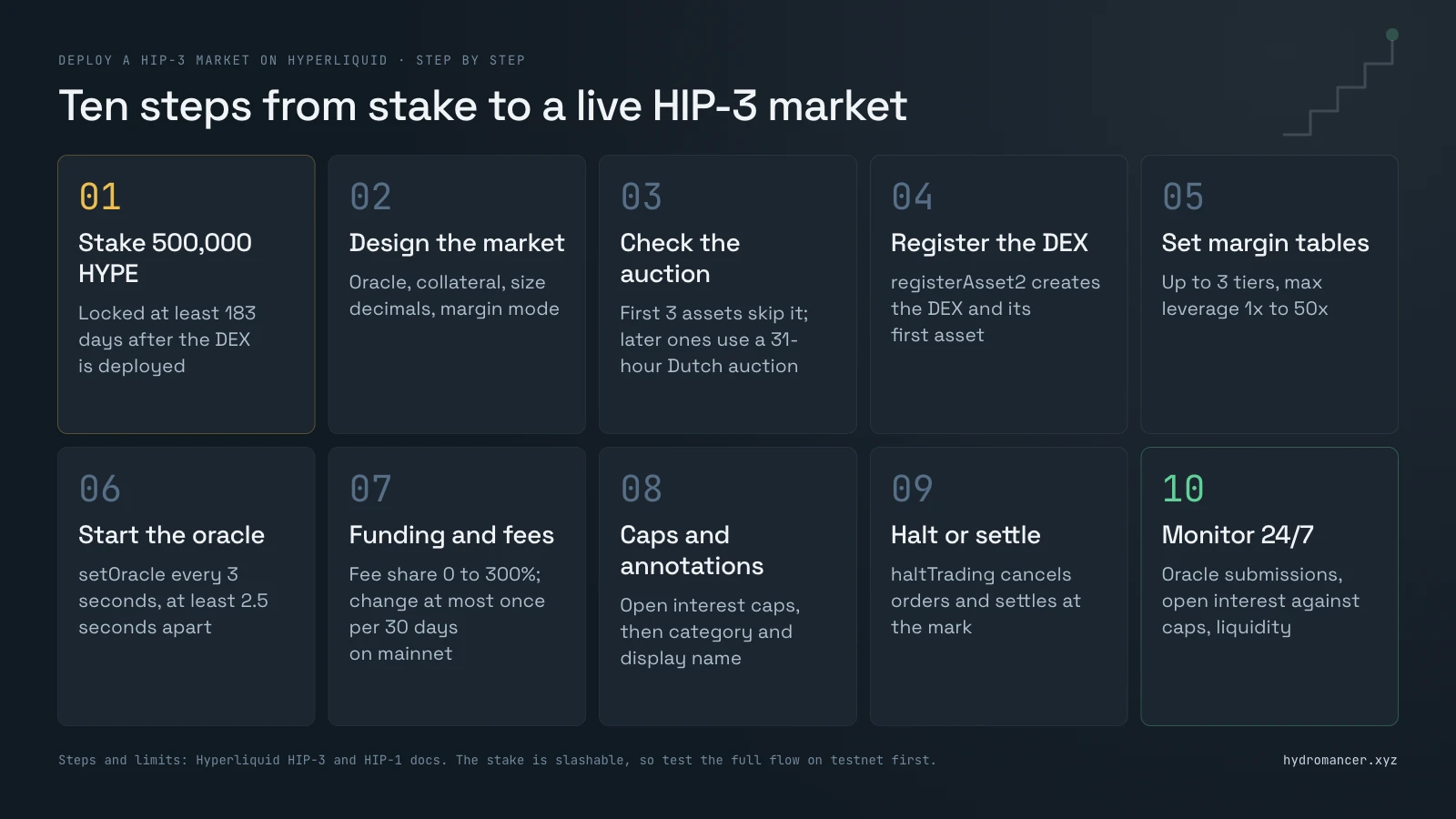
Step 1: Stake 500,000 HYPE on the deployer address
The deployer address must hold the HYPE stake before you register a DEX. Hyperliquid's HIP-3 specification sets four staking rules:
• The mainnet requirement is 500,000 HYPE, and anything staked above the current requirement can be unstaked.
• The stake must stay locked for at least 183 days after the DEX is deployed.
• Each deployer address can run one perp DEX.
• Once every asset on the DEX is settled, the required stake becomes free to unstake.
That stake also acts as collateral against misbehavior. Validators can slash it by vote, up to 100% for inputs that cause invalid state or long downtime.
Smaller ceilings apply too: up to 50% for brief downtime, and up to 20% for inputs that degrade performance. Slashing doesn't separate malice from mistakes, and even an attempted malicious input that causes no harm is slashable.
Stake sitting in the 7-day unstaking queue remains slashable. If you use a liquid staking token (LST) provider, Hyperliquid's docs advise operators to diligence deployers carefully because slashing applies regardless of who holds the stake.
Separate daily key operations from full DEX control from day one. Use setSubDeployers to delegate specific actions and assign a dedicated oracleUpdater, so the hot key sending prices every few seconds doesn't control the entire DEX.
Guard the deployer key closely. Slashing doesn't distinguish a deployer whose keys were stolen from one who misbehaved on purpose.
Step 2: Design the market before you touch the API
Hyperliquid's docs note perps fit best when the underlying is "difficult to manipulate and has underlying economic significance," and most price indices aren't suitable. Deployers are slashable across every market on their DEX, so settle four choices before signing:
• Oracle source: define your primary feed and fallback behavior for nights, weekends and upstream outages.
• Collateral token: any quote asset meeting Hyperliquid's requirements works, though DEXs using it are disabled if validators later revoke its quote status.
• Size decimals: caps count units of the asset (perpDexLimits returns oiSzCapPerPerp), so Hyperliquid's docs suggest setting szDecimals so the smallest size step is worth $1 to $10 at the starting mark price.
• Margin mode: choose strictIsolated (margin can't leave open positions), noCross (isolated only) or normal. Enabling cross margin is irreversible and carries validator eligibility rules.
Step 3: Check the perp deploy auction
The first 3 assets on any perp DEX skip the deploy auction. Every asset after that goes through a shared 31-hour Dutch auction using the same mechanics as the HIP-1 token auction.
The auction price falls linearly to 500 HYPE. It starts at twice the last price paid, or at 500 HYPE if the previous auction ended with no deployment.
Read the current auction state with perpDeployAuctionStatus. On Hyperliquid's native API, the request requires no API key:
# Expected output: a dict with startTimeSeconds, durationSeconds, startGas,
# currentGas (None once ended) and endGas (None while running)
import requests

status = requests.post(
    "https://api.hyperliquid.xyz/info",
    json={"type": "perpDeployAuctionStatus"},
).json()
print(status)
Hydromancer's API serves perpDeployAuctionStatus as well. Export your key in HYDROMANCER_API_KEY before calling it:
# Expected output: the same five fields as the native response
import os
import requests

key = os.environ["HYDROMANCER_API_KEY"]
resp = requests.post(
    "https://api.hydromancer.xyz/info",
    json={"type": "perpDeployAuctionStatus"},
    headers={"Authorization": f"Bearer {key}"},
)
print(resp.json())
Both endpoints returned matching five-field payloads for a completed 31-hour auction: durationSeconds was 111,600, currentGas was None and endGas was 664.24693596.
Deployers also receive reserve deployments, which skip the auction timer and pay the current auction price. Sending maxGas: 0 uses a reserve deployment whether or not the auction has ended, so Hyperliquid's docs advise querying the auction first.
Step 4: Register the DEX and its first asset with registerAsset2
registerAsset2 creates your DEX and registers its first asset in one signed action, while later assets omit the schema block. The snippet below builds the payload from Hyperliquid's docs; nothing deploys until you sign and submit it with your deployer key:
# Expected output: none. Structure only: sign with an SDK, testnet first.
# Keep the keys in this order: the signature hashes them as written.
action = {"type": "perpDeploy", "registerAsset2": {
    "maxGas": None,  # None: current auction price; 0: reserve deployment
    "assetRequest": {
        "coin": "abcd:EXAMPLE", "szDecimals": 2, "oraclePx": "100.0",
        "marginTableId": 10,
        "marginMode": "strictIsolated",  # or "noCross" / "normal"
    },
    "dex": "abcd",  # 2-4 lowercase characters
    "schema": {  # first call only: creates the DEX
        "fullName": "Example DEX", "collateralToken": 0,  # quote token
        "oracleUpdater": "0x...",  # optional, lowercase; default: deployer
    }}}
maxGas caps what you'll pay in the auction, expressed as an integer in HYPE's smallest unit rather than whole HYPE. For scale, the official Python SDK example passes 1000000000000 for 10,000 HYPE.
Three formatting rules catch deployers out before the transaction even reaches consensus. Sort every list of tuples, preserve the exact field order from the docs (field order changes the signature) and lowercase every address because some fields parse as bytes.
Every deploy action uses Hyperliquid's L1 action scheme, and the signing docs recommend an existing SDK over hand-written signatures. The official Python SDK ships helpers for only two actions: perp_deploy_register_asset and perp_deploy_set_oracle.
Watch out for perp_deploy_register_asset, which sends the older registerAsset form with an onlyIsolated flag instead of a margin mode. For registerAsset2 and every other deploy action, build the action yourself and sign it with the SDK's sign_l1_action.
Step 5: Set the margin tables
A margin table caps max leverage by position size across your DEX. Insert a table with insertMarginTable and point assets at it with setMarginTableIds, within three documented limits:
• Up to 3 tiers per table, sorted by rising lowerBound and falling maxLeverage.
• Max leverage between 1x and 50x.
• Margin table IDs must be non-zero.
Read your tables back with marginTable on Hydromancer, or query meta with your dex parameter on Hyperliquid's native API.
Step 6: Start the oracle with setOracle
From the moment an asset goes live, your oracle loop owes HyperCore continuous prices. Each setOracle call sends three DEX-wide lists: oraclePxs, markPxs (zero, one or two lists) and externalPerpPxs, which must include every listed asset:
• Leave at least 2.5 seconds between calls; Hyperliquid expects one call every 3 seconds, even with no change.
• The new mark is the median of your mark inputs and the local mark (the median of best bid, best ask and last trade).
• Mark moves are clamped to 1% per update, and all prices to 10x the start-of-day value.
• Mark prices can't be pushed so open interest would reach 10x the cap.
• After 10 seconds without updates, stale marks fall back to the local mark, though Hyperliquid's docs warn not to rely on this.
externalPerpPxs guards against sudden mark jumps. Hyperliquid's docs say it's ideally set from an outside source, with an exponential moving average (EMA) of recent marks as a fallback.
If cross margin is on, validators review an asset whenever this price moves more than 50% from start of day. Assets expected to move 50% in a day more than once a month aren't eligible, and deployers can be slashed.
Step 7: Configure funding rates and deployer fees
Funding parameters are set per asset using three actions that each take sorted lists:
• setFundingMultipliers: 0 to 10.
• setFundingInterestRates: an 8-hour rate from -0.01 to 0.01.
• setFundingClamps: 0 to 0.01, default 0.0003.
For trading fees, setDeployerFees sets a per-asset scale from 0 to 3, or under 10 with growthMode on, which cuts the base fee to a tenth.
The HIP-3 spec states those limits as a fee share: 0 to 300% of the normal fee, or 0 to 100% in growth mode where the scale applies to the reduced fee.
Above 100%, Hyperliquid raises its own fee to match yours. On mainnet, you can change fees once per 30 days, and setFeeRecipient routes payouts to your chosen wallet.
Step 8: Set open interest caps and market annotations
Use setOpenInterestCaps to cap each asset's notional open interest (position size times mark price). Each cap's minimum is the larger of 1,000,000 (described in Hyperliquid's docs as 1 size unit of the collateral asset) and half the current open interest.
Your DEX also carries a total notional cap (totalOiCap) alongside each asset's size cap (oiSzCapPerPerp). Query them with perpDexLimits, switching the URL below to https://api.hyperliquid.xyz/info and replacing abcd for a mainnet DEX:
# Expected output: a dict with totalOiCap, oiSzCapPerPerp, maxTransferNtl
# and coinToOiCap [coin, cap] pairs; None if the dex name is unknown
import requests

limits = requests.post(
    "https://api.hyperliquid-testnet.xyz/info",
    json={"type": "perpDexLimits", "dex": "abcd"},  # your dex name
).json()
print(limits)
In the testnet response for abcd, totalOiCap was 50,000,000, oiSzCapPerPerp was 10,000,000,000 and coinToOiCap was empty. Hyperliquid's deployer actions docs state a constant 1 billion units per asset, so read the live endpoint instead of assuming that figure.
To label the market for frontends, setPerpAnnotation adds a category (15 characters max), a description (400), a display name (9) and up to 2 keywords of up to 10 characters each.
Step 9: Halt, settle or wind down a market
Sending haltTrading with isHalted: true cancels all orders and settles positions at the current mark. Sending false resumes the asset, letting you recycle the slot for dated contracts without a new auction.
To close a DEX completely, settle every asset so your required stake becomes free to unstake. Several deployers have already sunset their DEXs, as Top HIP-3 Market Deployers by the Numbers records.
Give traders clear notice before you halt. Felix, for example, announced its sunset on 8 June 2026, 11 days before its markets began to close.
Step 10: Monitor the market once it's live
Once your market opens, keeping the oracle healthy is a 24/7 job. Hydromancer's HIP-3 market monitoring guide centers on three core checks:
1. Watch every oracle submission, including failed ones (failures carry success: false and an error).
2. Compare open interest from metaAndAssetCtxs against your caps from perpDexLimits on a schedule.
3. Track liquidity and slippage per market over time.
On Hyperliquid's native API, polling metaAndAssetCtxs and perpDexLimits is free. There is no native request for past oracle submissions, though a node run with --write-hip3-oracle-updates writes every deployer oracle update to disk.
Where Hydromancer fits
You don't need Hydromancer to deploy a HIP-3 market, and we'd rather say so up front. Every deploy action is signed by your team and sent to Hyperliquid, and its auction and limit requests are free.
Hydromancer fits once the market is live and its oracle has to be watched around the clock. That's when alerts on every failed submission and a price history you didn't have to record start to matter.
Hyperliquid API vs Hydromancer API, side by side
Hyperliquid's own API handles every deployment step for free, while Hydromancer's API adds live monitoring data: every oracle submission, accepted price history and liquidity per market.
| You need | Hyperliquid API | Hydromancer API |
|---|---|---|
| Auction status, limits, metadata | perpDeployAuctionStatus,perpDexLimits, meta, free | perpDeployAuctionStatus,perpDexLimits,marginTable, with a key |
| Every oracle update | Run a node with--write-hip3-oracle-updates | setOracleUpdates stream perDEX, failed ones included |
| Accepted oracle and mark history | Record it yourself | perpPriceHistoryByTime |
| Liquidity per market | Build it from the order book | marketLiquidity,slippageHistory |
| Your DEX's trade history | Node fills on Hyperliquid's S3, requester pays | Reservoir, free per HIP-3 DEX, requester pays |
| Key | None | API key on a paid plan |
| Sending deploy actions | Signed by you, sent to Hyperliquid | Not involved: actions always go to Hyperliquid |
Pricing and free Reservoir history
Live REST and WebSocket data needs an API key on a paid plan, from $300 a month (pricing). Reservoir trade history for each HIP-3 DEX is free, and you pay only AWS's request and transfer costs (Hyperliquid historical data).
For how HIP-3 DEXs work as a whole, see HIP-3 on Hyperliquid: How It Works and How to Get the Data.
What to know before you deploy a HIP-3 market
A wrong signature fails without saying why
Every deploy action is signed, and a signing mistake returns an error such as "L1 error: User or API Wallet 0x... does not exist." That address is the signer Hyperliquid recovered from your payload, not your own wallet.
Hyperliquid's signing page warns the error doesn't say what went wrong. It lists field order, trailing zeros on numbers and uppercase letters in addresses as usual causes, and advises matching the official Python SDK exactly.
Cross-margin assets get an onchain backstop liquidator
Every HIP-3 DEX has its own onchain backstop liquidator to take over positions due for backstop liquidation. Because it only accepts assets with cross margin enabled, auto-deleveraging (ADL) is significantly rarer on cross-margin assets in volatile markets.
If the backstop liquidator can't cover a position, the DEX falls back to ADL to stay solvent. Weigh that tradeoff when you pick a margin mode in Step 2, since enabling cross margin is irreversible.
Next steps
• Run a first deployment on testnet with the official Python SDK's perp deploy example.
• Keep Hyperliquid's HIP-3 deployer actions page open while you build, as it defines every action in this guide.
• Set up alerts for a live market with the HIP-3 market monitoring guide.
• Compare active and sunset deployments in Top HIP-3 Market Deployers by the Numbers.
Test and Validation
Code blocksThree of the four code blocks ran as printed on 19 November 2026. The registerAsset2 block was checked against Hyperliquid's HIP-3 deployer actions page without submitting, since it requires a deployer signature and registers a DEX; as plain Python, it prints nothing.
Both perpDeployAuctionStatus requests, on Hyperliquid's API and on Hydromancer's, returned the same five fields and values. The auction had ended: durationSeconds was 111,600 (31 hours), currentGas was None and endGas was 664.24693596.
The testnet perpDexLimits request for abcd returned a totalOiCap of 50,000,000, an oiSzCapPerPerp of 10,000,000,000 and an empty coinToOiCap. Hyperliquid's deployer actions docs list size caps as a constant 1 billion units per asset, so this guide reads the live value.
The documented limits in this guide come from Hyperliquid's HIP-3 page and HIP-3 deployer actions page, and the auction terms from its HIP-1 page, all re-read on 19 November 2026.
FAQ
How much does it cost to deploy a HIP-3 market?
You need 500,000 HYPE staked on mainnet for at least 183 days. The first 3 assets skip the auction; later assets pay the current Dutch auction price in HYPE, which you can read with perpDeployAuctionStatus.
Can I test a HIP-3 deployment first?
Yes. Hyperliquid's API runs on testnet at https://api.hyperliquid-testnet.xyz, where the official Python SDK's perp deploy example executes.
Some features, such as HIP-3* allow-list venues, are labeled testnet-only in the docs, so confirm mainnet availability before building around them.
How often must a HIP-3 deployer update the oracle?
Hyperliquid's docs expect a setOracle call every 3 seconds, with at least 2.5 seconds between calls. After 10 seconds, stale marks fall back to the local mark (order book and last trade), which the docs warn not to rely on.
What leverage can a HIP-3 market offer?
Margin tables allow max leverage from 1x to 50x, with up to 3 tiers by position size. Enabling cross margin is irreversible and subject to validator eligibility rules.
Can a HIP-3 deployer lose their stake?
Yes, validators can slash by stake-weighted vote, up to 100% for inputs that cause invalid state or long downtime. Slashed stake is burned, not paid to traders.
Do I need Hydromancer to deploy a HIP-3 market?
No, you sign every deploy action and send it to Hyperliquid, whose info requests cover the auction and your limits. Hydromancer's API adds monitoring data, such as failed oracle updates and price history.
Sources
1. Hyperliquid docs: HIP-3, builder-deployed perpetuals
2. Hyperliquid docs: HIP-3 deployer actions
3. Hyperliquid docs: HIP-1 native token standard (the deploy auction)
4. Hyperliquid docs: signing
5. Hyperliquid docs: info endpoint, perpetuals
6. Hyperliquid docs: historical data
7. Hyperliquid node README
8. Hyperliquid Python SDK
9. Hydromancer docs: HIP-3 market monitoring
10. Hydromancer docs: setOracleUpdates
11. Hydromancer docs: perpDeployAuctionStatus
12. Hydromancer docs: perpDexLimits
13. Hydromancer docs: Reservoir
14. Hydromancer docs: Get API keys
15. Top HIP-3 Market Deployers by the Numbers
Read next

Hyperliquid Frontend: Top Launch Checklist for Builders
Launch checklist for a Hyperliquid trading frontend: builder code fees, API wallet security, HIP-3 and HIP-4 markets, referrals, analytics and monitoring.

Hyperliquid Smart Money: How to Read Wallet Labels
Tell Hyperliquid market makers, delta-neutral wallets, vaults, whales and new wallets apart, and see why a wallet's label matters more than its size.

Hyperliquid Backtest: How to Test a Strategy in Python
Backtest a Hyperliquid strategy in Python with free historical candles and funding, real fee tiers and slippage, and no look-ahead bias.