Hyperliquid Smart Money: How to Read Wallet Labels
Tell Hyperliquid market makers, delta-neutral wallets, vaults, whales and new wallets apart, and see why a wallet's label matters more than its size.
Smart money on Hyperliquid is the set of wallets whose trades carry a directional view on where price is heading. Because every order, trade and liquidation happens on-chain, any wallet's positions, trades and transfers are public, but its intent is not.
That is why wallet size alone misleads. In a Hydromancer study of fills from August 2025 to April 2026, HLP vaults and automated traders were 0.48% of Hyperliquid users yet drove 71.9% of volume on the native frontend.
Most of that native frontend volume came from accounts that weren't making directional bets. Those figures cover one study window and shift over time, so take the pattern from them, not the exact shares.
Labels answer whether a large position reflects conviction, a hedge, market-maker inventory or one trader split across sub-accounts. Traders use them to read who sits behind a move, while builders use them to filter trackers and leaderboards.
For the live userRole check, the walletLabels docs review and the study window behind those figures, jump to Test and Validation.
Hyperliquid wallet types at a glance
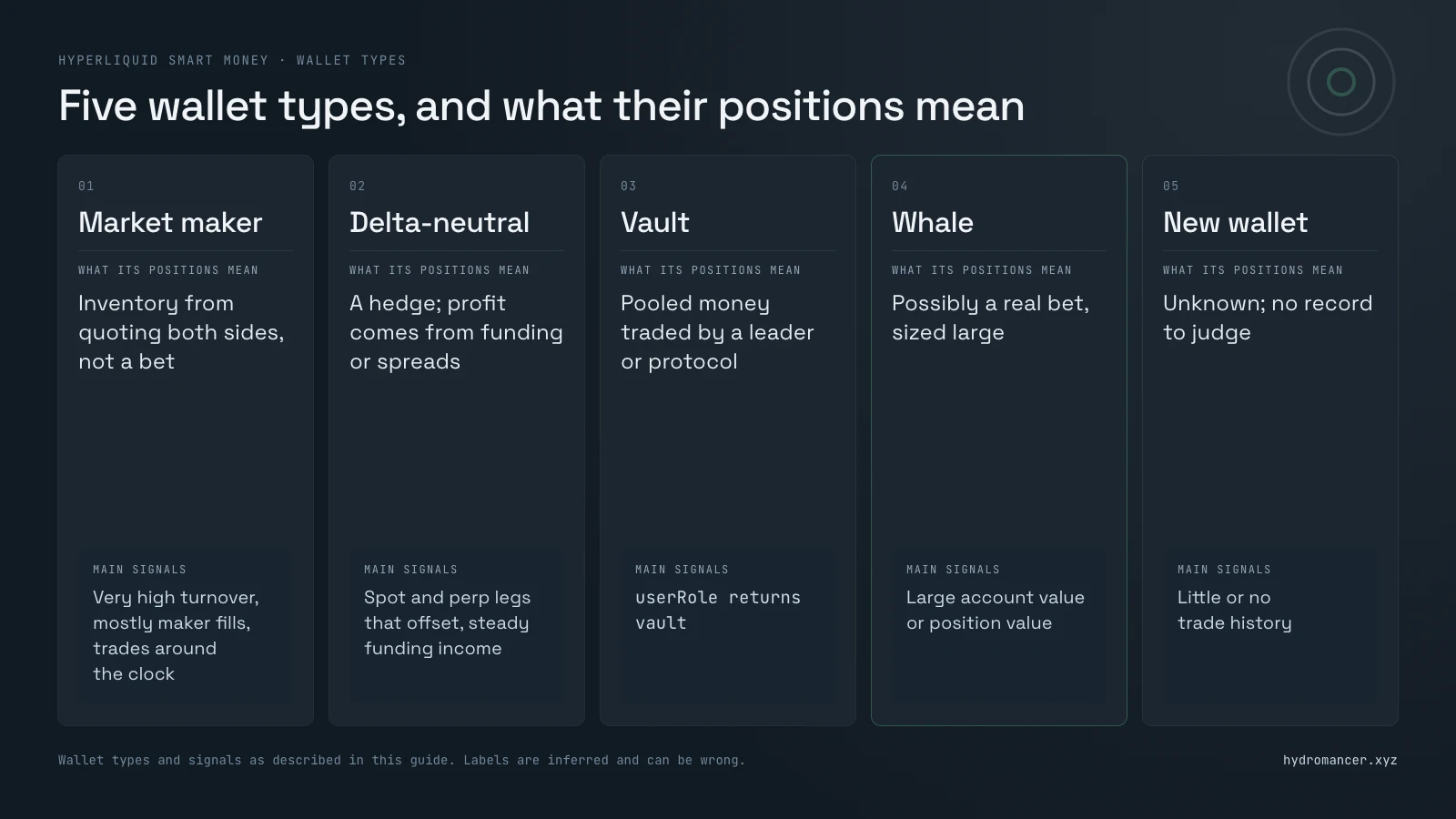
Size ranks wallets by how much money they control, while labels tell you whether that money is expressing a view. Here are the five Hyperliquid wallet types worth separating and the signals that define each.
| Wallet type | What its positions mean | Main signals |
|---|---|---|
| Market maker | Inventory from quoting both sides, not a bet | Very high turnover, many fills, mostly maker fills, trades around the clock |
| Delta-neutral | A hedge; profit comes from funding or spreads | Spot and perp legs that offset, steady funding income |
| Vault | Pooled money traded by a leader or protocol | userRole returns vault |
| Whale | Possibly a real bet, sized large | Large account value or position value |
| New wallet | Unknown; no record to judge | Little or no trade history |
How to separate Hyperliquid smart money from other wallets
Each wallet type leaves a distinct trace in its fills and account structure. Once you read that trace, the same large position separates into a directional bet, a hedge or leftover inventory.
Market makers, whose positions are inventory
A market maker quotes bids and asks to earn the spread, so its open position is whatever inventory it hasn't offloaded yet. A large short from a market maker says little about where it expects price to move.
The tell is behavior, not size. Our whale tracker guide found leaderboard wallets whose monthly volume was hundreds of times their account, and one more than 4,000 times.
The frontend-trader study flagged automated traders by fill frequency combined with hour-of-day coverage that a person can't sustain. Together with HLP vaults, those accounts were 0.48% of users and 71.9% of native frontend volume over the study window.
A high share of maker fills points the same way. Hyperliquid's own HLP vault is a protocol market maker, so its positions belong in this group too.
Delta-neutral wallets, whose positions are hedged
A delta-neutral wallet holds offsetting exposure, often a spot long against a perp short, to collect funding or a spread. Its perp short looks bearish on its own, yet paired with the spot leg, the wallet is flat.
Some hedges sit in plain sight on-chain because both the spot and perp legs live in one account. Others stay hidden because the offsetting leg sits on an outside exchange.
The frontend-trader study filtered both kinds, catching outside-exchange hedges by matching activity patterns. Treat any cross-venue delta-neutral tag as an inference rather than a protocol fact.
Vaults and sub-accounts, which Hyperliquid labels for you
Vaults are the easiest wallet type to identify because Hyperliquid labels them at the protocol level. Sending a userRole request returns {"role": "vault"} for any vault address.
The same request returns subAccount along with the master address, and agent for API wallets. That matters because a vault trades pooled money and one trader can split positions across several addresses.
Our positioning guide walks through how sub-accounts and vaults split one trader across multiple addresses, and how open positions divide between longs and shorts.
Whales, sized large but not always betting
A whale is any wallet holding a large account balance or large open positions. The cutoff is yours to choose; our whale tracker used $1M as an example.
Size is the easiest signal to measure and the weakest on its own. A whale that also quotes as a market maker or runs a hedge tells you nothing about direction.
A whale that is directional, human-paced and profitable over time is the wallet people usually mean by smart money. That is why Hydromancer's leaderboard post excluded wallets labeled as funds, market makers or trading firms when ranking individual traders.
One catch from the whale tracker: unified accounts keep their balance in spot, so a perp-only balance check can miss them.
New wallets, with no record to judge yet
A new wallet carries no trading history to evaluate. It can belong to a first-time trader or an existing trader using a new address, and you usually can't tell which.
Treat a large new wallet as an open question rather than a directional signal. Account age is the one part of its record you can measure cleanly.
How to get Hyperliquid smart money labels from the API
Hyperliquid's free API tells you what role an address has and how large its account is. Hydromancer's API adds behavior flags across every labeled wallet plus realized PnL rankings you can filter for bots.
Roles and size for a few wallets with Hyperliquid's free API
If you're checking a handful of wallets, Hyperliquid's public API covers account roles and size with no key. userRole identifies vaults, sub-accounts and agents, while clearinghouseState and spotClearinghouseState return perp and spot balances.
Our whale tracker guide shows how to read both balance endpoints. Each userRole call weighs 60 of the 1,200 weight per minute Hyperliquid allows per IP, so it suits a watchlist, not the whole exchange.
# Expected output: each address with its role, e.g. "0xdfc2...f303 vault"
import requests

INFO = "https://api.hyperliquid.xyz/info"
addresses = ["0xdfc24b077bc1425ad1dea75bcb6f8158e10df303"]  # HLP, a vault

for a in addresses:
    role = requests.post(INFO, json={"type": "userRole", "user": a}).json()
print(a[:6] + "..." + a[-4:], role["role"])0xdfc2...f303 vaultCalling userRole on HLP's address against Hyperliquid's public endpoint with no key returned 0xdfc2...f303 vault. What the native API doesn't give you is behavior labels: market maker, delta-neutral and "human or bot" are inferences you build yourself from fills.
Behavior flags for every wallet with Hydromancer's walletLabels
If you'd rather not build behavior classifiers from raw fills, Hydromancer's walletLabels request returns every labeled Hyperliquid wallet, about 250k of them, in one gzip download. The list refreshes hourly, and each tag and flag is Hydromancer's classification of the wallet:
• address and name (a known name, if any)
• tag: a trader classification such as "New wallet", "+ day", "- swing", "+ intraday" or "- scalper"
• marketMaker, deltaNeutral and newWallet: true or false flags
Your API key needs the wallet-labels add-on, which Hydromancer enables on request, or the endpoint returns 403. You can call it 10 times every 10 minutes per key, and the response shape may change while it's experimental.
The snippet below reads a key with the wallet-labels add-on from HYDROMANCER_API_KEY and counts wallets carrying each flag.
# Expected output: counts of wallets flagged market maker, delta-neutral, new
import os
import requests

r = requests.post(
    "https://api.hydromancer.xyz/info",
    json={"type": "walletLabels"},
    headers={"Authorization": "Bearer " + os.environ["HYDROMANCER_API_KEY"]},
)
r.raise_for_status()
wallets = r.json()  # requests decompresses the gzip body

for flag in ("marketMaker", "deltaNeutral", "newWallet"):
    print(flag, sum(w[flag] for w in wallets))
Rankings and track records with userPnlLeaderboard and userPnlSummary
Hydromancer's two PnL endpoints rank and profile traders by realized PnL from closed trades, after fees and funding. Both sit in the "User performance" add-on ($500 per month per the pricing docs), and both use data from 1 August 2025 onward.
userPnlLeaderboard ranks users by totalPnl, winRate or volumeTraded over 1d, 7d, 30d, 90d or all. Its filters are where smart-money screening happens: minTrades, minDaysActive, minAccountAgeDays and minHumanScore.
Those filters strip out one-shot accounts, brand-new wallets and high-frequency bots. You can also scope the ranking to a single dex or a single builder.
userPnlSummary profiles one wallet. Useful fields for labeling:
• humanScore: a 0 to 100 heuristic combining average fills per trade, distinct trading hours per active day and maker-to-taker fill ratio, where higher scores point to a human trader and lower ones to an algorithm.
• medianDurationSeconds: the median time the wallet held a position it has since closed.
• accountAgeDays: days since its earliest known fill.
• winRate, totalTrades, totalFees and totalFunding.
A short median hold and a low human score point to a bot or market maker. A longer hold, a high human score and positive PnL over many trades point to a directional trader.
Hyperliquid API vs Hydromancer API, side by side
The two APIs answer different questions: Hyperliquid's tells you what one address is, and Hydromancer's tells you how every labeled wallet trades.
| What you need | Hyperliquid API | Hydromancer API |
|---|---|---|
| Is this address a vault, sub-account or agent? | userRole, free | Same: use userRole |
| Market-maker, delta-neutral and new-wallet flags | Build from fills yourself | walletLabels(experimental add-on) |
| Rank traders and filter out bots | Leaderboard file (undocumented, no bot filter) | userPnlLeaderboard withminHumanScore (add-on) |
| One wallet's realized record | Rebuild from userFillsByTime(latest 10,000 fills) | userPnlSummary (add-on) |
| Raw history to build your own labels | Node fills on S3 (requester pays) | Reservoir fills, free (requester pays) |
| Key | None | API key with the add-on |
| Documented limit | userRole weighs 60 of1,200 a minute per IP | walletLabels: 10 requestsper 10 minutes per key |
| Fits | A handful of wallets you already know | Every labeled wallet, or a ranked list of traders |
Where Hydromancer fits
You don't need Hydromancer just to look up a few addresses or pull raw fills for offline research, and we'd rather say so. Live REST and WebSocket access requires an API key on a paid plan starting from $300 per month.
walletLabels, userPnlLeaderboard and userPnlSummary are add-ons on top of that plan. See the REST API page for the endpoint list and pricing for plans and add-ons.
Going further: build a tracker or custom wallet labels
Once you can separate directional wallets from market makers and hedges, you can either track those wallets live or build your own classifier from raw fills.
Build a whale tracker from labeled wallets
Once you know which wallets to keep, the next step is watching their positions and fills in real time. Follow the whale tracker guide rather than starting from scratch.
It shows how to find large wallets from the trades stream, size them up and follow their fills.
Build your own labels from raw fills
If you want full control over your labeling rules, start from every historical fill. Reservoir, Hydromancer's historical archive, is free with AWS requester-pays charges, and Hyperliquid publishes its node fills on S3 the same way.
The frontend-trader study was built on Reservoir data, using its own filters for automated and delta-neutral traders.
What to know before acting on Hyperliquid smart money labels
A wallet label tells you what kind of account you're looking at, not whether that account is right. Keep four limits in mind before trading or shipping a product on top of labels.
Labels are inferred, and can be wrong
A market-maker or delta-neutral flag is Hydromancer's classification of a wallet, and a classification can be wrong. The leaderboard post calls the human score "a filter, not a label", and notes that an unlabeled wallet can still belong to a firm.
Realized PnL leaves out open positions
Realized PnL counts only closed trades, so open positions aren't included. Our copy trading guide shows one trader whose realized and account PnL had opposite signs.
Following a wallet isn't a strategy
On-chain trades become visible only after they happen, and you can't see positions a wallet holds on other venues. Past results don't predict future ones.
Hydromancer's PnL history starts in August 2025
Hydromancer's PnL data starts on 1 August 2025. The all window in userPnlLeaderboard covers closed trades since that date, not earlier exchange history.
None of this is investment advice.
Next steps
• Build the tracker with the whale tracker guide.
• Rank traders with bots filtered out in the Hyperliquid leaderboard guide.
• See how a market's open positions split in the trader positioning guide.
• Run the userRole code block on any address to check whether it is a vault, sub-account or agent.
Test and Validation
Native\1 checkThe first code block was run as printed on 19 November 2026 against Hyperliquid's public API with no key. It sent userRole for HLP's address (0xdfc24b077bc1425ad1dea75bcb6f8158e10df303) and printed 0xdfc2...f303 vault.
\1 checkThe walletLabels block was checked against Hydromancer's walletLabels docs page but hasn't been run with a key that has the wallet-labels add-on, so its output isn't shown. Without the add-on, the request returns 403.
The 0.48% and 71.9% figures in the intro and market-maker section come from Hydromancer's study How Profitable are Hyperliquid Frontend Traders?. It covers HyperCore fills from 1 August 2025 to 9 April 2026, and its methodology describes each filter.
FAQ
How do I find smart money wallets on Hyperliquid?
Start by setting aside market makers and delta-neutral hedgers, whose positions aren't directional bets, and vaults, which trade pooled money. Then evaluate what's left by realized PnL over many trades, not by account size.
Hydromancer's userPnlLeaderboard ranks wallets by realized PnL, and its minHumanScore and minTrades filters strip out high-frequency bots and one-shot accounts.
How can I tell if a Hyperliquid wallet is a market maker?
Look at behavior: very high turnover relative to account size, many fills, mostly maker fills and activity around the clock. Hydromancer's walletLabels includes a marketMaker flag, though it's inferred and can be wrong.
Is the biggest wallet on Hyperliquid the smartest?
Not necessarily: many of the busiest wallets are market makers or hedged, so their positions aren't directional views on price. Size tells you how much money a wallet controls, not whether it's right.
How do I know if an address is a Hyperliquid vault?
Send userRole with the address to Hyperliquid's info endpoint. A vault returns {"role": "vault"}, and a sub-account returns its master address.
Should I copy what smart money wallets do?
Copying a wallet isn't a strategy on its own. You see trades after they happen, you can't see positions held elsewhere, and past PnL doesn't predict future results.
Sources
1. Hyperliquid docs: info endpoint
2. Hyperliquid docs: rate limits and user limits
3. Hyperliquid docs: about Hyperliquid
4. Hyperliquid docs: protocol vaults
5. Hyperliquid docs: historical data
6. Hydromancer docs: walletLabels
7. Hydromancer docs: userPnlLeaderboard
8. Hydromancer docs: userPnlSummary
9. Hydromancer docs: pricing
10. Hydromancer docs: get API keys
11. How Profitable are Hyperliquid Frontend Traders?
12. Hyperliquid whale tracker
13. Hyperliquid leaderboard
14. Hyperliquid copy trading bot
15. Hyperliquid trader positioning
Read next

Hyperliquid Frontend: Top Launch Checklist for Builders
Launch checklist for a Hyperliquid trading frontend: builder code fees, API wallet security, HIP-3 and HIP-4 markets, referrals, analytics and monitoring.
Deploy a HIP-3 Market on Hyperliquid: Guide for Builders
Step-by-step HIP-3 deployment on Hyperliquid: the 500k HYPE stake, the Dutch auction, registerAsset2, setOracle, margin tables, OI caps and fees.

Hyperliquid Backtest: How to Test a Strategy in Python
Backtest a Hyperliquid strategy in Python with free historical candles and funding, real fee tiers and slippage, and no look-ahead bias.