Hyperliquid Stocks: How ORCL, NVDA and Equity Perps Work
Hyperliquid stocks are HIP-3 equity perps, not shares. How xyz:NVDA and xyz:ORCL are priced, funded and capped, and how to get their data.
Hyperliquid stocks are perpetual futures, or perps, that track equities such as Oracle (ORCL), NVIDIA (NVDA) and Tesla (TSLA) via HIP-3. Outside teams deploy these contracts on Hyperliquid, so you trade price exposure on USDC margin rather than owning shares.
You get no shares, votes or dividends, and leveraged positions can be liquidated. The mechanics that catch traders and builders off guard are 24/7 trading across weekend market closures, deployer-supplied oracles blended with the order book, and Hyperliquid's 1% per-update mark clamp.
Traders go long or short from a crypto wallet even on weekends, while builders pull on-chain prices, funding and history for terminals and backtests. Trade[XYZ], the largest deployer, listed 122 active markets, though teams add and delist contracts often.
For the live market counts, five-ticker margin checks and real query outputs behind every code block below, jump to Test and Validation.
Hyperliquid stocks at a glance
Several teams have listed stock perps, each on its own HIP-3 DEX with a distinct ticker prefix and collateral token. Some have since closed, and the table below shows which remain active.
| Deployer | DEX prefix | Collateral | What it lists | Status |
|---|---|---|---|---|
| Trade[XYZ] | xyz | USDC | US and Asian stocks, ETFs, indices, commodities, FX, pre-IPO ( xyz:ANT,xyz:OURA) | Active |
| Entropy | io | USDC | Pre-IPO valuation perps ( io:ANTH,io:OAI) andpublic equities ( io:SNDK) | Active |
| Paragon | para | USDC | Crypto indices ( para:BTCD), USTreasury yields and stocks such as para:AVGO,para:NET | Active |
| Markets.xyz | km | USDH | Indices, equities and commodities, all delisted (its deployer now runs BVIV on a separate DEX) | Delisted |
| Felix | flx | USDH | Equities such asflx:NVDA,flx:TSLA | Wound down June 2026 |
| Dreamcash | cash | USDT0 | Equities such ascash:MSFT,cash:TSLA | Wind-down began 30 June 2026 |
Trade[XYZ] is the largest deployer by far, listing US and Asian stocks alongside indices, commodities, currencies and pre-IPO contracts. For each team's trading volume, see Top HIP-3 Market Deployers by the Numbers.
For the five major US equities this guide follows, Trade[XYZ]'s specification index sets the limits below. All five take outside prices 24/5, from Sunday 8:05 PM to Friday 8:00 PM ET, and use a 0.5 funding multiplier.
| Ticker | Max leverage | Discovery bound | Re-anchors each way | Margin |
|---|---|---|---|---|
xyz:NVDA | 10x | ±10% | 1 | Cross |
xyz:ORCL | 10x | ±10% | 1 | Isolated only |
xyz:TSLA | 20x | ±5% | 2 | Cross |
xyz:AAPL | 20x | ±5% | 1 | Cross |
xyz:MSFT | 20x | ±5% | 2 | Cross |
Trade[XYZ] can change leverage caps, bounds or margin modes at any time. Read live values from Hyperliquid's API before relying on them in code or trading.
How Hyperliquid stocks work
A stock perp trades on Hyperliquid's matching engine like any crypto perp, but its oracle feed, funding parameters and risk caps come from the team that listed it.
HIP-3 builder-deployed perp DEXs
HIP-3 (Hyperliquid Improvement Proposal 3) lets any team that stakes 500,000 HYPE run its own perpetual exchange on Hyperliquid's engine. Hyperliquid calls each venue a perp DEX, with its own order books, margining and market settings.
The deployer defines each market, supplies its prices and sets its limits, while HyperCore runs the order books and margining. Every order, trade and deployer price submission lands on-chain, unlike a centralized exchange where contract pricing stays internal.
Linear USDC contracts instead of shares
A perp is a derivative with no delivery and no expiry. You post margin, open a long or short, and your profit or loss follows the contract's price.
Trade[XYZ]'s docs describe its markets as linear contracts margined and settled in USDC. Because you hold a contract rather than a claim on the company, you get no ownership, votes or direct dividend payouts.
Market naming with dex:SYMBOL prefixes
Every HIP-3 market identifier pairs the DEX prefix with the symbol, such as xyz:ORCL for Oracle and xyz:NVDA for NVIDIA on Trade[XYZ]. Always pass this full prefixed string when calling an API.
Multiple teams can list the same company as separate contracts with independent order books and prices, so xyz:NVDA and flx:NVDA were never the same market. Display labels can also differ from API names: Trade[XYZ] shows xyz:CL as WTIOIL.
Deployer oracles and Hyperliquid's 1% mark clamp
On a HIP-3 market, the deployer supplies prices rather than Hyperliquid's validators. Every few seconds it sends a setOracle action with three sets of prices for its DEX: oracle prices, mark price inputs and external perp prices.
Hyperliquid's HIP-3 docs enforce four guardrails on those submissions:
• Calls need at least 2.5 seconds between them, and deployers are expected to send one every 3 seconds.
• The new mark price is the median of the deployer's mark inputs and the local mark (median of best bid, best ask and last trade).
• A mark price can move at most 1% from the previous mark per update.
• All submitted prices are clamped to 10x the start-of-day value.
Because HyperCore blends deployer inputs with the local order book, liquidation prices do not rest on the deployer's feed alone. Our oracle price vs mark price guide details what the deployer sends versus what the network accepts.
24/7 weekend trading and internal EMA pricing
US stock exchanges trade on weekdays during set hours, while Trade[XYZ]'s stock perps trade 24/7. When outside prices pause over weekends or holidays, Trade[XYZ]'s oracle switches between two documented modes.
Under external pricing, some US stocks take outside feeds only during regular hours (9:30 AM to 4:00 PM ET). Others include pre-market, post-market and overnight sessions for 24/5 coverage from Sunday 8:05 PM ET to Friday 8:00 PM ET.
Under internal pricing, the oracle moves by an exponential moving average (EMA) of the gap between order-book impact prices and the last oracle, with a 30-minute time constant. Once outside feeds return, the oracle snaps back on the next tick.
In one September 2026 weekend, Trade[XYZ]'s stock and index markets had priced 31 to 62% of Monday's cash-open fall before equity futures reopened Sunday. That was one weekend, not a rule.
Discovery bounds and re-anchoring caps
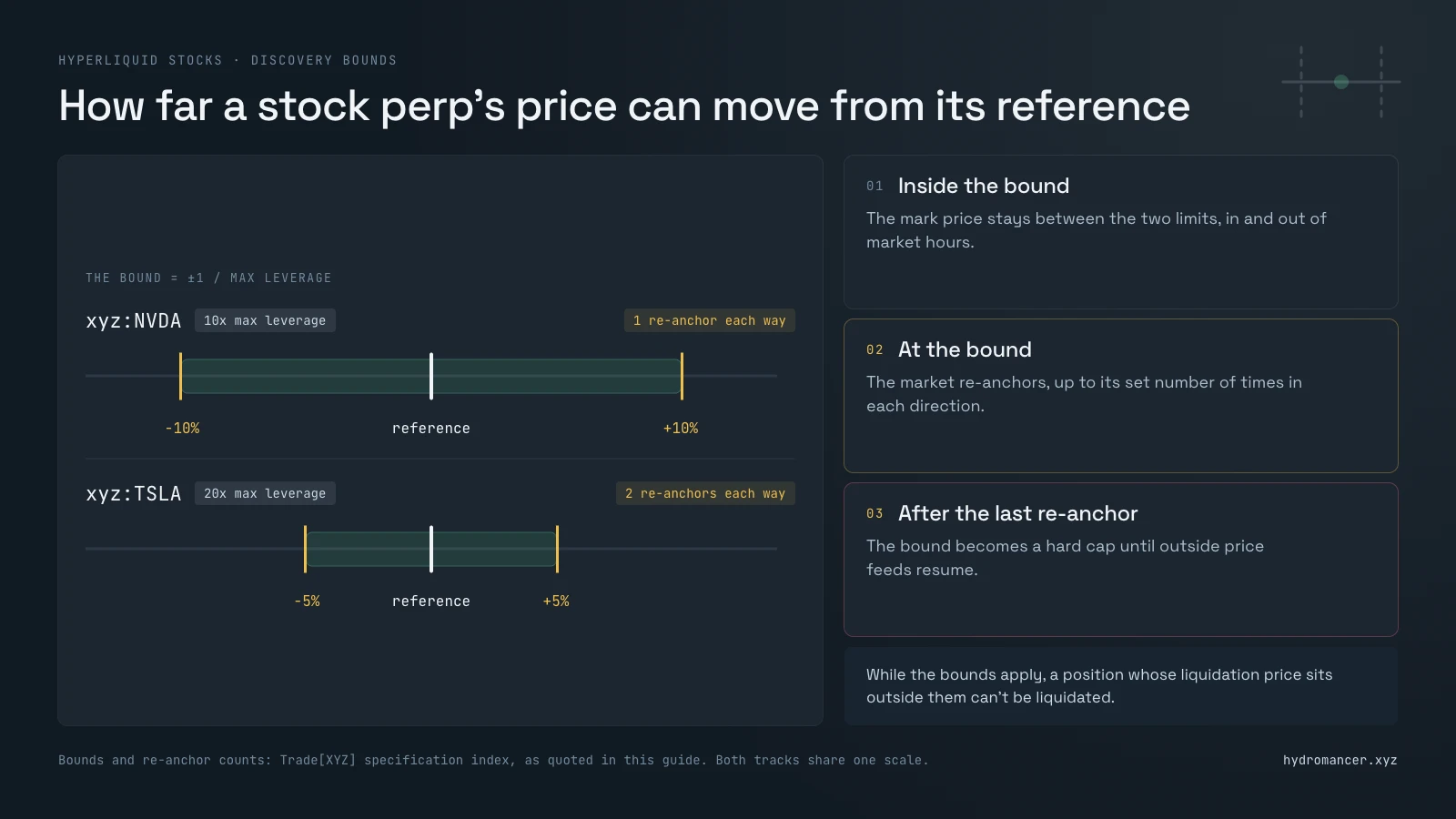
Trade[XYZ]'s discovery bounds hold the mark price within plus or minus 1/(max leverage) of a reference price, both in and out of market hours. A 10x contract such as xyz:NVDA can move roughly 10% before re-anchoring or capping.
Each market allows a set number of re-anchors per direction, shown in the specification table above. After the final re-anchor, the bound becomes a hard cap until outside price feeds resume.
Bounds also constrain liquidations. Trade[XYZ]'s docs state that if your liquidation price sits outside the active bounds, your position cannot be liquidated while those bounds apply.
Hourly funding rates and deployer dials
Perp longs and shorts exchange funding every hour, so holding costs shift over time. HIP-3 markets use a more responsive premium formula than Hyperliquid's native crypto markets.
The deployer also sets three dials per asset: a funding multiplier (0 to 10), an 8-hour interest rate (-0.01 to 0.01) and a clamp (0 to 0.01, default 0.0003).
Trade[XYZ]'s docs list a 0.5 multiplier on public stocks and 0.005 on pre-IPO contracts, with a 0.01% 8-hour interest rate except on selected currency markets at 0. Our Hyperliquid funding rates guide explains the underlying formula.
Pre-IPO equity perps
Some HIP-3 markets track private companies before they list, including Trade[XYZ]'s xyz:ANT (Anthropic) and xyz:OURA, and Entropy's io:OAI (OpenAI) and io:ANTH. They settle in USDC like public stock perps but have no exchange share price to follow.
With no outside stock feed available, Trade[XYZ] moves the oracle of its pre-IPO contracts using their own order books. It also applies the lower 0.005 funding multiplier noted above.
Per-market leverage caps
Unlike spot shares bought outright, equity perps use leverage and carry liquidation risk. HIP-3 lets each deployer set max leverage from 1x to 50x per market through margin tables.
On Trade[XYZ], xyz:TSLA, xyz:AAPL and xyz:MSFT allow up to 20x, while xyz:NVDA and xyz:ORCL cap at 10x. Read live maxLeverage values from the API before building position checks on them.
Cross margin vs isolated-only stock markets
Each HIP-3 asset uses cross margin, isolated-only (noCross), or strict isolated mode, where you cannot withdraw margin from an open position. Check marginMode in live market metadata before assuming shared collateral.
Oracle (xyz:ORCL) is a notable example: Trade[XYZ]'s specification index lists it as isolated-only, so its margin is never shared with your other positions.
Dividends and stock splits
A company's corporate actions still reach its perp even though you hold no shares. Trade[XYZ]'s docs explain that perp holders receive no direct dividend payouts; cash dividends rarely pause trading and flow into price and funding via share arbitrage.
Stock splits work differently. Trade[XYZ] settles open positions and reopens the contract on a post-split basis, as it did for Kioxia's 3-for-1 split in September 2026, so traders must open a new position afterward.
How to get Hyperliquid stock data
You have three main routes into Hyperliquid stock data depending on whether you need live state, full trade and candle history, or historical accepted oracle prices.
Current price, funding and open interest from Hyperliquid's API
Hyperliquid's own API is free and needs no key. Request metaAndAssetCtxs with the lowercase DEX prefix in dex to pull every market's mark price, oracle price, funding and open interest:
# Expected output: one line per market, e.g. "xyz:NVDA mark= ... maxLev= 10"
import requests

resp = requests.post(
    "https://api.hyperliquid.xyz/info",
    json={"type": "metaAndAssetCtxs", "dex": "xyz"}, timeout=10,
)
resp.raise_for_status()
meta, ctxs = resp.json()
for asset, ctx in zip(meta["universe"], ctxs):
    if asset["name"] in ("xyz:NVDA", "xyz:ORCL", "xyz:TSLA"):
        print(asset["name"], "mark=", ctx["markPx"],
              "oracle=", ctx["oraclePx"], "funding=", ctx["funding"],
              "OI=", ctx["openInterest"], "maxLev=", asset["maxLeverage"])
funding is the hourly rate as a fraction (so 0.00000625 is 0.000625% an hour), and openInterest is in stock units, not dollars. On Trade[XYZ], the call returned 122 active markets out of 146, with xyz:ORCL marked "marginMode": "noCross".
Trade, candle and weekend history from Reservoir
Hyperliquid's info API keeps only a market's most recent 5,000 candles per interval and no full trade log. Hydromancer's Reservoir archive holds both from each HIP-3 DEX's launch, including closed venues, with Trade[XYZ] starting on 13 October 2025.
To run the query below, you need DuckDB and an AWS account configured via aws configure or environment variables. It aggregates Reservoir's 1-second candles into 1-minute xyz:ORCL bars across a Saturday when US stock exchanges were closed:
-- Expected output: 1-minute OHLCV rows for xyz:ORCL, Saturday 2026-11-14 UTC
INSTALL httpfs; LOAD httpfs;
CREATE OR REPLACE SECRET (TYPE s3, PROVIDER credential_chain,
    REGION 'ap-northeast-1');
SET s3_requester_pays = true;
SET TimeZone = 'UTC';

SELECT time_bucket(INTERVAL '1 minute', timestamp) AS minute,
       arg_min(open, timestamp) AS open, max(high) AS high, min(low) AS low,
       arg_max(close, timestamp) AS close, sum(volume) AS volume
FROM read_parquet('s3://hydromancer-reservoir/by_dex/xyz/candles/1s/'
                  || 'date=2026-11-14/candles.parquet')
WHERE coin = 'xyz:ORCL'
GROUP BY minute
ORDER BY minute;
For Saturday 14 November 2026 UTC, that query returned 558 one-minute xyz:ORCL bars from 00:00 to 23:59 UTC, omitting minutes with no trades. That lets you replay weekend price moves against Monday's open, as in How Hyperliquid Priced In Dario's Tweet.
Reservoir uses AWS requester-pays, so you pay AWS transfer fees without needing a Hydromancer key. The historical data page lists every Trade[XYZ] dataset and S3 path.
Accepted oracle and mark prices from Hydromancer's API
Hyperliquid's API has no request for historical oracle or mark prices. Hydromancer's perpPriceHistoryByTime returns the exact prices HyperCore accepted on every oracle round, about every 3 seconds, which drive margining and liquidation.
Each row carries its block number, and accepted HIP-3 rounds go back to 24 February 2026. The call needs an API key read from HYDROMANCER_API_KEY:
# Expected output: height, row count (about 200) and the newest xyz:NVDA row
import os, time, requests

now_ms = int(time.time() * 1000)
resp = requests.post(
    "https://api.hydromancer.xyz/info",
    json={"type": "perpPriceHistoryByTime", "coin": "xyz:NVDA",
          "startTime": now_ms - 10 * 60 * 1000, "limit": 2000},
    headers={"Authorization": f"Bearer {os.environ['HYDROMANCER_API_KEY']}"},
    timeout=10,
)
resp.raise_for_status()
data = resp.json()
print(data["height"], len(data["prices"]), data["prices"][-1:])
Across a 10-minute xyz:NVDA window, this endpoint returned 200 and then 199 accepted price rows, matching the 3-second HIP-3 oracle cadence.
Hourly funding history from Hyperliquid's API
Because stock perp funding resets every hour, its history shows what holding a position actually cost across sessions. Hyperliquid's free fundingHistory request takes any prefixed HIP-3 symbol such as xyz:ORCL and returns up to 500 hourly rates per call.
Deployer oracle submissions vs accepted network prices
Every oracle round has two records: what the deployer submitted and what HyperCore accepted after clamping. Hydromancer's oraclePriceHistoryByTime returns deployer submissions, while perpPriceHistoryByTime returns the accepted prices.
To monitor that comparison live, subscribe to Hydromancer's setOracleUpdates feed. It emits every oracle update for a DEX, including submissions that failed validation.
Where Hydromancer fits
If you only need current prices, funding and open interest for a few stock markets, Hyperliquid's free API is enough. You don't need Hydromancer for that, and we'd rather say so.
Hydromancer comes in when you need what Hyperliquid's API omits: full trade and 1-second candle history in Reservoir, accepted oracle rounds via perpPriceHistoryByTime, or multi-market live fills. One allFills subscription covers up to 20, 100 or 200 coins by plan.
Live REST and WebSocket endpoints need an API key on a paid plan starting at $300 a month, while Reservoir needs no key. See pricing, and the oracle data page for price endpoints.
Hyperliquid API vs Hydromancer API, side by side
Hyperliquid's free API reports where a stock perp stands right now, while Hydromancer adds full historical archives, oracle round logs and multi-market live fills.
| You need | Hyperliquid API | Hydromancer |
|---|---|---|
| Current price, funding, OI | metaAndAssetCtxs with dex:every market on one DEX | assetContext: up to20 coins per request |
| Past trades and candles | candleSnapshot: the latest5,000 candles. Trades: record them yourself | Reservoir: every fill and 1-second candles since each DEX's launch |
| Past oracle and mark prices | No request | perpPriceHistoryByTime,oraclePriceHistory |
| Live fills across many stock markets | trades WebSocket: onecoin per subscription | allFills: up to 20, 100or 200 coins, by plan |
| Key | None | Paid API key; Reservoir needs none |
| Fits | The current state of a few markets | History, and many markets at once |
What to know before you trade or build on Hyperliquid stocks
None of this is investment advice. These are structural risks documented in Hyperliquid's and deployers' specs that can affect a live position or an app built on these markets.
Deployers can halt or settle a market
A HIP-3 deployer runs its own markets and can stop trading on any of them. Its haltTrading action cancels all orders and settles open positions at the current mark price.
Deployers can leave and delist
A market exists only while its deployer keeps operating it. Felix closed its HIP-3 markets in June 2026, Dreamcash began winding down on 30 June 2026, and Markets.xyz delisted its last index markets in October 2026.
Monday's open can gap from weekend prices
Over the weekend, the oracle tracks the perp's own order book rather than the underlying share. When outside feeds return, the oracle snaps to external prices on the next update, so the price can jump at the open.
Open interest caps can stop new entries
Each HIP-3 deployer sets an open interest cap per market and across its whole DEX. When a market hits its cap, you may be unable to add to positions; call perpsAtOpenInterestCap with a dex parameter to list capped markets.
Thin order books move more on liquidations
Newer markets can carry shallow books, which makes liquidations move prices further. On one weekend in September 2026, Entropy's io:OAI had a median of 200 USDC in bids within 0.05% of the price, against 2,691 USDC on io:ANTH.
io:OAI saw about 9.5 times the liquidation volume of io:ANTH that weekend, as our study of that weekend found.
Auto-deleveraging on isolated-only markets
If liquidations cannot clear cleanly, winning positions may be reduced through auto-deleveraging (ADL). Reservoir keeps ADL fills in their own folder so you can check when it happened.
Hyperliquid's on-chain backstop liquidator only takes positions on cross-margin assets, making ADL significantly rarer there. An isolated-only market such as xyz:ORCL does not get that cover.
Next steps
• Run the first code block to see live price, funding and open interest for xyz:NVDA, xyz:ORCL and xyz:TSLA.
• Download a weekend of Trade[XYZ] trades or candles from Reservoir.
• Compare commodity perps in Hyperliquid Oil and Gold Perps: Guide for Traders & Builders.
• Learn how HIP-3 itself works in HIP-3 on Hyperliquid: How It Works and How to Get the Data.
Test and Validation
The figures in this article come from Hyperliquid's public API and docs, Trade[XYZ]'s docs, and Hydromancer's docs and weekend study. Live values change, so treat them as a picture of the moment they were read.
What was requestedmeta and metaAndAssetCtxs from Hyperliquid's public API, with "dex": "xyz", on 18 and 19 November 2026. Both times, 122 Trade[XYZ] markets were active.
On 19 November the reply listed 146 Trade[XYZ] markets in all, 24 of them marked delisted. On the same day, the API showed no live markets on km, flx or cash (all delisted), while io and para had active ones.
On 19 November the live maxLeverage matched Trade[XYZ]'s specification index for all five tickers: 20 for TSLA, AAPL and MSFT, and 10 for NVDA and ORCL. xyz:ORCL returned isolated-only ("marginMode": "noCross"), matching the index.
The first code block ran on 19 November 2026 and printed all three markets. The third ran twice that day, with the key read from HYDROMANCER_API_KEY, and returned 200 and then 199 accepted price rows for xyz:NVDA over 10 minutes.
The Reservoir query ran on 19 November 2026 with AWS credentials set. It returned 558 one-minute xyz:ORCL bars for 14 November, from 00:00 to 23:59 UTC, and minutes with no trade have no row.
FAQ
Can you buy real stocks on Hyperliquid?
No. You trade perpetual futures that track a stock's price, margined and settled in the DEX's collateral token (USDC on Trade[XYZ]), so you do not own shares, vote or receive dividends.
What is xyz:ORCL on Hyperliquid?
It is Trade[XYZ]'s perpetual future on Oracle Corporation stock: xyz is the HIP-3 DEX name and ORCL is the market. Despite the name, it is unrelated to Hyperliquid's price oracle.
Do Hyperliquid stock perps trade on weekends?
Trade[XYZ]'s markets trade 24/7. When outside prices stop, the oracle follows the order book through an internal EMA, and discovery bounds limit how far the mark can drift.
What are pre-IPO perps on Hyperliquid?
They are perps on a private company's valuation, such as Trade[XYZ]'s xyz:ANT and xyz:OURA or Entropy's io:ANTH. Trade[XYZ]'s docs state they give no ownership or IPO allocation rights, and the starting price is set by the deployer, not a forecast.
Where can I download Hyperliquid stock price history?
Reservoir holds 1-second candles, every fill and daily position snapshots for each HIP-3 DEX from launch through AWS S3, where you pay only AWS transfer costs. For the accepted oracle and mark price of every oracle round, use Hydromancer's perpPriceHistoryByTime.
Sources
1. Hyperliquid docs: HIP-3, builder-deployed perpetuals
2. Hyperliquid docs: HIP-3 deployer actions
3. Hyperliquid docs: funding
4. Hyperliquid docs: info endpoint
5. Hyperliquid docs: info endpoint, perpetuals
6. Hyperliquid docs: subscriptions
7. Hyperliquid docs: about Hyperliquid
8. trade.xyz docs: oracle price
9. trade.xyz docs: discovery bounds
10. trade.xyz docs: funding
11. trade.xyz docs: US stocks
12. trade.xyz docs: specification index
13. trade.xyz docs: pre-IPO perpetuals
14. trade.xyz docs: corporate actions
15. Hydromancer docs: perpPriceHistoryByTime
16. Hydromancer docs: oraclePriceHistoryByTime
17. Hydromancer docs: assetContext
18. Hydromancer docs: allFills
19. Hydromancer docs: setOracleUpdates
20. Hydromancer docs: Reservoir, Trade XYZ
21. Hydromancer docs: get API keys
22. Top HIP-3 Market Deployers by the Numbers
23. How Hyperliquid Priced In Dario's Tweet
24. Hyperliquid Oracle Price vs Mark Price
Read next
Hyperliquid Staking: Guide for HYPE Stakers & Builders
How HYPE staking works on Hyperliquid: validators, commission, the 1-day lockup and 7-day unstaking queue, how APR is set, and how to read staking data.

HLP Vault: Returns, Drawdowns and Tracking for Traders
What Hyperliquid's HLP vault does, how depositors earn and lose, the 4-day lock-up, and how to read its APR, PnL and drawdowns yourself.
HIP-3 on Hyperliquid: How It Works and How to Get the Data
HIP-3 lets teams deploy their own perp DEXs on Hyperliquid. How staking, oracles, fees and OI caps work, and how to list every DEX and market by API.